



Light up Africa with green energy









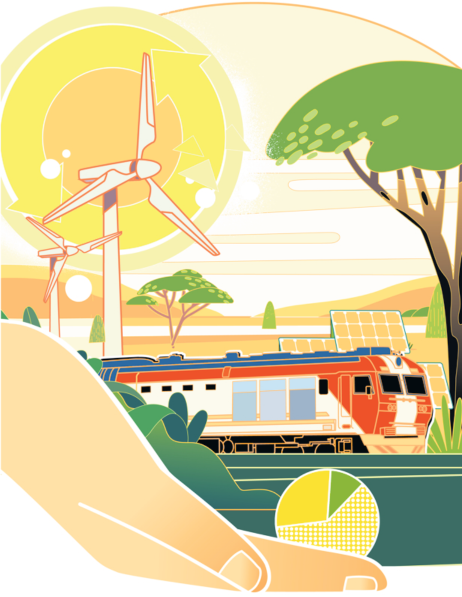
By ensuring coordination and alignment among various cooperation mechanisms to guarantee effective implementation, China can lead in promoting just energy transition and green development
A just energy transition has become a hot topic in the context of the global green and low-carbon transition, and the world's major economies are accelerating the global transition process through a variety of international cooperation mechanisms.
In recent years, as developed economies have achieved a structural decline in carbon dioxide emissions, the share of carbon emissions from emerging economies has steadily increased. Since 2021, developed economies such as the United States and the European Union have actively promoted the Just Energy Transition Partnership (JETP), a multilateral intergovernmental financing cooperation mechanism, to help the most vulnerable populations affected by the transition. This is done by providing financial aid to developing countries, especially those with a high percentage of coal and other fossil fuels in their energy mix.
JETP assists grantee countries in realizing just energy transition by accelerating the phasing out of coal power and promoting renewable energy development. So far, South Africa, Indonesia, Vietnam and Senegal have joined JETP. The donor countries have promised an initial funding package of nearly $50 billion in the form of grants, concessional loans, non-concessional loans and guarantees.
However, the actual progress of JETP has lagged far behind expectations. On the one hand, JETP emphasizes the acceleration of coal power phase-out and renewable energy development, but the donor countries have not been able to provide low-cost and high-efficiency renewable technologies and capacity. More importantly, the types and scale of funding cannot sufficiently meet the actual needs of the grantee countries. On the other hand, coal power still dominates the energy sector in most of the grantee countries. Given the rapid increase in power demand, the pace of clean energy development is unlikely to meet the fast-growing power demand of these grantee countries. As a result, they lack the motivation to phase down or phase out coal power. In addition, recent election results in the US and European countries may also bring uncertainty to the future of JETP.
Take South Africa as an example. As of 2023, the proportion of coal power in South Africa was as high as 80 percent. Factors such as aging and backward power infrastructure and the serious debt problem at ESKOM, South Africa's state-owned electricity utility, have brought great challenges to South Africa's power supply and energy security. The dominance of coal power cannot be altered rapidly. As projected by South Africa's Just Energy Transition Investment Plan (2023-27), nearly $98 billion is needed for a just energy transition there. In comparison, developed countries have committed about $11.6 billion in JETP, of which concessional loans and commercial loans account for about 80 percent, and grants only 6.2 percent, with only a small amount of these funds having been actually put into place so far.
In addition to JETP, major economies around the world, including the European Union, the United States and China, have launched strategic plans and cooperation mechanisms to support developing countries, especially in Africa, to obtain a stable and affordable electricity supply. Among them, the EU has prioritized "green transition "and "energy access" in its Europe-Africa Partnership, as outlined in its "Towards a Comprehensive Strategy with Africa". Additionally, Africa is listed as a key focus in the Global Gateway program, which supports the sustainable development of partner countries and strengthens infrastructure construction. The US has launched the Power Africa program, which aims to support the installation of at least 30GW of cleaner and more reliable electricity generation capacity in Africa by 2030, driving increased inclusiveness and low-carbon economic growth, and promoting health, education and prosperity. China continues to support green development in Africa through South-South Cooperation and the Belt and Road Initiative.
In recent years, China and African countries have strengthened cooperation in green development, particularly in the energy sector. The China-Africa Cooperation Vision 2035, released in 2021, pointed out that China and Africa shall improve development quality with green cooperation, comprehensively advancing their climate cooperation and promoting transition to clean and low-carbon energy. As for energy cooperation, China will support Africa in increasing the proportion of clean energy utilization, such as hydropower and nuclear energy, actively develop renewable energy based on the level of development and energy needs of countries, provide stable and affordable power supply with distributed power supply technologies for remote African areas, and support the development of the photovoltaic industry.
As of now, through cooperation mechanisms such as South-South Cooperation and the BRI, Chinese companies have participated in constructing a series of energy projects, which are technologically advanced and environmentally friendly, in over 40 countries and regions across Africa. These projects range from photovoltaic, wind power, hydropower, to biomass, with a total of 120GW of installed capacity and 66,000 kilometers of grid lines. These efforts have not only enhanced Africa's power supply capacity but also effectively promoted the energy transition. In recent years, a number of "small and beautiful" projects have landed in Africa, contributing to the improvement of local livelihoods and the promotion of green development. Meanwhile, China has also been providing support for energy professional training and energy sector development in Africa, attracting government officials, technical personnel, and researchers from over 30 African countries to visit China.
To deepen cooperation with developing countries, especially Africa, in just energy transition, China needs to innovate its cooperation mechanisms in technology and finance, in order to achieve synergy in green development, energy security and social justice.
First, by taking advantage in renewable energy, clean coal power technology, and equipment manufacturing, China can offer greater support to developing countries in scientifically assessing and choosing their own energy transition pathways. Priority should be given to renewable energy development, while steadily optimizing coal power through measures such as capacity replacement, upgrading and retrofitting.
Second, China should strengthen cooperation with multilateral financial institutions such as the Asian Infrastructure Investment Bank, the New Development Bank, the China-Africa Development Fund and the Silk Road Fund. This includes leveraging green finance, transition finance, and other mechanisms to support sustainable development in emerging economies, actively participating in and effectively mobilizing international fundings.
Third, while continuing to promote China-Africa cooperation under the framework of South-South Cooperation and the BRI, China may also take on a role in other international energy transition mechanisms. By ensuring coordination and alignment among various cooperation mechanisms to guarantee effective implementation, China can lead in promoting just energy transition and green development.
Zhou Xiaozhu and Han Qinke are analysts at Peking University Institute of Energy. The authors contributed this article to China Watch, a think tank powered by China Daily.
The views do not necessarily reflect those of China Daily.
Contact the editor at editor@chinawatch.cn.





