Chinese high-tech can boost Africa's farm sector









The Chinese and African leaders' meeting for the 2024 Forum on China-Africa Cooperation Summit in Beijing from Thursday to Friday will discuss a range of issues, from trade and investment to security and social development.
One of the most important topics should be cooperation in digital technology, which has emerged as a driver of economic growth and development over the past 15 years.
Digital technology is not a new issue for China-Africa cooperation. Since 2006, cooperation in digital technology has been part of the FOCAC action plans, though it became more prominent in the 2021 Action Plan. Several initiatives, including the "Initiative to Jointly Build a China-Africa Community with a Shared Future in Cyberspace" and the "China-Africa Digital Innovation Partnership Program", have been proposed to enhance cooperation in this field. That was in addition to the China-Africa Digital Cooperation Forum which facilitates discussions on digital cooperation between FOCAC summits.
China pledged to implement 10 digital assistance projects in Africa to aid the development of digital infrastructure in Africa. China is already one of the most visible players in Africa's digital technology sector, with Chinese companies having been contracted to build national information and communications technology infrastructure in several countries across the continent including Uganda, Tanzania, Ethiopia, Cameroon and Nigeria.
According to a 2021 white paper issued by the Chinese government, Chinese enterprises have laid more than 200,000 kilometers of optical fiber, connecting millions of people to the internet, partnered with 1,500 companies in Africa in their digital transformation strategies, and worked with 29 African governments for developing e-government services. Also, China is venturing into Africa's public cloud market with its companies having been contracted to build data centers in countries such as Senegal and South Africa.
All these show digital technology has become a prime driver of economic growth and development. The construction of digital technology infrastructure will boost Africa's capacity to harness big data and develop artificial intelligence (AI) tools, which can improve productivity and economic efficiency leading to positive development outcomes.
Studies by McKinsey Global Institute show the strategic use of big data could add $13 trillion to the global economy by 2030. And a report by the World Economic Forum has argued that the application of big data analytics in the healthcare, agriculture, manufacturing, energy, banking and insurance, automobile, telecom and logistics sectors could add $500 billion to the Indian economy by 2025.
As such, it is imperative for Africa and China to explore ways to harness digital technology in order to boost the economy in critical sectors such as agriculture and industry. While Africa has the largest share (about 60 percent) of the world's uncultivated arable land, it still spends $78 billion of scarce foreign currency per year on food imports. And although agriculture is the largest economic sector in Africa, accounting for 35 percent of its GDP, as well as the biggest employer, it still does not produce enough crops to feed its people.
This dire state of agriculture is largely due to numerous factors, including weather patterns, political instability, misgovernance and the use of outdated technology. The use of big data in agriculture gathered through sensors, satellites, drones and other technology devices can improve efficiency and help farmers make more informed decisions. These technologies collect data on different aspects of farming including soil conditions, weather patterns, crop health and optimal use of inputs.
AI algorithms can be used to analyze these data, helping farmers make better decisions about when to plant, the amount of inputs to use, as well as read the weather patterns. Hence, the use of big data and AI in African agriculture can increase productivity and help alleviate concerns about food security.
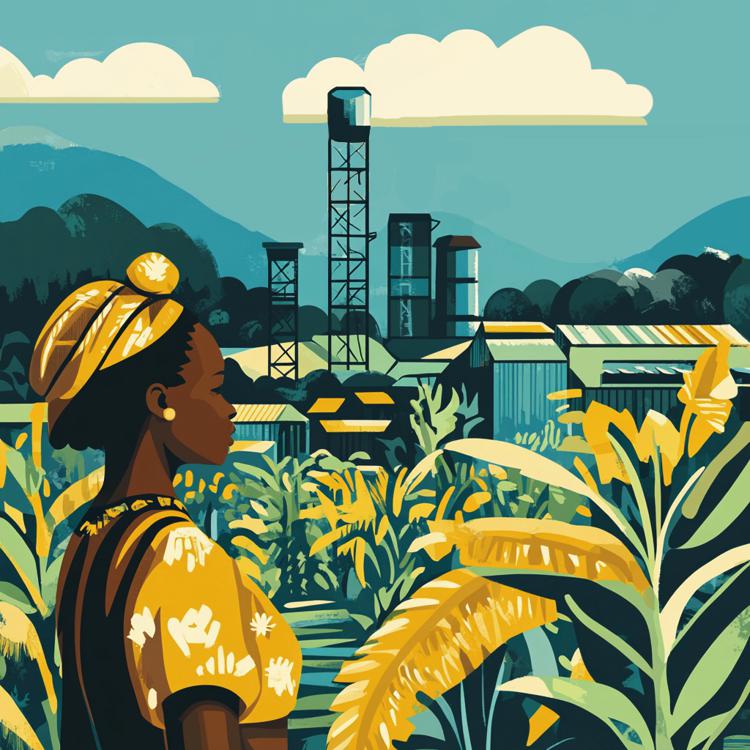
As a global leader in digital technology and with 24 agricultural technology demonstration centers across Africa, China is better placed to help African countries boost their agricultural production by using advanced technologies. In this regard, the ongoing FOCAC Summit should come up with practical strategies on how this can be done. Industrial production in Africa, too, lags behind other regions. As a result, the continent loses precious foreign currency by importing most of the manufactured products it needs.
The share of the manufacturing sector in Africa's GDP is a relatively low 13 percent while its share in global manufacturing is a paltry 2 percent. Like in agriculture, big data analytics and AI can be used to improve efficiency and productivity in the African manufacturing sector. Technologies such as industrial internet of things, manufacturing execution systems and industrial control systems have been used in manufacturing to gather, process and analyze information, which aids decision-making and increases productivity.
In other words, African countries should work with China to facilitate the transfer of the new technologies to their industrial sectors. The FOCAC Summit presents an opportunity for the two sides to discuss and chart a way forward in incorporating technology in the critical sectors of agriculture and manufacturing.
The author is director of the Centre for Africa-China Studies at the University of Johannesburg, South Africa.
The views don't necessarily reflect those of China Daily.