



NPC system significant for China









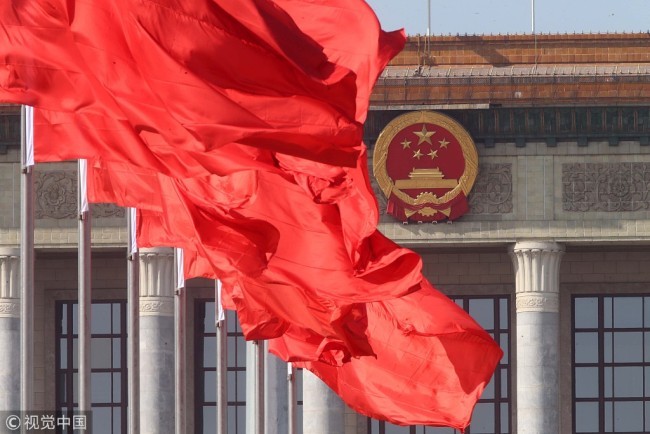
On Sept 14, President Xi Jinping delivered an important speech at a conference celebrating the 70th anniversary of the people's congress system. He noted that over the past 70 years, the system of people's congresses has demonstrated its political strength, providing an important institutional guarantee for achieving rapid economic development and long-term social stability. The people's congress system is a crucial component of China's political structure, a key element of the country's political system and an important institutional part of whole-process people's democracy. Since the founding of the People's Republic of China in 1949, especially since the launch of reform and opening-up policy in the late 1970s, the people's congress system has helped the Communist Party of China to lead the people in performing an economic miracle and realizing long-term social stability. It has also helped the country establish true democracy.
The people's congress system, which suits China's national conditions, promotes socialism with Chinese characteristics and ensures the people run the country, while propelling the country toward realizing national rejuvenation.
The system has helped the leadership to explore ways to develop a sound democratic system that suits China's real conditions, and better understand democratic concepts and forms that the West claims monopoly over. As such, the system has great significance in global political history.
The people's congress system is rooted in Chinese history and culture. It was established under the Party's leadership because it suited China's national realities. After the founding of the People's Republic in 1949, the Party, in order to establish a new political system which would meet the country's real needs and allow the people to express their wishes, learned from the Soviet Union's congress system and localized it based on China's realities to establish the people's congress system with Chinese characteristics.
The Chinese people, for the first time, elected more than 1,200 deputies to the people's congresses in 1953. And the first National People's Congress was convened in 1954, marking the formal establishment of the people's congress system in China. In the same year, the NPC adopted and enacted China's Constitution, establishing the people's congress system as the country's basic political system and declared that all powers in the country belong to the people.
The national people's congress system is the result of the country's social transformations over the past century and the inevitable choice of the Chinese people to decide their destiny.
The people's congress system upholds the principle that all powers belong to the people and the people are masters of the country. Under the Party's leadership, China has been advancing the people's congress system despite regional differences. The system has thus become a major pillar of China's democratic system.
The form of democracy, that is, whole-process people's democracy, China practices is inclusive in nature. It helps people to exercise their lawful right to elect deputies to the people's congresses through democratic polls. The people's congress system also guarantees the people the rights to information and expression, and allows them to participate in and oversee political work. It also ensures that people's voices are heard and taken into consideration before making any policy decision.
The people's congress system shows the advantages of Chinese-style governance, which benefits national development, and helps maintain stability and unity. Under the Party's leadership, departments and organizations enjoying State power uphold the principle of democratic centralism, ensuring the people exercise State power through people's congresses.
Democratic centralism is both democratic and centralized; it is centralized on the basis of democracy and democratic in centralization. It gives full expression to democracy because it vests in the people's congresses at various levels full powers and, at the same time, ensures centralized administration with governments at various levels managing the affairs entrusted to them by the people's congresses at the corresponding level.
The advantages of democratic centralism are reflected in the efficiency and unity of the NPC's legislation, policy implementation and administrative efficiency, with the latter strengthening national governance, facilitating rapid economic growth and ensuring social justice. The people's congress system has helped the authorities better manage political relationships that influence the country's future. The system also helps mobilize all positive factors, while unifying all domestic forces to promote development, better safeguard national security and maintain political stability.
The people's congress system enriches democratic politics and promotes the progress of human civilization. A country's democratic system should suit its realities and, therefore, countries should avoid blindly copying foreign democracy models. In this regard, China's people's congress system breaks through the stereotypes of Western democracy, putting forward a democratic concept that is different from the Western parliamentary system. Under the people's congress system, democracy is not only about elections, it is also about consultations, decision-making, management and oversight.
The system ensures not only democracy in legislation and decision-making, but also efficient policy implementation. No wonder China's efficient political mechanism has become a reference for other countries eager to expedite their democratic development and economic growth, and solve their complex socioeconomic and political problems.
The author is a researcher at the Institute of Political Science, Chinese Academy of Social Sciences.
The views don't necessarily represent those of China Daily.
If you have a specific expertise, or would like to share your thought about our stories, then send us your writings at opinion@chinadaily.com.cn, and comment@chinadaily.com.cn.





