



People's congresses play vital role









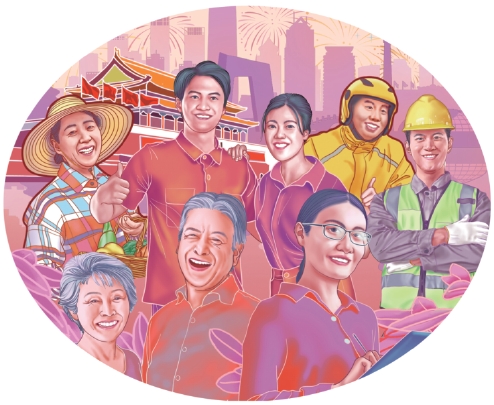
Since 2012 Chinese top leader Xi Jinping has reminded officials and other leaders of their noble beginnings while highlighting the importance of the "mass line". From the people and to the people, serving the people, and the people governing themselves — these principles have always been the cornerstone of Chinese-style democracy. These principles continue to evolve and develop in tandem with China's pursuit of national rejuvenation and promotion of whole-process people's democracy.
From the perspective of dialectical materialism, how can we understand the democratic qualities of China's political system? We can cite a number of empirical findings to help people understand those qualities. For example, an astounding 85 percent of the Chinese people trust their government to make the right decisions. This trust stems in part from the remarkable achievements the government has already made, including lifting more than 800 million people out of poverty, eradicating extreme poverty, advancing regional equality, vitalizing the countryside, expanding the middle-income group, helping increase life expectancy, creating the world's most advanced industrial and infrastructure systems, and leading the world in green innovation and development.
Another achievement is China's return to the world stage as a major power and peacemaker, and making efforts to establish a multipolar world order, strengthening security, and boosting global development.
The above achievements are the actualization of Chinese-style democracy. And yet the essence of Chinese-style democracy is something deeper. More fundamentally, it's the Chinese people, the oldest and one of the most diverse peoples in history, coming together in unity and ruling themselves for their own good. Without this, neither the achievements nor the satisfaction would be possible.
More to the point, as the National People's Congress celebrates the 70th anniversary of its founding, it is important to acknowledge the vital role the people's congress system has played in making the Chinese political system so effective and conducive to delivering good governance.
Many foreign, especially Western, observers misunderstand Chinese-style democracy, because they have a deep distrust of socialism, consider non-Western-style democracy as an aberration, have a strong sense of superiority and thus look down upon China's whole-process people's democracy.
In the past, many people could not understand Chinese-style democracy because in the early decades of the People's Republic, China considered it unnecessary to explain its political system to the world. But for many years now, China has been telling its story well to the outside world. Still, not much seems to have changed. In fact, the more democratic, the more successful, the more promising the Chinese political system becomes, the more some Western politicians and media hate it.
Western politicians, media and observers are more than happy to accept non-Western political systems as long as those systems serve Western strategic and economic interests. That's why countries such as the United States continue to embrace countries with different political systems and regimes, including military dictatorships, theocracies and monarchies, and meddle in the internal affairs of other countries, including democracies, fomenting coups, triggering "color revolutions" and exploiting the vulnerabilities of weaker nations. Ironically, Western powers indulge in these Machiavellian acts in the name of promoting democracy.
If we assess the US' motives for denigrating China's political system and reasons for aggressively pushing forward its China-containment strategy, we will realize they have very little to do with democracy, human rights or social justice. Instead, it marks a return to "Sinophobia," which first surfaced in the West during the time of Marco Polo, when China was a major power, and which has now returned again as China has again stepped to the forefront of nations, especially as Western powers experience declines.
The remarkable achievements of Chinese-style democracy contrasted with the economic, social and political failures in the West have exposed the inadequacy of Western-style democracy. This contributes to their fear and resentment. What they can't face is the possibility that China is more democratic than they are, in both domestic and foreign policy. And yet, most Americans today don't believe their system is truly democratic, and increasingly the French and the British among many others are thinking the same things about themselves.
Perhaps Western countries have regressed in the digital age, thanks to the social fragmentation and political polarization. This could be described as the contextual jouissance of contemporary Western democracies: political spectacles, which long ago stopped offering constituents substantial policy choices or realistic visions for the future.
Perhaps this has led to social decay and what can be described as "terror of the self", a terror that is externalized and projected on other countries and people. It includes the loss of subject identity and cultural roots, inducing a grave sense of danger.
Perhaps the Western powers feel a "slight coolness on the neck", as the inventor of the guillotine once described the final sensation before losing one's head. This is a type of political terror, a pathology rooted in Western development and modernization paths, which have passed through colonialism, genocide, slavery, theft and continued suppression, which have little in common with Chinese-style democracy — because under Chinese-style democracy, people keep their heads and wits and move forward together to build a community with a shared future.
The author is a professor of Politics and International Relations and deputy dean of the Institute of Singularity Studies at East China Normal University (Shanghai), and a senior research fellow at the Institute for the Development of Socialism with Chinese Characteristics at Southeast University (Nanjing) and the Hainan CGE Peace Development Foundation (Sanya).
The views don't necessarily reflect those of China Daily.
If you have a specific expertise, or would like to share your thought about our stories, then send us your writings at opinion@chinadaily.com.cn, and comment@chinadaily.com.cn.





