



Historical opening-up paves way for fashion revolution
From the Zhongshan suit to Guangdong's textile trade, self-expression through clothing brings sense of pride, Zhao Xu discovers.









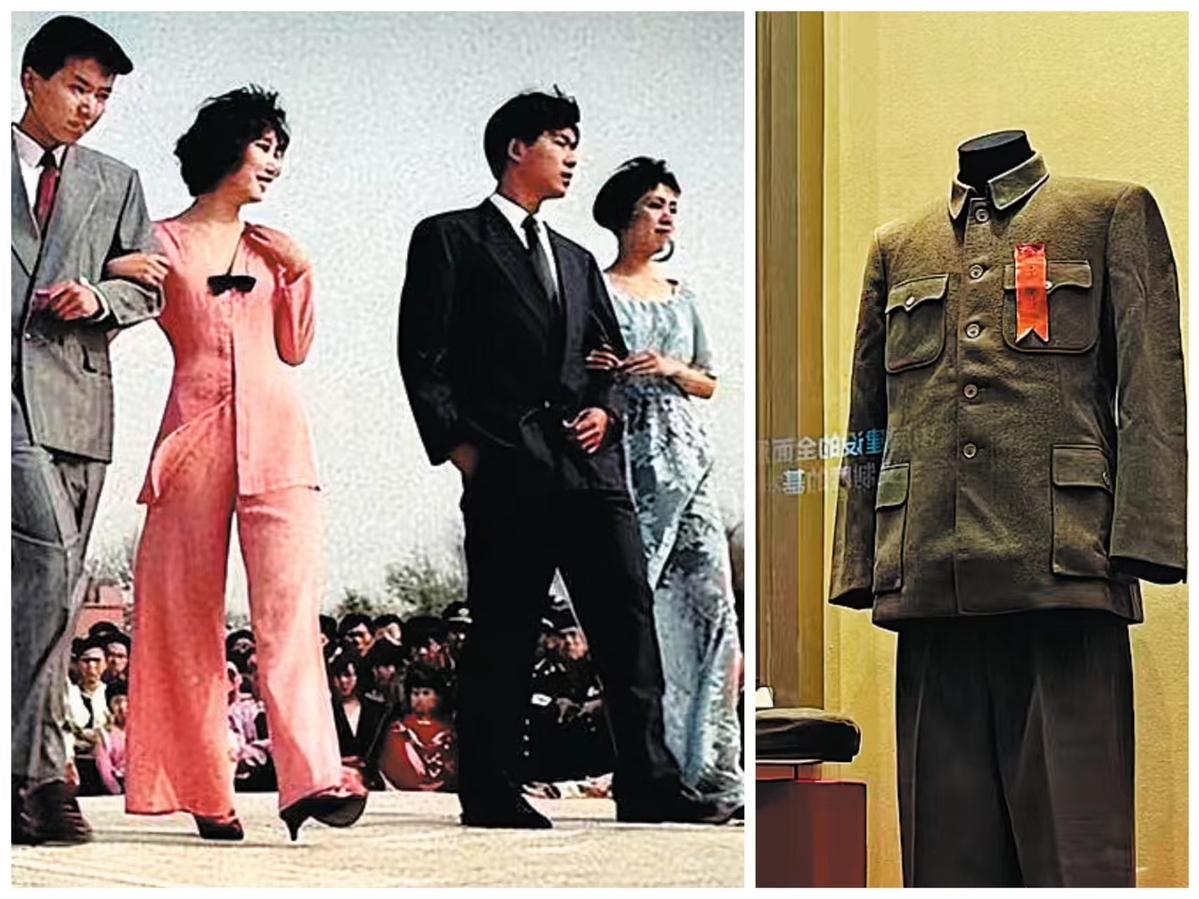
One Chinese city to feel the immediate effects of Deng's reform measures was Guangzhou, capital of Guangdong province, whose historic name "Canton" was familiar to those working in trade between China and the West during the 18th and 19th centuries. Adjacent to Hong Kong, the port city became a bridge between the Chinese mainland and the global fashion and textile markets, and in that process transformed itself into China's first fashion hub.
"With preferential treatment for investors, many of whom were from Hong Kong and Taiwan, the factories in Guangdong started to manufacture at an unprecedented scale, mostly with materials and samples provided by whoever placed the order," says Liu. "Many who had placed orders were European fashion companies who decided not to deal with the Guangdong factories directly but instead through their business partners in Hong Kong. But it didn't take long before they switched, as Guangdong rose in prominence as 'the world's factory'."
It's no coincidence that the very first joint venture between the mainland and Hong Kong was a factory located in Guangdong's Dongguan city that produced sample-based handbags. From Guangdong, the influence of Western fashion started to spread throughout the rest of China, first in trickles then in waves.
By the time Yang Jie, Liu's colleague at BIFT, was in middle school in the mid-1990s, the cultural impacts of opening up were fully felt. "Film, music, fashion, hairstyles… they were all one package," says the 42-year-old. For him and many of his peers back then, Hong Kong entertainment stars, whose images flooded TV screens, were indisputable fashion icons.
"Those were the days when young people dressed up like hippies and danced to loud rock music pouring out of cassette players," continues Yang, who remembers vividly wearing a leather jacket to school before anyone else and was gently reprimanded by the head teacher to put his studies first. "The economic reform had led to a substantial improvement in living standards for the average Chinese, which led to an explosion of ideas and a newfound need for self-expression, which the younger generation reveled in. Fashion allowed them to make bold statements, not completely unlike the way the revolutionaries did with the Zhongshan suit."
"And you know what's so great about that moment? The internet had yet to appear, which meant we didn't have many references while trying to interpret fashion. As a result, people came up with their own answers, which sometimes resulted in raw creativity," Yang says.
The leather jacket, which Yang wore with great panache — so he thought — was given to him by his mother who belongs to China's Miao ethnic group, whose members were known as gifted singers and dancers and whose traditional clothing often features intricate, colorful embroidery.
"Unlike most of my older family members who would often dress up from head to toe in ethnic attire, my mother loves to deck out her traditional looks with a few modern pieces. She instilled in me an idiosyncratic sense of fashion long before I studied it, first at BIFT and then at a fashion institute in Milan," says Yang.
In 2006, Yang opened BIFT's first menswear courses after returning from Italy. "What I have come up with as a designer today represents everything I've been through — physically, emotionally and aesthetically," he says. "I believe it's the same for Chinese fashion."
Contact the writer at zhaoxu@chinadaily.com.cn


- Guangdong remains at forefront of opening-up
- China's birth-friendly initiative supports women's 'full lifecycle'
- Xinjiang NPC deputy: Draft bill to strengthen ethnic unity
- Tianjin research team develops broadly applicable approach to nanotube synthesis
- Shenzhen empowers seniors with AI skills
- Shanxi 'slow train' offers affordability, convenience





