


An American guide for a Chinese museum
Long before smartphones and WeChat, Liangzhu's people were 'posting their moments' on pots, revealing the UNESCO Heritage place's rich and interesting past









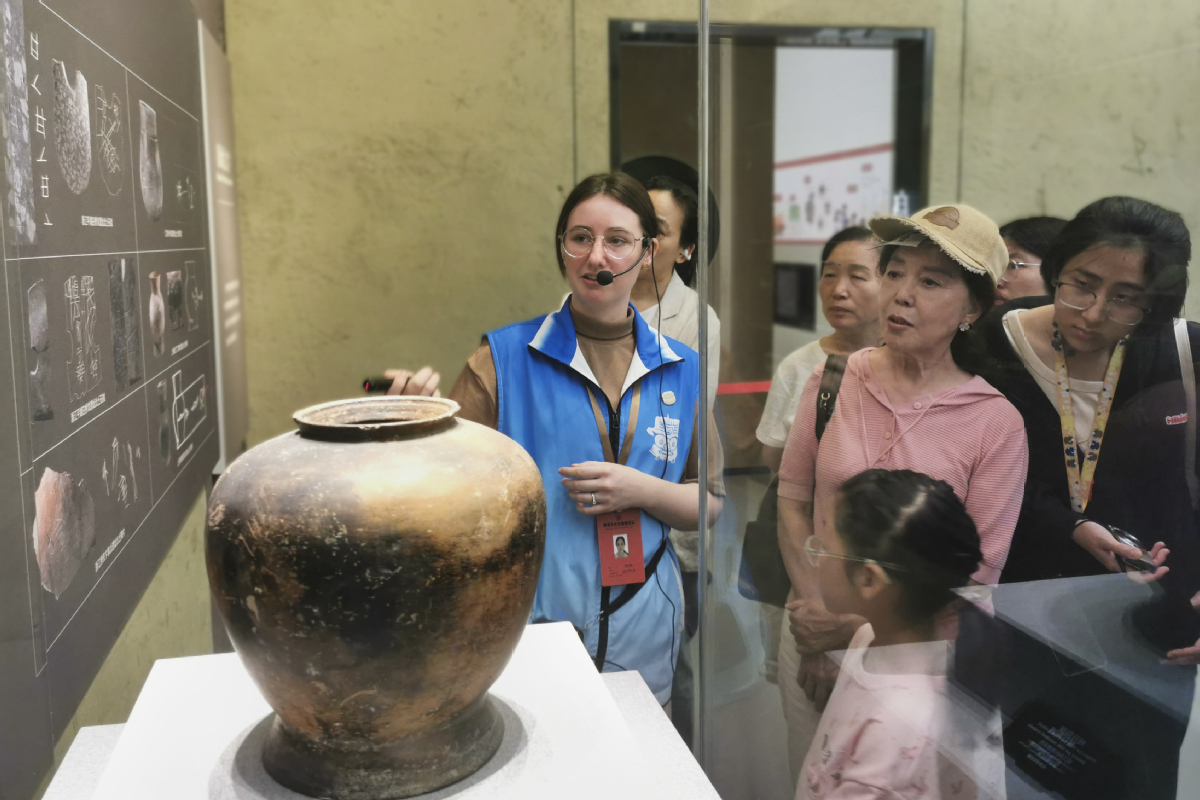
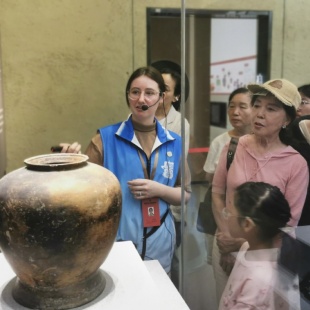
The Liangzhu Museum in Hangzhou, Zhejiang province, houses a treasure trove of jade, lacquerware and myriad artifacts, but what has impressed Emma Chen, a volunteer there, the most is its black pottery collection, which sports unique symbols that some scholars think are inscriptions from another era. She passionately explains to visitors that long before smartphones, the Liangzhu people were possibly "posting their moments" on pottery like people today do on WeChat.
Located on the outskirts of Hangzhou, Liangzhu Museum, established in 2005, showcases the archaeological findings from the Liangzhu ruins.
What has caught Chen's attention the most is a ring-footed black pottery jar that bears 12 symbols. Some scholars feel it tells a story. "One version is that it says that a man caught a tiger with a net," Chen said. "There are many different explanations, but they were probably depicting specific scenes or events, inscribing on a pot what had happened earlier that day, the way people these days post moments on WeChat," she said.
Though she has a partially Chinese name and speaks fluent Mandarin, Chen is from the United States, making her an unlikely guide for China's ancient past.
Her knowledge of museums is extensive and her enthusiasm bridges centuries. Chen has the knack of captivating visitors by making the ancient feel familiar.
She even quizzes visitors, asking them if they thought a wooden well, unearthed in Liangzhu and dating back over 5,000 years, was real.
Looking at it many of them say it can't be authentic as the wood would have decayed long ago. But Chen corrects them.
"That's what we learn from archaeology, that objects submerged under water are often better preserved," she said, adding that the well stood as an example of how the ancient Liangzhu people knew about water conservancy.
Her passion for Chinese history precedes the time when she was majoring in Oriental studies. She learned Chinese during her college days in the US, and the interest ultimately propelled her across the Pacific Ocean.
"In addition, instead of what books said, I wanted to see a true, three-dimensional and comprehensive China with my own eyes," she said.
Coming to China in early 2015 after graduating, she became a member of the museum's volunteer team in 2022. Chen said her frequent visits to the museum led to them making an offer. "I remembered a staff member coming up to me and asking if I wanted to do the job. I had always wanted to do it, so I agreed without hesitation," she said. "I just happened to be at the right place at the right time."
And since then she has clocked 232 hours of volunteering experience, which is not surprising given her passion.
Being a bilingual volunteer guide is not without its share of challenges though. Chen has diligently read numerous books on Chinese history and visited many museums in China to overcome problems.
"What helped me the most was the volunteering team at the museum. Through a series of training sessions, I learned more about Liangzhu's civilization, how to tailor my presentations to cater to different cultural backgrounds of audiences and accurately and vividly explain the stories behind each cultural relic," she said.
For Chen, Liangzhu Museum has become "a big family" that gives her a sense of belonging. "What fascinates me even more is that the museum itself is inclusive," she said. "People sometimes ask me, 'As a foreigner, why do you want to be a volunteer in a Chinese museum?' My answer is quite simple. Because I think the museum is inclusive. It opens its arms, welcoming everyone who comes here, regardless of their background. I hope everyone can walk into museums and get a glimpse of the rich and profound history behind the cultural relics.
"I will continue to dedicate myself to promoting the ancient Liangzhu culture among both Chinese and international visitors," she said.
In September, Chen went to Zhejiang University to study museology and learn Chinese history. Looking ahead, she said, "I am always ready and will continue to volunteer as a guide as long as there is a need."
Being a guide enables her to interact with people from all walks of life. "We once received the president of a prestigious university in the US. I was nervous at first, but soon engaged in an interesting conversation, learning a lot from the interaction. The president asked me a lot about Liangzhu culture," she said.
She was deeply touched by a Chinese father who came with some children to the museum in August last year. "He told me that he had made a lot of preparations before visiting, such as watching documentaries and reading books to better learn about Liangzhu culture," she said. "I really appreciated this attitude. We need more people like him."
Chen has visited many museums in China, such as the Yinxu Museum in Henan province and the Sanxingdui Museum in Sichuan province. But in her eyes, Liangzhu Museum is an invaluable treasure that cannot be replaced because she believes every word that is written on a wall in the hall of the museum, that "Liangzhu is the most concrete testimony of 5,000 years of Chinese civilization".
In 2019, the Liangzhu ruins made it to the UNESCO World Heritage List. According to UNESCO, the city "provides unparalleled evidence for concepts of cultural identity, social and political organization, and the development of society and culture in the late Neolithic and early Bronze Age in China and the region".