


Shining a light on early royalty










In 1018, a princess of China's Liao Dynasty (916-1125) died at the tender age of 18 and was laid to rest beside her husband, almost 20 years her senior, who died the previous year, barely two years into their marriage.
There they lay undisturbed for nearly a millennium in a corner of the modern-day Inner Mongolia autonomous region in North China. When their resting place was finally discovered by archaeologists in 1986, the couple, both among the highest nobility of Liao's ruling class, proved their capacity to dazzle with all things that glittered, including gold masks covering their faces.
Recently, one of the masks, worn by the princess, was on view at the Suzhou Museum in Suzhou city, East China's Jiangsu province, in an exhibition titled La Bella in the Northern Land that ran until June 30.
"These were no average beauties, but princesses and royal consorts whose elevated status meant much more than a luxurious lifestyle," said Xu Xincheng, the curator of the exhibition.
With more than 100 exhibits, all from the Research Institute of Cultural Relics and Archaeology of the Inner Mongolia Autonomous Region, Xu intended to tell — in his own words — "the little-known stories of these noble women, almost all of whom had a role to play in the support and continuation of a political alliance lying at the heart of Liao's imperial rule".
That alliance can be traced back to the very beginning of the Liao Dynasty, whose first emperor Yelyu Abaoji received crucial backing from his equally ambitious wife Shulyu Ping and her family. The latter group later adopted the surname Xiao, modeling themselves on Xiao He, the right-hand man of Liu Bang, founder of the Han Dynasty (206 BC-AD 220) in whom Abaoji saw himself.
"Ever since then, all of the Liao empresses — main wives to the Liao emperors — were surnamed Xiao with only one notable exception. In fact, it's not exaggerating to say that almost every Yelyu had married a Xiao and vice versa. The resulting familial relations could be absolutely daunting from a modern perspective," said Xu, referring to the marriage between the princess whose paternal grandfather was the fifth emperor of Liao, and her husband, Xiao Shaoju, who was also the princess' maternal uncle.
Few aristocratic ladies would treat matters of beauty casually, certainly not the show's protagonists. From the tomb of the princess — more commonly known as the Princess of the State (fiefdom) of Chen — came a dragon-embossed gilt silver makeup case which, upon its discovery, yielded several smaller silver cases, some tainted with the residues of face powder and blush. Similar items, decorated with dragon, phoenix, and lion patterns, were found in the tomb — also located in Inner Mongolia — of a lady whom some researchers suggest was a sister of Abaoji, a member of the nomadic Khitan people.
"Gold and silver wares, thanks partly to their portability, featured prominently in the aristocratic life of Liao society, as it did with other nomadic groups, such as the ancient Turkic people," said Gai Zhiyong, deputy director of the Research Institute of Cultural Relics and Archaeology of the Inner Mongolia Autonomous Region, who has been closely involved in the excavation of several prominent Liao tombs.
In that respect, Liao had come under the direct influence of the once-powerful Tang Dynasty (618-907), which, in the year 648, made the traditional Khitan land its protectorate. When the fortunes of Tang started to wane, Abaoji, who had united the various Khitan tribes, rose to seize the opportunity, establishing the rule of Liao in 916.
"One of the things Liao had inherited from Tang was the gold and silver making tradition which, thanks to the flourishing of the Ancient Silk Road trade during the Tang period, had come to bear multiple stylistic imprints ranging from Chinese to Sogdian and Sassanian," said Gai.
However, according to Xu, "it was the spirit of internationalism that must have counted as Tang's single most important bequest to Liao".
Pointing to the agate bracelets and amber necklaces, as well as crystal and glassware, that were on view at the exhibition, the curator said: "Some of them may have come from the Baltic Sea region, the Middle East or the Byzantine Empire. Many of these exchanges were conducted along what's known today as the Steppe Silk Road which, extending westward across the Eurasian Steppe, linked Liao with other cultures along the way."
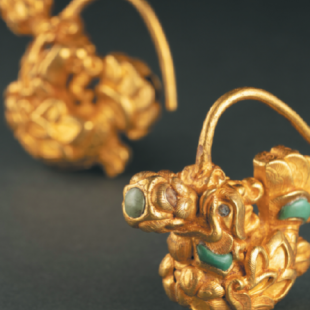
The same hybridity could be found in the spiritual realm. While the gilt silver crown that had accompanied the Princess of the State of Chen in death features a Taoist deity on top, the pair of turquoise-embedded gold earrings from that suspected sister of Abaoji were Makara-shaped.
The Makara is a dragon-headed, fish-bodied mythical animal first introduced into China along with Buddhism. The latter was also believed to be a female shaman, her identity indicated by, among other things, her gold headband that was typically worn by Liao shaman priests.
Forty-four years after Liao's birth, the Northern Song Dynasty (960-1127) emerged from all the chaos following Tang's fall and gained large tracts of land south of the Liao rule. An agricultural society steeped in Confucianism and populated largely by the Han Chinese — China's largest ethnic group then and now — the Northern Song for almost its entire duration faced a serious threat from its Khitan neighbor.