



Xinjiang now enjoying stability, growth









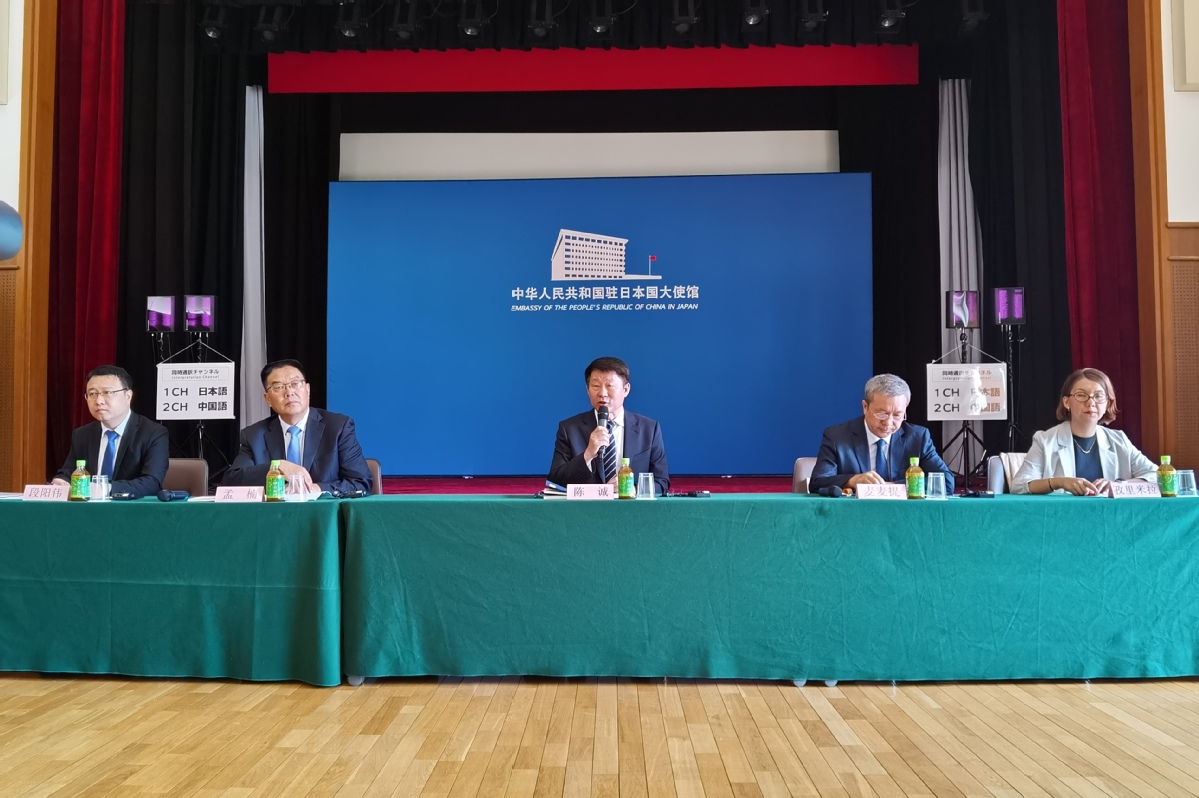
During a visit to Japan on Tuesday, a delegation from the Xinjiang Uygur autonomous region highlighted how policies have curbed the frequent occurrence of terrorist attacks, supported high-quality economic growth and cultural prosperity, and strengthened interethnic exchanges.
Between 1990 and 2016, Xinjiang witnessed many terrorist attacks. However, since 2017, no such attacks have taken place, primarily because of the government's efforts to combat terrorism and extremism in accordance with the law, said Chen Cheng, deputy director of the Information Office of the People's Government of Xinjiang Uygur Autonomous Region.
Chen attributed the root causes of violent terrorism, religious extremism and ethnic separatism to the lingering influence of "pan-Turkism and pan-Islamism", which has been exacerbated by anti-China forces. "Their ultimate goal is to separate Xinjiang from China," he added.
In recent years, Xinjiang has emphasized counterterrorism and de-extremization efforts under the rule of law. Duan Yangwei, an associate professor at the National Security School of Northwest University of Political Science and Law in Xi'an, Shaanxi province, said China has gradually developed a legal approach to counterterrorism and de-extremization tailored to its specific needs.
"The international community should respect different approaches to counterterrorism based on the rule of law, oppose double standards and reject the politicization of counterterrorism issues," Duan said.
Xinjiang has deepened reforms in its administrative law enforcement system to ensure supervision at every stage, he said. In cases involving terrorism, judicial authorities strictly protect suspects' rights, prohibiting the use of torture or other illegal methods to extract confessions.
Stability is the cornerstone of development. Last year, Xinjiang's GDP reached 1.91 trillion yuan ($268.2 billion), fiscal revenue surpassed 200 billion yuan, and imports and exports rose 45.9 percent year-on-year to 357.3 billion yuan. These accomplishments are closely tied to Xinjiang's sustained de-extremization and anti-terrorism efforts, Chen said.
Education has also played a key role in Xinjiang's fight against poverty. By last year, all eligible children aged 4 to 6 in Xinjiang had access to nearby preschools, said Zilimila Ainiwaer, a research associate at the Institute of Law of the Xinjiang Academy of Social Sciences. Since 1988, more than 2 million rural middle school students and some impoverished urban students in Xinjiang have received free compulsory education.
Zhang Peilin, minister-counselor at the Chinese embassy in Japan, said Xinjiang is experiencing its best development period in history, marked by economic prosperity, social stability and ethnic unity. The region also plays a key role in China's efforts to enhance openness and global cooperation, he added.
Meng Nan, dean of the School of History at Xinjiang University, said that from a historical perspective, Xinjiang has always been an inseparable part of Chinese territory. "The multiethnic composition of Xinjiang dates back to ancient times, and it has always been a region where multiple cultures and religions coexist."
Maimaiti Juma, vice-president of the China Islamic Association, said the Chinese government fully respects citizens' rights to religious freedom and lawfully protects legitimate religious activities.
Kumiko Haba, a professor emeritus at Aoyama Gakuin University in Tokyo, recently visited Xinjiang with a Japanese delegation. In every city they visited, such as Urumqi and Turpan, she noted a deeply rooted and high-level culture, alongside impressive preservation of ancient heritage.
"In Japan, information about Xinjiang is scarce, and much of the news on religion is focused on terrorism and negative stories," she said. "Seeing Xinjiang firsthand, I was struck by the richness of people's lives and the many developments taking place. We realized it's our mission to share these new realities with Japanese society."










