



Watery Wuzhen puts on wave of shows
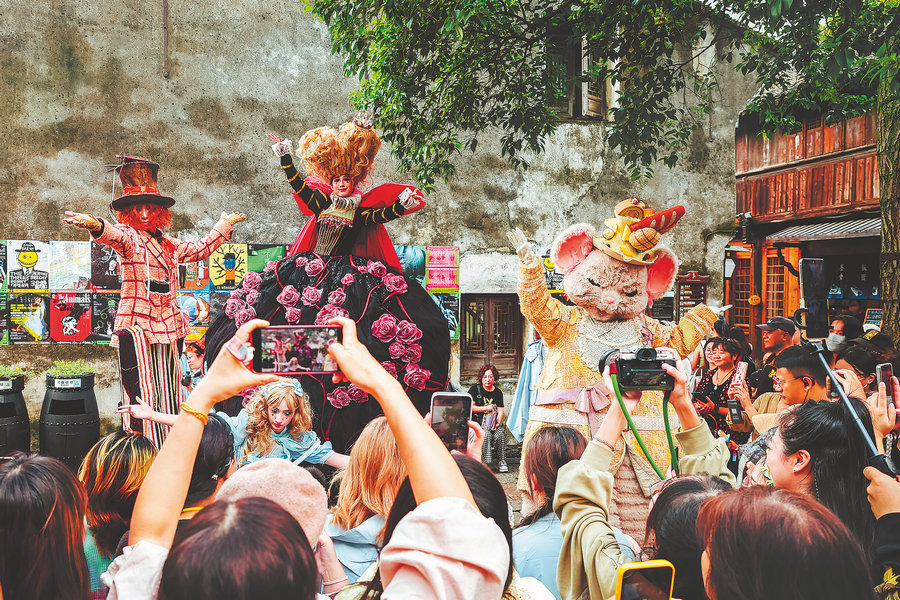
The Wuzhen Theatre Festival in Jiaxing, Zhejiang province, offers outdoor celebrations for residents and visitors. [Photo provided to China Daily]
The Wuzhen Theatre Festival, which takes place each year in the ancient water town of Wuzhen in Jiaxing, Zhejiang province, boasts that — to borrow a phrase from Shakespeare — "all Wuzhen is a stage".
A long, narrow alleyway, an ancient dock, and a pole boat … performances can happen anywhere in the town. It's a place where the boundary between theater and the surroundings dissolve.
Even the moon can play a part. In the play, Run Away to the Moon, which was staged this year in the town's open-air Sun Moon Plaza, the moon merged with the performance at its zenith above the plaza, becoming the most sublime overhead prop.
In Chinese mythology, Chang'e is said to run away by flying to the moon, after she drinks an elixir of immortality, and turns into a goddess. In some versions, Chang'e steals the elixir from her husband Hou Yi, a legendary archer, while in others, she drinks it to prevent it from falling into the wrong hands.
The play, an adaptation of Lu Min's 2017 novel, reimagines the tale of escape in a contemporary setting. In the story, the protagonist Xiaoliu survives a bus accident and decides to disappear from her previous life. She assumes a borrowed identity and lives in the strange town of Wuque. As her husband searches for her, he discovers unknown sides of his wife.
"I've read many contemporary novels over the past two years. I first came across Lu Min's Run Away to the Moon earlier this year, and it particularly resonated with me," says Xiao Jing, the play's director and playwright.
"The story of Chang'e isn't entirely new to us, but Lu has given it a fresh, contemporary interpretation, writing a story that reflects the predicaments of modern life. I knew I wanted to adapt the novel for the stage even while I was reading it."
One aspect of the novel that struck a chord with Xiao was its depiction of the yearning to escape from one's social identity. Bound by constraints, many people seek escape, some choosing temporary retreat, while others move from big cities to smaller ones.
She is also interested in the feminist perspective of the story. While the theme of women leaving home has been explored in classics, such as Norwegian playwright Henrik Ibsen's A Doll's House, Xiao points out that these works often end at the moment of departure.
"I think Lu opens up a new perspective. The protagonist arrives at her 'utopia', and then discovers that it is no different from other places. She wants to go back to her previous life, but there's no place for her anymore. So what should she do? The novel has an open ending. Personally, this question has no answer. It's for all of us to think about," she says.
For many people, the annual festival is itself an escape from the mundane, everyday routine to a town with theater happening in every nook and cranny.
Walking from the entrance of the Xizha scenic area to the town's center, visitors will pass the Wuzhen Grand Theatre, where the festival's opening and closing ceremonies are held, enter the ancient town with its interwoven alleys and waterways, and pass historical squares and docks, which serve as antique backdrops for open-air vignettes.
The old buildings with their white walls and gray, upturned eaves conceal within them theater venues of different sizes and functions, among them the West Warehouse Theatre, where young practitioners bring their shows to compete every year. On the water town's outskirts lies the Wuzhen International Internet Exhibition and Convention Center, which has three theater venues that can accommodate both international forums and large-scale theater productions.
Held between Oct 17 and 27, this year's Wuzhen Theatre Festival was its 11th edition, and was organized around the theme of "solidity", because according to the festival committee, the pursuit of ambition amid uncertain external factors requires having "a spirit like a torch, faith like a great rock".
"What's changed about the festival is that it keeps growing, and what hasn't changed is our goal," says the festival's co-founder and director, Stan Lai. "We're not aiming for a large-scale event with countless productions. We only hope to hold a well-executed festival, where people can come for 11 days to enjoy shows, talk about them, and simply have a great time."
Reflecting on the past decade, Lai says that Wuzhen and theater seem a natural fit. Compared to other major theater festivals around the world, the Wuzhen festival stands out for being a compact, cozy hub of theatrical art and other activities.
"If you're fortunate enough to spend 11 days in Wuzhen, you can immerse yourself in the atmosphere," Lai adds. "Enjoy a meal and chat with your friends, and when the time draws near, stroll to the theater and watch a play, then unwind in a teahouse afterward. It's a wonderful lifestyle here in Wuzhen, free of stress, whether you are a theater enthusiast or not."
Each year, he stages a show of his own. This year, he's putting on his 40th production, River/Cloud, a spinoff of his classic play, Secret Love in Peach Blossom Land. The classic play is a tragicomedy. It involves a poignant love story of Yun Zhifan and Jiang Binliu, who are separated and lose contact during the War of Liberation (1946-49). Then unbeknown to each other, both move from the Chinese mainland to Taiwan.
"There's so little background information about them, so I wanted to explore these characters I created. It's a fascinating exercise for a writer to dissect their characters and write their life stories," Lai says. "It becomes a journey of self-discovery. These themes of missed connections, chance encounters, life, and love have been swirling around my mind. I felt it was the perfect time to write a piece that weaves all these elements together."
This year, the festival also shed light on inclusive art, with a "Nothing Is Impossible" section dedicated to The Revised Future, a play written and performed by actors with diverse abilities from The Pleasure Troupe, an original theater brand founded by a group of enthusiasts.
The production addresses social issues in a sci-fi setting. In a distant future under alien attack, people with disabilities are able to receive body modifications and are treated as superior to those without disabilities. The protagonist, a boy without disabilities, is accused of patricide, and as the trial progresses, the group's struggles come to light.
"My parents taught me to dedicate 10 percent of my free time to public welfare," says Ma Yan, the play's director. "I first worked with people with disabilities in 2008, when I volunteered at the Summer Paralympics and received training on how to offer accessible services."
The reason why some people overlook social resources for people with disabilities is because they fail to consider that they might find themselves in a similar situation at some point in their lives, Ma adds. By reversing the social dynamics between those with and without disabilities, the production allows the audience to see things from the perspectives of others.
The Revised Future won best play award at this year's Nanjing Festival of New Theatre, where Lai was chairman of the committee. In the hopes that more people would be able to see the play, he invited the troupe to perform in Wuzhen. "It is featured in the festival because it's a high-quality production, free from external biases. The Wuzhen festival is fundamentally inclusive and diverse. We would like to promote all types of theater productions here," Lai says.
