West's attacks on Chinese industrial aid unjustified









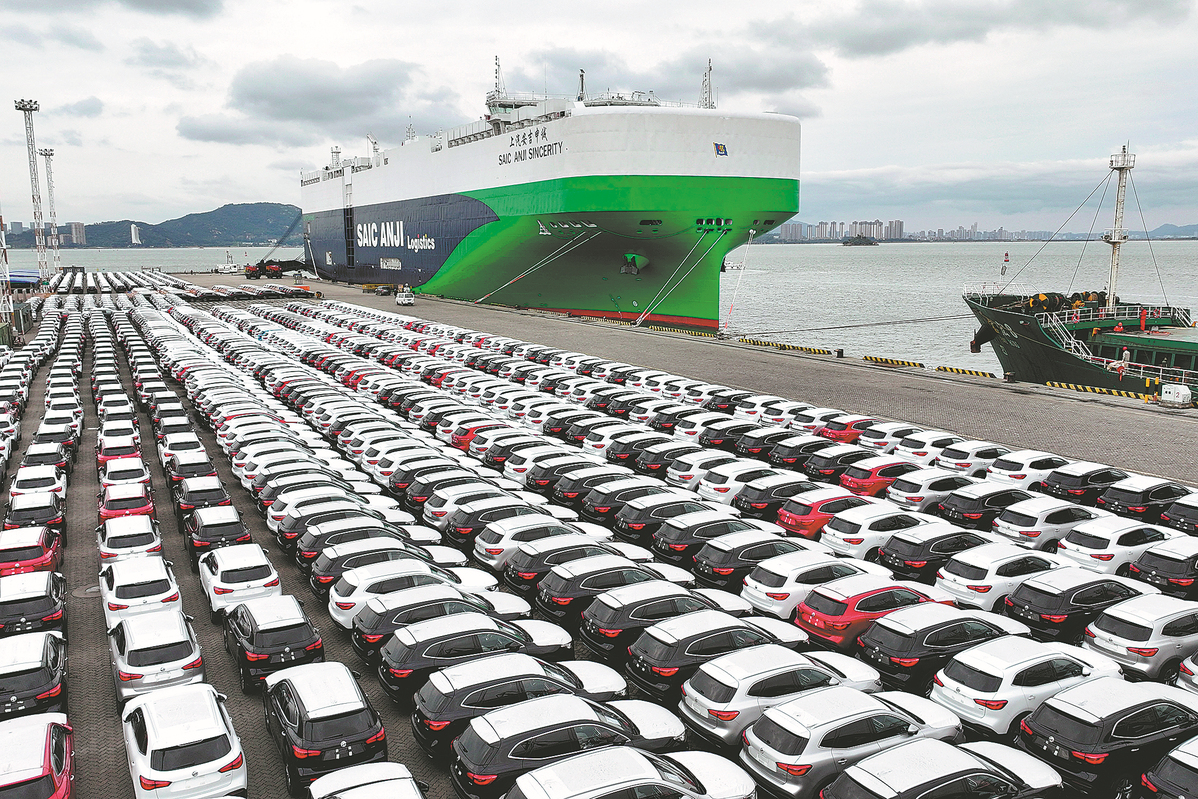
The United States and the European Union have repeatedly criticized the Chinese government for subsidizing the development of electric vehicles and other industries. However, during a business forum in Shanghai on Sept 22, Roche Chairman Severin Schwan denounced the industrial subsidies offered by the US and European governments as a "waste of money" and a distortion of market competition.
Although Schwan did not directly comment on China's subsidy policies, his criticism of the West can also be construed as indirectly aimed at China. Regardless of his intention, his comments exposed Western hypocrisy regarding China's industrial policies.
China indeed has implemented extensive industrial policies, offering tax breaks and other aids, to develop new energy and emerging sectors such as EVs, semiconductors, artificial intelligence and blockchain technologies.
Since the early 2000s, the Chinese government has offered procurement contracts to purchase EVs for public transit, as part of green development. These contracts helped domestic EV makers such as BYD stay afloat and enabled them to learn and improve quickly.
Concerns about China's dominance in EVs and EV batteries affecting the economy, job growth and the automotive industry in the West led the European Commission to launch investigations into subsidies for Chinese electric cars. The commission alleged that these subsidies allow Chinese manufacturers to undercut European automakers. Simultaneously, the US government accused China of maintaining industrial overcapacity, leading to lower prices and hurting global competitors, especially in the EV sector.
Instead of finding ways to develop affordable EVs in the West to compete with Chinese EVs, Western countries decided to use import tariffs to "level the playing field". The US and Canada imposed 100 percent tariffs on EVs imported from China, while the EU plans to impose tariffs of up to 38 percent on imports of Chinese EVs.
However, the West's criticism of China's industrial subsidies is hypocritical, given its similar practice.
The US has been actively supporting its manufacturing sector with substantial subsidies. For instance, the $7,500 tax credit for purchasing EVs in the US is subject to various labor content requirements imposed by the Inflation Reduction Act. To qualify for the full $7,500 tax credit, EVs must meet specific criteria regarding the sourcing of battery materials: At least 40 percent of the value of critical minerals and components used in the battery must be extracted or processed in the US or a country with a free-trade agreement with the US.
Additionally, the CHIPS and Science Act has provided significant funding to companies like Intel and TSMC of China's Taiwan region to build advanced semiconductor factories in the US. For example, Intel received $8.5 billion this year for its semiconductor projects, including new factories in the states of Ohio, Arizona, New Mexico and Oregon. Similarly, TSMC was awarded $6.6 billion to expand its operations in Arizona.
Across the Atlantic, the EU offers various subsidies and tax incentives to both manufacturers and consumers. These include purchase subsidies, tax rebates and grants for research and development in EV technology.
Throughout history, government subsidies have played a crucial role in jump-starting nascent technologies with highly uncertain success rates and financial returns.
In the US, the Advanced Research Projects Agency Network, the precursor to the modern internet, was funded by the US Department of Defense in the 1960s. In recent years, US government subsidies for renewable energy increased from $7.4 billion in 2016 to $15.6 billion in 2022. Additionally, US defense contracts continue to support internet-related technologies, including the development of AI applications, quantum computing, unmanned aerial vehicles and space technologies.
Beyond EVs, European governments have offered subsidies to protect various industries. For example, the EU's Common Agricultural Policy provides direct subsidies to farmers to ensure sustainable food production, stable income and fair living standards for agricultural workers. In the technology and innovation sectors, many European countries offer subsidies to promote renewable energy. Germany's Renewable Energy Sources Act, for instance, provides financial incentives for firms to produce renewable energy such as wind and solar power.
The EU also has various programs to support technological innovation. Horizon Europe, for example, is the EU's key funding program for research and innovation, running from 2021-27 with a budget of 95.5 billion euros ($104 billion). It aims to tackle global challenges, including climate change, and boost the EU's competitiveness and growth by facilitating collaboration and strengthening the impact of research and innovation.
Industrial subsidies remain a polarizing issue in global economic policy circles. Without giving specific examples, Schwan's criticism of Western subsidies is indeed perplexing. It is hypocritical of the West to criticize China's industrial subsidies while it subsidizes its own various critical and nascent industries.
The author is a distinguished professor at the UCLA Anderson School of Management.