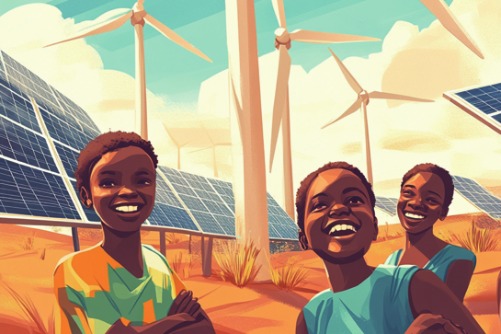
Innovative development should champion true multilateralism










SONG CHEN/CHINA DAILY
Scientific and technological cooperation cannot be disguised as the export of major countries' value to the Global South
Currently, Global South cooperation is in full swing, and innovation cooperation has become a key driving force. At the 16th BRICS Summit held in Kazan, Russia, from Oct 22 to 24, President Xi Jinping pointed out that "as the latest round of technological revolution and industrial transformation is advancing at an accelerated speed, we must keep pace with the times and foster new quality productive forces". The Global South is deepening high-level cooperation in innovation and promoting green and low-carbon transformation. But it can be seen that the Global South is weak in innovation foundation and innovation investment, and still needs the support of developed countries to strengthen scientific and technological cooperation.
As a bloc of world's leading economies, how does the G7 regard international scientific and technological cooperation? There are two different narratives. In October, the G7 held the Competition Authorities and Policymakers Summit in Rome, focusing on competition issues arising from rapid developments in the field of artificial intelligence. Dialogues and knowledge sharing among the G7 members were emphasized for strengthening international cooperation. And, the G7 science and technology ministers' meeting in Bologna and Forli in July focused on scientific communication and open collaboration. While explaining the concept of promoting open science, it further described the broad framework of the G7 cooperation with the international community, including the Global South such as Africa. However, when it comes to international scientific and technological cooperation, the G7 focuses only on a small bloc, lacking an open and inclusive approach to the Global South and public spirit for the international society.
The G7's approach to scientific and technological cooperation with the Global South is complex. Its relevant initiatives require the Global South to share innovation costs. Under cost-benefit consideration, the G7 is willing to promote some specific scientific and technological cooperation with the Global South. However, it calls for the formation of a common system in scientific and technological cooperation, attaching great importance to the security and integrity of scientific research. It emphasizes the cooperation needs to have a common technical foundation, so as to enhance interoperability. Shared values are also regarded by the G7 as a key condition for the cooperation.
Because of such a threshold, the G7 can carry out some cooperation with the Global South on specific issues to promote the G7's expansion in the global market, and to establish a stable supply chain. But in high-tech sectors, the G7 wants to maintain its technological edge. Thus, in many mechanisms dominated by the G7, it is still exclusive. It can be seen that the G7's technology is for its own good.
In fact, the main purpose of the G7 international scientific and technological cooperation is to integrate the Global South into its system. The G7's initiatives not only strengthen the synergy of small groups through cooperation and lead to the setting up of specific innovation agendas, but also aim to acquire the broader support from the international community. In this context, the G7's scientific and technological cooperation follows a process — some issues are discussed internally, and then the scope is expanded, cooperating with other regional or international mechanisms. The G7 wants to create such an order by promoting standard-setting, data flows and technology cooperation from inside to outside.
Take data governance as an example. It was high on the agenda of the G7 science and technology ministers' meetings both in 2021 and 2022. And in 2024, a set of the findable, accessible, interoperable, and reusable (FAIR) data principles was proposed, making the G7 have the upper hand in the rule-setting in global science and technology governance.
Due to the lack of public spirit, the G7 cannot naturally and effectively interact with the Global South in international scientific and technological cooperation. The G7's initiative covers extensive scopes, but actual open sharing is barred by the high threshold, which is difficult to implement. For example, if the initiative on cooperation with Africa was pragmatically advanced, it would help promote the development of the Global South. However, poor public spirit and lack of fairness make it difficult to achieve effective results.
According to Science and Technology Indicators 2024, released by the National Institute of Science and Technology Policy of Japan in August, two different plates have formed in terms of the structure of highly cited papers. One is about the G7 and OECD countries, another about China and the Global South countries. There are many reasons for this, notably insufficient factors of science communication. It is clear that effective and pragmatic international scientific and technological cooperation is of great significance in strengthening communication and removing barriers.
With respect to opening-up and cooperation in science and technology, the international society should work together, jointly building a truly open and inclusive environment. In short, technological cooperation should be for the common good of all.
First, international cooperation in science and technology should respect different countries' choice of development paths. Scientific communication cannot be disguised as the export of major countries' value to the Global South. Under the United Nations' framework, the views of all sides should be taken into consideration to form a fair framework for science and technology cooperation.
Second, international cooperation in science and technology should be inclusive, truly benefiting people of all walks of life and responding actively to urgent issues in global governance and the specific development needs of the Global South. It should jointly help solve governance problems through pragmatic innovation cooperation, project practice and personnel exchanges by improving the development environment.
Third, international cooperation in science and technology should not come with strings attached. Especially, the cooperation of infrastructure projects in the Global South should not become the arena of major country rivalry.
In a word, innovative development should champion true multilateralism.
Wang Xinwei is an assistant researcher at the Beijing Academy of Science and Technology. Zhai Kun is a professor at the School of International Studies and deputy director of the Institute of Area Studies at Peking University. The authors contributed this article to China Watch, a think tank powered by China Daily.
The views do not necessarily reflect those of China Daily.
Contact the editor at editor@chinawatch.cn.