'Green and just transition'
The EU views China as a partner for cooperation, an economic competitor and a systemic rival, thus changing its policy on the basis of specific issue area in question









Following the 2024 European Parliament elections, a competitiveness strategy has been incorporated into the European Union's strategic agenda. The Future of European Competitiveness, a report introduced in September, addresses a range of areas, including scientific and technological competitiveness, green competitiveness, fair competitiveness, social competitiveness, industrial competitiveness and so forth. The report offers a detailed examination of the factors influencing Europe's future competitiveness, accompanied by strategic recommendations for addressing these challenges. It provides a comprehensive assessment of the obstacles confronting Europe in the context of the evolving global landscape and proposes a series of programs aimed at achieving sustainable growth, enhancing productivity and safeguarding European values.
The EU is currently facing a significant challenge to maintaining its industrial competitiveness, prompting a search for solutions.
First, the Centre for European Policy Studies has indicated that the EU economy has been affected by the Ukraine crisis and the COVID-19 pandemic. Furthermore, the escalation of US export controls and tariffs on China has resulted in an acceleration of Chinese products entering the EU market. The Potsdam Institute for Climate Impact Research posits that as oil and gas prices rise, the EU is becoming increasingly reliant on external clean energy products in its green transition. The EU's dependence on China for photovoltaic and wind power equipment and new energy vehicles is estimated to exceed 20 percent.
Second, the energy crisis and the Ukraine crisis, along with other significant occurrences, have given rise to a novel political climate. This has prompted the EU to accord greater consideration to the significance of its single market, strategic autonomy and competitiveness concerns, while also expressing concern about China's "economic intervention and control "of the EU.
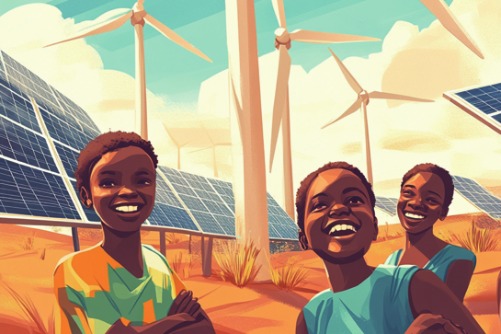
Third, the outbreak of the Ukraine crisis has resulted in a decline in the EU's competitiveness across all aspects of the triangles of great powers, including the China-US-Russia, China-US-Europe and China-Europe-Russia triangles. This has led to a weakening of the EU's strategic autonomy and its influence in international affairs. The EU is striving to spearhead the "green and just transition", a process of competitiveness-building that will enable it to maintain its voice in the great power triangles and avoid becoming a victim of geopolitical competition between China and the United States.
The EU's competitiveness strategy of a green and fair transition will be based on the construction of its internal supply chains, green trade barriers, the Carbon Border Adjustment Mechanism, the Corporate Sustainability Due Diligence Directive and other tools. The objective is to curb industrial outflow and reduce import dependence, as well as to enhance the level of the EU's local manufacturing industry. The improvement of the European single market represents a pivotal aspect of this strategy. One key objective is the formation of a new green supply chain spanning the Nordic countries, Central and Eastern Europe, and Germany and France, with a focus on critical raw materials for the energy transition. This initiative aims to reduce external dependence through the construction of the EU internal market. The EU's "fair competition" policy considers not only strategic autonomy and climate change, but also the demands of the middle class within EU member states. First, the EU's fundamental premise is that the cornerstone of a green and fair competition strategy is strategic autonomy. The EU's Fair Competition Strategy represents a solution to the dual challenges of pursuing climate change ambitions and improving industrial competitiveness. It also offers a means of achieving a balance between economic security and industrial decarbonization. This strategy places an emphasis on consensus among EU members, promotes policy coherence, and builds on the previously agreed European Green Deal to adapt and innovate policy instruments in order to highlight the competitiveness of the EU's climate economy. Second, the EU considers it essential to safeguard the interests of the middle class in all member states in order to ensure green and fair competitiveness. While the US is becoming increasingly detached from globalization, the EU is also aware of the dangers of over-globalization, which is detrimental to the interests of the middle class. The Centre for European Policy Studies posits that globalization has harmed the interests of the middle class and that Europe must find a way to accommodate both emerging and existing developed economies. In this regard, the EU has emphasized the decentralization of the industrial chain to different countries within the union, as well as the use of subsidies to finance the development of the industry. Third, the EU's foreign policy is still based on the principles of multilateralism, which it will continue to uphold in order to ensure fair competitiveness. The internal market and the system of bilateral and small multilateral trading partners will be accorded greater priority than global trading systems such as the World Trade Organization.
The EU is increasingly examining its relations with China through the lens of "fair competitiveness", which is based on the concept of a green transition. First, the EU perceives China as engaging in unfair competition within the green industries, emphasizing that China is heavily subsidized in its pursuit of competitive advantage. For example, the Bruegel Institute in Brussels posits that China's subsidies and production capacity are excessive, that green industries are directly supported by the government, and that China's system has a natural advantage over other countries in manufacturing, which undermines the fairness of the global marketplace. The EU perceives China as a strategic competitor, with a government that exerts significant influence over the country's economic and industrial policies. Concurrently, given the pivotal role of the automotive industry in the European economy, the EU will implement policies to safeguard this sector in the near to intermediate term. For instance, the EU has the capacity to establish standards and implement tariffs with the objective of safeguarding its automotive industry. Furthermore, it has the option of postponing the decarbonization of its transportation sector in order to mitigate the impact of China's electric vehicles and advance its own clean energy industry. At present, the EU has put forth a strategy, designated as the "China+1" approach, with the objective of establishing a contingency plan for its manufacturing sector. Second, the EU continues to adhere to a tripartite positioning of China as a "partner", "competitor" and "rival" in a relatively short period of time. The EU views China as a partner for cooperation, an economic competitor and a systemic rival. Consequently, the EU differentiates its policies toward China based on the specific issue area in question. In the context of the ongoing crisis in Ukraine and the evolving relationship between Russia and China, the EU perceives China as a potential rival and a disruptive force in Sino-European relations. In the domains of energy and climate change, the EU perceives China as a cooperative partner.


Yu Hongyuan is a professor and director of the Institute for Public Policy and Innovation at the Shanghai Institutes for International Studies. Wang Xinyu is a research assistant at the Shanghai Institutes for International Studies. The authors contributed this article to China Watch, a think tank powered by China Daily. The views do not necessarily reflect those of China Daily.
Contact the editor at editor@chinawatch.cn.