Door opened wider for foreign-invested businesses
Positive policies, easier market access, advances in innovation attract more overseas players










When discussing the pace of innovation in China, Matthew Ye, the local head of French tire and mobility company Michelin, offers a perspective that differs from many senior executives in other parts of the world.
Collaborating with Chinese electric vehicle companies and traditional car manufacturers has become more demanding in terms of response speed and technical requirements compared with the past, said Ye, CEO and president of Michelin China and Mongolia.
"As a result, I must spend more time to push our local, European and Japanese engineers in China to accelerate their innovation efforts," Ye said, adding that the company will continue to expand passenger car tire production capacity at its factories in Shanghai and Shenyang, Liaoning province, to meet the country's surging demand.
With a similar outlook, Josh Weiss, president of the manufacturing intelligence division at Hexagon AB, said the Swedish industrial group will put its new South China headquarters in Shenzhen, Guangdong province, with investment of more than 200 million euros ($214.38 million), into operation by the end of 2025.
Along with supporting the company and its partners' manufacturing businesses in China, the facility will provide solutions for clients in Southeast Asia and other Asian countries.
With China creating more favorable conditions to transform and modernize traditional industries and cultivate emerging sectors, market watchers and executives from multinational corporations are confident about the substantial growth opportunities and greater commercial engagement in the world's second-largest economy.
Recent policy measures to remove all market access restrictions for foreign investors in the manufacturing sector are expected to prompt foreign companies to increase their investments in China, with a focus on high-end manufacturing and innovation, they said.
'Negative list' update
The latest edition of China's national negative list for foreign investment, which took effect on Nov 1, removed the last two manufacturing-related restrictions, according to the National Development and Reform Commission, the country's top economic planner.
The items on the latest negative list, which specifies fields that are off-limits to foreign investors, have been further reduced to 29.
Another negative list applied in the country's free trade zones, which involve pioneering pilots in opening-up practices, achieved zero restrictions on foreign investment in manufacturing in 2021.
Wang Xing, a partner expert at management consultancy Roland Berger, believes that these opening-up moves have significant strategic importance.
The updated national negative list, in conjunction with other policies aimed at attracting overseas capital, not only demonstrates China's determination to deepen reforms, but also creates a better investment and business environment for foreign companies. They are key measures for the integration of Chinese industries into the global economy, said Wang.
"In the current complex geopolitical environment, many multinational corporations are reconfiguring their global manufacturing bases and supply chain layouts," said Wang.
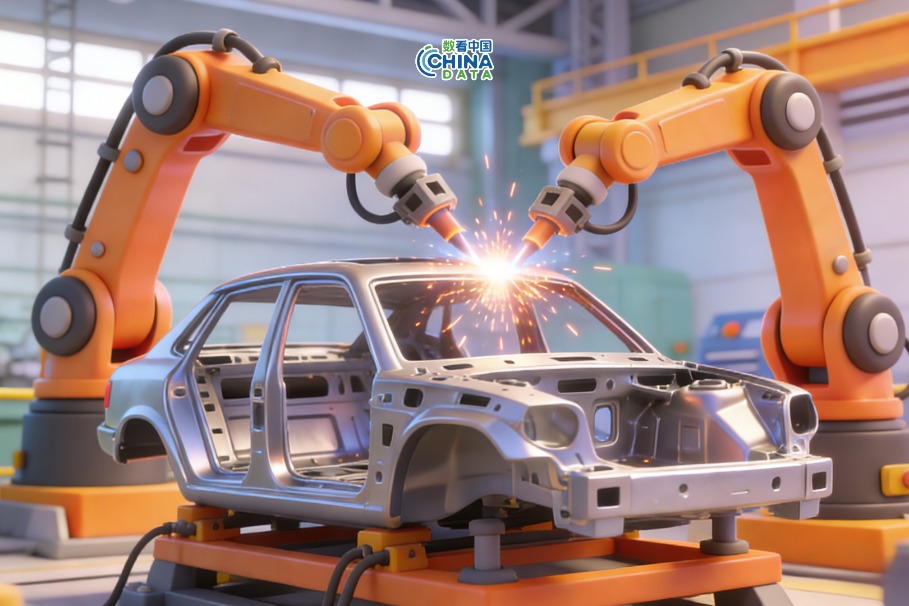
Numerous companies are actively establishing "lighthouse factories" — advanced manufacturing facilities recognized for their leadership in applying cutting-edge technologies to drive innovation, efficiency and sustainability in production — across China. These investments cater not only to the Chinese market, but also strive to bolster overall global competitiveness and digital transformation, he added.
Lighthouse factories can effectively optimize operations, and significantly reduce waste, energy consumption and production costs while boosting productivity, according to the Ministry of Industry and Information Technology.
The manufacturing industry was the earliest sector in China to open up to foreign investors and is also the most competitive and closely coordinated one in terms of the global industrial division of labor.
Scaling up high-tech manufacturing can help China enhance the value-added component of its economy and secure its position in global value chains. This will move China away from reliance on low-cost, labor-intensive industries, said Zhao Ping, dean of the academy at China Council for the Promotion of International Trade in Beijing.
"A well-established supply chain and infrastructure for high-tech industries make it easier for foreign companies to set up operations and integrate into local ecosystems," said Zhao. "By prioritizing innovation, China grants opportunities for collaboration in research and development, which appeals to multinational corporations seeking to advance their technologies."
Confident outlook
Attracted by these factors, German investment in China has reached a record high so far this year, and again reaffirmed the confidence German companies have in the Chinese market, said Clas Neumann, chairperson of the board of German Chamber of Commerce in China, East China.
Currently, around 5,000 German companies operate in China, while over 2,000 Chinese companies have invested in Germany. The industrial and supply chains of both China and Germany are deeply integrated and their markets are highly interdependent, according to information released by the chamber.
With the structure of foreign investment continuing to be optimized, China saw the high-tech manufacturing sector utilize 80.18 billion yuan ($11.07 billion) in foreign direct investment between January and October this year, accounting for 11.6 percent of the national total, data from the Ministry of Commerce shows. That represents an increase of 0.7 percentage points from the same period last year.
Investment in China from Germany, Australia and Singapore has also increased, surging by 7.5 percent, 6 percent and 4.4 percent respectively year-on-year.
Expressing long-term confidence in the Chinese market, German carmaker BMW Group announced in April an additional investment of 20 billion yuan in its production base in Shenyang. In September, French industrial group Schneider Electric SE completed the second phase of an innovation laboratory park project in Shanghai.
US chipmaker Intel Corp announced in late October the expansion of its packaging and testing base in Chengdu, Sichuan province, along with a $300 million capital injection for its subsidiary there.
Eager to expand its market share in China, Trane Technologies plc, a US manufacturer of heating, ventilation, air conditioning, and refrigeration systems, put a new plant into operation in Suzhou, Jiangsu province, in mid-November.
With an investment of 300 million yuan, the facility not only aims to enhance the company's production capacity in China but also to supply products to other markets in the Asia-Pacific region, such as Japan, South Korea, Australia, New Zealand and India.
Noting that China is one of Trane Technologies' key growth markets globally, Wu Chuangang, the group's vice-president of operations and integrated supply chain for the Asia-Pacific region, said that the company has maintained double-digit growth in China over the past three years, demonstrating strong business performance.
"The new factory will introduce additional product lines, particularly temperature control products, in the coming years, which are expected to drive further business growth," he added.
Chen Jianwei, a researcher at the Beijing-based University of International Business and Economics' Academy of China Open Economy Studies, said: "By actively engaging in global industrial division and reinforcing multilateral, bilateral and regional economic cooperation, China has played a key role in maintaining a diversified and stable international economic framework."
The nation's ongoing progress in market openness, business model transformation, and industrial, consumption and large-scale equipment upgrades, will consolidate its position as a strategic priority for global manufacturing businesses, fostering sustainable long-term financial growth, he said.
Customized solutions
That sentiment is in line with the latest trade figures. Exports of foreign-invested businesses in China amounted to 5.77 trillion yuan between January and October of 2024, marking year-on-year growth of 1.9 percent, according to data from the General Administration of Customs.
With more Chinese firms rushing to adopt new equipment to cut carbon emissions and boost productivity, Swiss technology company ABB Ltd said it will focus on developing more customized solutions for local clients, with plans to extend these innovations to other parts of the world.
Joachim Braun, president of ABB process industries, said that process industries serve the steel and nonferrous metals, mining, pulp and paper, and cement sectors, all of which hold a significant global share in China.
"Therefore, if you are active in these sectors, the Chinese market naturally plays a crucial role. We believe that the outlook for the Chinese market will be fairly positive over the next three years," said Braun.
Apart from extensive production on a global scale, quality upgrades and decarbonization will become key drivers for further development in China, making ABB quite optimistic about future demands in this market, Braun added.
Tsuyoshi Nishiwaki, chairman of China trading at ASICS Corp, a Japanese sportswear manufacturer, said as China, along with Europe, North America and Japan, is one of the group's four major global markets, the company will continue to invest in the Chinese market.
China's consumption trends present a significant growth opportunity, and ASICS is actively responding to them through a combination of market expansion and localization, said Tsuyoshi, who is also the company's senior managing director for China.
"We are firmly committed to further investing in the Chinese market through local product development, digital transformation and national initiatives, strengthening our position in China and meeting the evolving needs of Chinese consumers," he added.
Wang Xiaohong, a researcher at the China Center for International Economic Exchanges in Beijing, said China is already established as a key export hub for many foreign corporations, and this has generated numerous growth points for businesses, including those in the service sector.
On Nov 21, US express transport company Federal Express Corp announced more frequent international cargo flights between Xiamen, Fujian province, and the US, along with the inauguration of its Xiamen international gateway facility.
These initiatives will enhance FedEx's network in China and empower local businesses to capitalize on global trade opportunities with more efficient and intelligent logistics services and solutions, said Poh-Yian Koh, senior vice-president of FedEx and president of FedEx China.
In addition to the removal of all restrictions on foreign investment in the manufacturing sector, China has also vowed to further shorten the negative list for foreign investment this year, with market access restrictions in services sectors such as telecommunications and healthcare to be reduced.
In September, steps were announced to expand opening-up in the medical field, including giving the greenlight for the establishment of wholly foreign-owned hospitals in selected cities including Beijing and Shanghai.
The government also decided in late October to allow foreign investors to operate wholly-owned businesses such as internet data centers and to engage in online data processing and transaction processing in certain areas, as part of a pilot program to expand opening-up in value-added telecom services.