Light beyond sight
Guangming Cinema, a public welfare initiative, empowers visually impaired audiences to experience and connect through cinema.









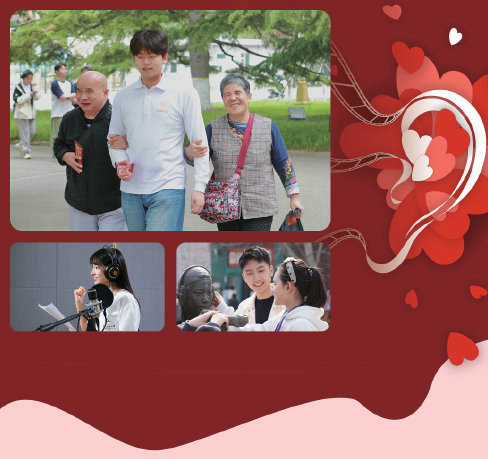
A special version of the Chinese animated film Nezha: Birth of the Demon Child (2019) was recently screened at a nursing home in Taiwan, allowing visually impaired elderly residents to "see" the movie.
This version was created by Guangming Cinema, a public welfare initiative launched in 2017 by the Communication University of China (CUC) in collaboration with Beijing Gehua CATV Network and Dongfang Jiaying Television Cinema Media Co Ltd.
The name "Guangming", meaning "bright" in Chinese, reflects its mission to make films more accessible to visually impaired audiences.
Li Yiying, 27, a CUC student volunteer who joined the project in 2018, explained that accessible movies feature audio descriptions of visual elements, added during pauses in dialogue and sound effects.
According to her, most volunteers at Guangming Cinema come from CUC's Television School. The team has grown from an initial group of about 30 members to more than 800 today.
Making an accessible movie involves several steps: selecting a film from the copyright library, writing the audio description script, recording the narration, reviewing the content, and testing it with visually impaired audiences. The entire process usually takes about 28 days and involves at least three students and two teachers.
For many volunteers, the most difficult part of creating an accessible movie is writing the audio descriptions. "Film is an art where a picture speaks a thousand words. It's tough to fit concise, accurate narration into the brief pauses in the soundtrack without disrupting the film's rhythm," Li explained.
When she first started, it took her an entire day to write the script for a five-minute segment. To ensure accuracy, she paused the film over 3,000 times to review scenes.
Writing descriptions for suspense films is even more demanding, as it's crucial to avoid spoilers.
"I want to make sure that, even though visually impaired viewers can't see the screen, our narration still captures the emotions and atmosphere of the film, offering an experience that matches that of sighted audiences," Li said.
For 28-year-old Li Chaopeng, his biggest challenge is writing descriptions for sci-fi and fantasy films, as it requires describing scenes far beyond everyday experience.
While working on the animated film Big Fish & Begonia (2016), he researched extensively to accurately describe the film's fantastical creatures, many of which were inspired by the ancient Chinese text The Classic of Mountains and Rivers. These ancient and imaginative beings required lively and detailed narration.
Li Chaopeng was pleasantly surprised to discover that visually impaired viewers also deeply enjoy fantasy movies. "Whether sighted or visually impaired, everyone creates their own imagined world when watching such films. The ability to fantasize is something we all share," he said.
Chen Zhongrui, 24, recalled an experience after a screening when a congenitally blind girl asked her mother, "What is the color red?" This question made him realize the importance of paying closer attention to the details when translating visual elements into audio for accessible films.
For example, he now describes "red" through other sensory perceptions, such as the warmth of heat or emotions like passion and shyness, whenever appropriate.
"Seeing visually impaired audiences fully grasp the films we create gives me immense satisfaction," Chen said.
Making a difference
Zhao Xijing, a CUC teacher and a Guangming Cinema volunteer, noted that the team currently produces 104 accessible films each year. This allows visually impaired people in China to watch two films per week, matching or even surpassing the viewing frequency of sighted individuals.
These films are distributed nationwide through hard drives or cloud storage, reaching cinemas, film festivals, neighborhoods, and public welfare groups. The network covers all 2,244 special education schools in China and serves visually impaired audiences across 23 provinces, five autonomous regions, four municipalities, and Macao.
In 2022, Guangming Cinema began offering its films on cable television, making it easier for visually impaired individuals to watch accessible films at home.
"We want to make accessible films a regular part of visually impaired audiences' daily lives," Zhao said.
Li Chaopeng recalls meeting a visually impaired mother and her son at a film screening. The mother explained that after losing her sight, she struggled to find topics to discuss with her family and often felt isolated. However, at Guangming Cinema, she was able to enjoy films just as much as her son.
"What we do may seem simple, but it gives the audience a way to interact and engage socially, helping them feel more connected to the world," said Li Chaopeng.
Today, the volunteers at Guangming Cinema are not just making films more accessible; they are also working to promote the concept of information accessibility to better engage with visually impaired individuals.
With this goal in mind, Guangming Cinema continues to improve accessibility in cinemas and advocate for standardized film technology. For example, inspired by their efforts, renowned Chinese director Jia Zhangke proposed the development of an accessible film industry during the 2019 National People's Congress.
Moreover, the Marrakesh Treaty to Facilitate Access to Published Works for Persons Who Are Blind, Visually Impaired or Otherwise Print Disabled took effect in China in May 2022, opening up more opportunities for accessible film production and promotion.
"This journey of illumination is also a journey of breaking down barriers," said Li Yiying. "We hope that accessible films can help our visually impaired friends discover a world of light."
mengwenjie@i21st.cn