Mosaic of magic
Grass grids have proven an effective way to combat desertification










There are more than 30 million square kilometers of deserts globally, accounting for one-fifth of the Earth's land area. Deserts are often associated with desolation, affecting agriculture and leading to sandstorms that disrupt the lives of nearby residents.
Over several generations, dedicated Chinese people have established a "Green Great Wall" of 32 million hectares of forests and 85 million hectares of grasslands across 13 provinces and regions to combat the growth of deserts and sandy lands.
Over the past decade, the frequency of sandstorms in northern China has significantly decreased, a remarkable achievement attributed to measures such as controlling the sources of sand and dust storms in the Beijing-Tianjin region, establishing protective forest systems under the Three-North Shelterbelt Forest Program, returning farmland to forestry and grassland, and implementing soil and water conservation.
In the process of desertification control, the "Chinese Magic Cube" holds a prominent position. The grass grid system has stabilized significant amounts of sand and become the preferred method in many provinces.
The renovated grass grid sand-fixing method originated during the construction of the Baotou-Lanzhou Railway. In the 1950s, the construction of the railway that connects Baotou in Inner Mongolia autonomous region and Lanzhou in Gansu province was highly challenging, as it crosses the Tengger Desert six times in Zhongwei, Ningxia Hui autonomous region.
To lock down the sand dunes, researchers and local residents used shovels to insert wheat straw into the shifting sands, forming a grid comprised of sections each measuring 1 square meter that were partially buried, making it difficult for the sand to be blown by the wind.
This method not only ensured the smooth operation of the railway but also protected China's mother river. The Yellow River flows through the Shapotou area in Zhongwei. A grass grid stabilized the sand dunes there, preventing the desert from encroaching on the Yellow River.
Even today, the wheat straw grids, which are inexpensive, convenient, and environmentally friendly, remain a key tool in combating desertification in China and various parts of the world, including Australia, the United States, Morocco, Tunisia, and more.
However, the life span of manually installed wheat straw grids is only three years, requiring a lot of manpower for long-term use.
In 2019, researchers from the Northwest Institute of Eco-Environment and Resources of the Chinese Academy of Sciences, led by researcher Qu Jianjun, developed the "Sand Control Magic Cube 2.0" after repeated experiments.
This method involves using machines to weave wheat straw into brush-like ropes and directly insert them into the sandy soil, saving labor and cost, and enabling large-scale sand control projects.
According to the institute's data, the production efficiency of the brush-like rope grid has increased by over 60 percent compared to manually installed grids. The durability of these grids is also superior, with a life span extending from three to six years.
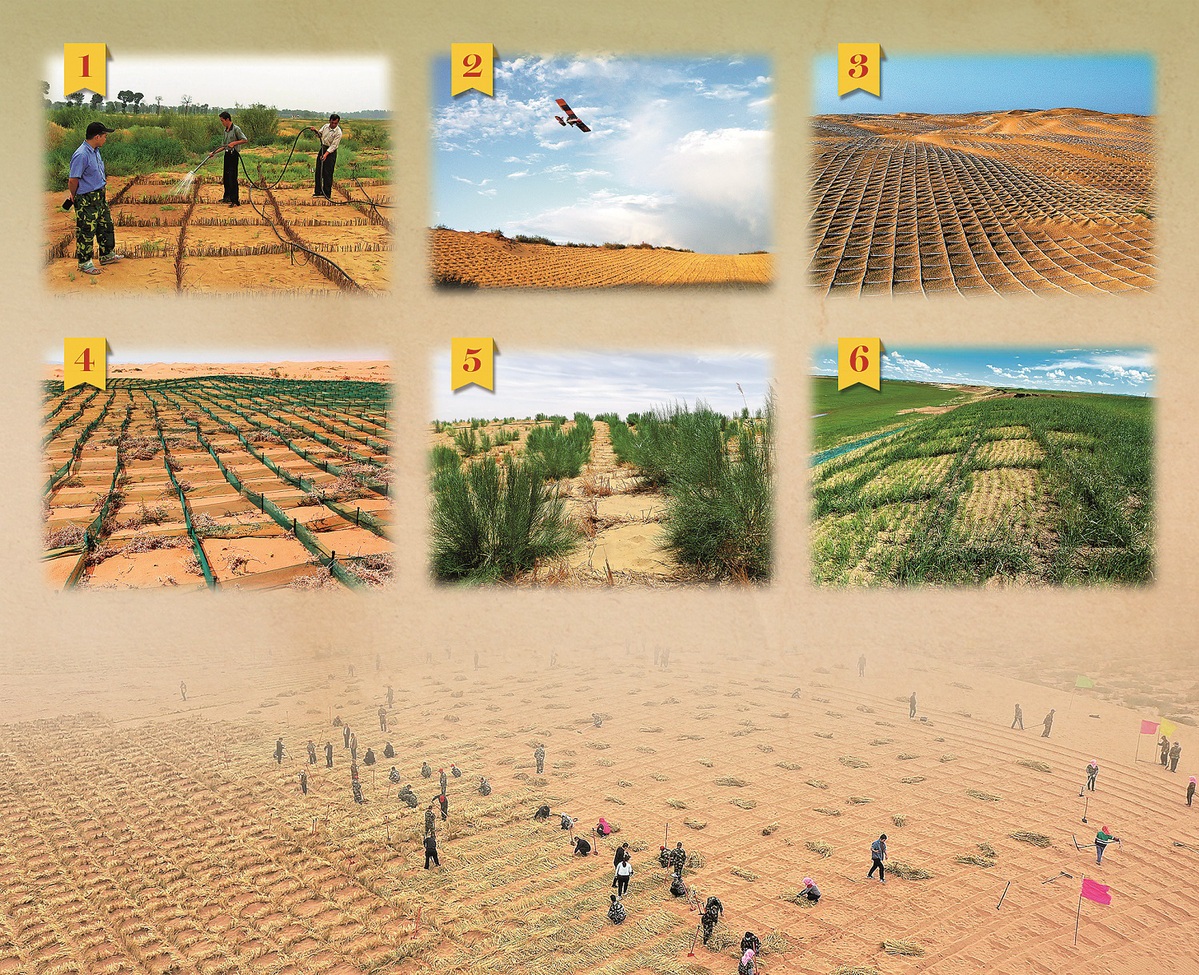
"After the installation of the brush-like ropes, air currents passing through create a vortex in the center of the grids, forming a funnel-shaped depression in the sand, resembling a large pot that pushes the sand in the center toward the periphery of the ropes, fixing the sand while also securing the ropes," explained Tang Ximing, chief engineer of the State-owned forestry station in Zhongwei.
Furthermore, they can be reused, and this technology has now obtained a national patent.
With the sand fixed by the grass grids, tree planting on the sand dunes becomes possible. Planting trees is crucial for permanently stabilizing the sand dunes and preventing them from being disturbed by wind and sand.
"The average thickness of the dry sand layer is 30 to 35 centimeters, and the surface temperature in summer reaches up to 70 C. The survival rate was only a little more than 40 percent," Tang recalled of his experience of planting trees in the grass grids 10 years ago.
"One day, I was so exhausted so I picked up a wooden stick and started poking it into the desert. The stick created holes in the sand, giving me an idea," Tang said.
He created a tool shaped like the Chinese character " ", resembling two uppercase English letter "Fs" back to back. It could hold the seedlings in place, and with a simple step, the roots of the seedlings could be sent into the moist sand layer at a depth of 45 to 50 centimeters, creating holes in the surface of the sand for easy watering.
Subsequent data showed that this simple tool increased the survival rate of planted trees by 25 percentage points compared to digging holes directly with a shovel and doubled the speed of tree planting.
In 2017, this earthy invention was named the "Moisture-Conducting Precision Desert Planting Tool" and obtained a utility model patent. It has not only been widely used locally but has also been promoted in Inner Mongolia, Shaanxi, Gansu, and other regions.
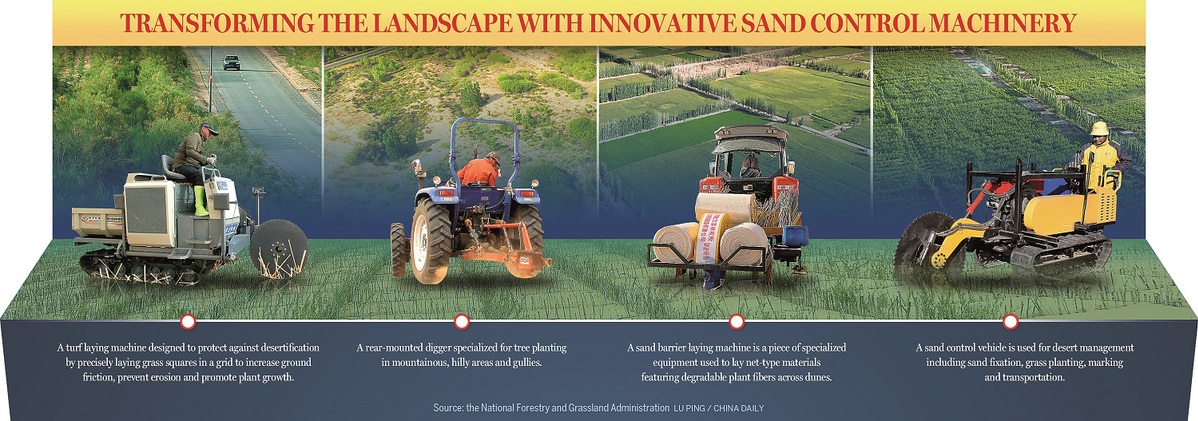
This traditional method was upgraded to an electric tree-planting tool in 2023, further increasing efficiency and tree survival rates. As sand control technology advances, so do the ideas of those involved in desert control, opening up new avenues for desert management.
The Three-North Shelterbelt Forest Program, which was initiated in 1978 and will span 73 years, has yielded numerous techniques and innovations as the crystallization of the wisdom of those combating desertification.
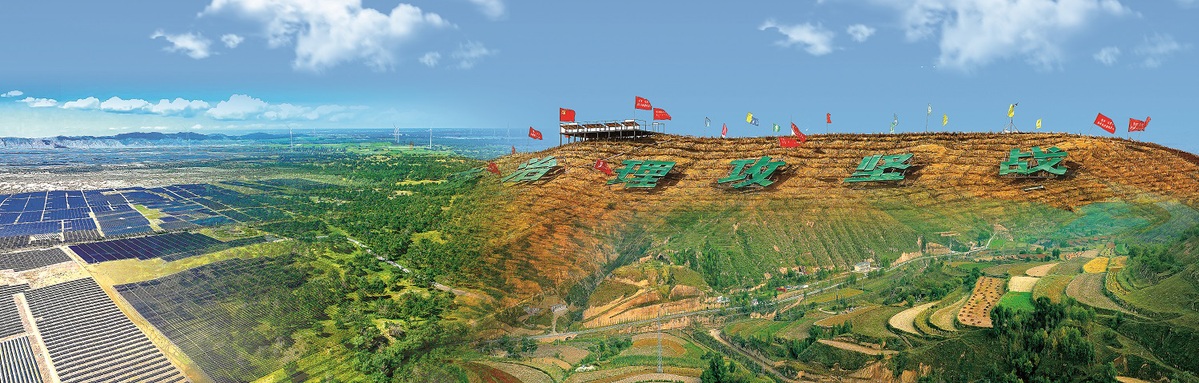
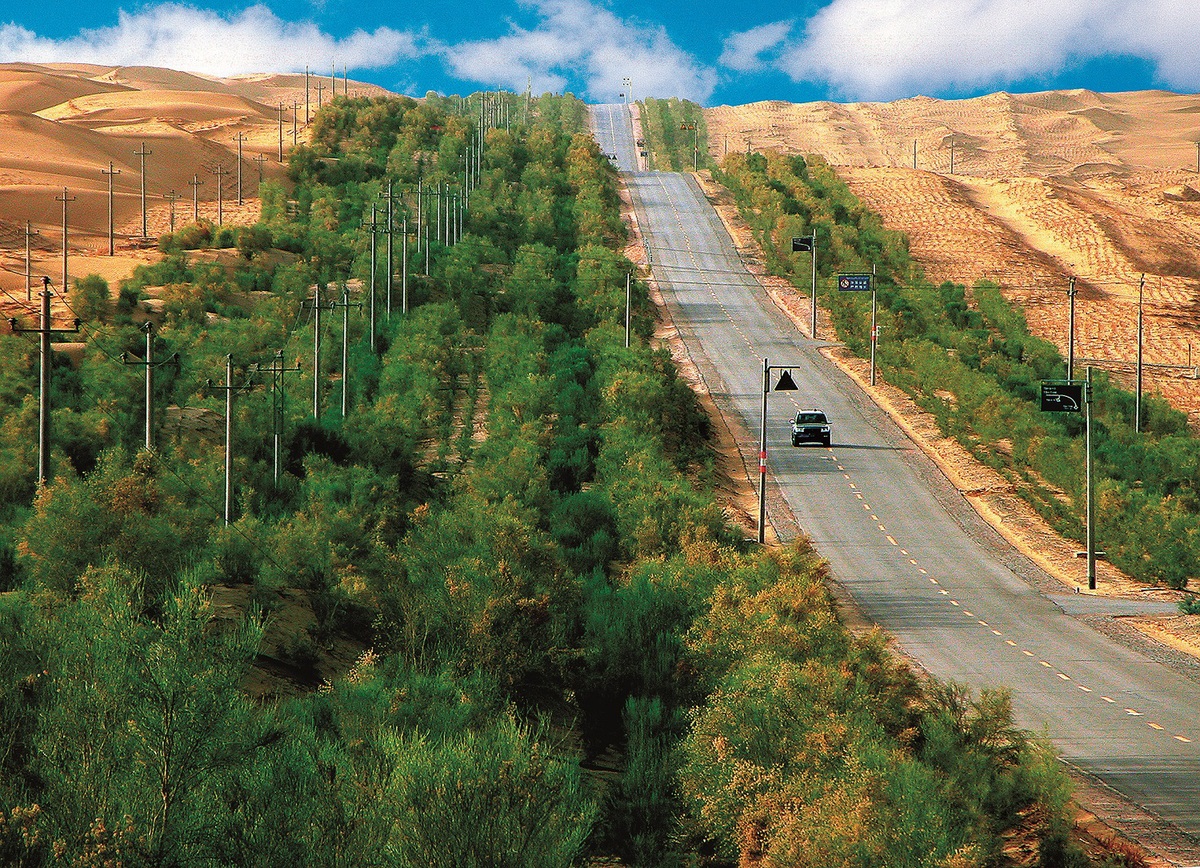
For example, photovoltaic sand control, which utilizes solar panels in desert areas for solar power generation while conducting agricultural production underneath the solar panels. The construction of sand-piercing roads not only divides vast sandy areas but also facilitates the transport of sand control materials and measures deep into the heart of deserts.
"Each desertification control project is now customized based on diverse local conditions and resources supported by research data. There is a consensus that the goal of desertification control is to protect people's lives and development from desert threats while preserving deserts as integral components of the ecological system," said Lu Qi, head of the Three-North program research institute.
The program has increased forest coverage in Northwest, North and Northeast China from just above 5 percent in the 1970s to nearly 14 percent last year, protecting more than 30 million hectares of farmland from desert encroachment.
In 2020, China achieved zero net land degradation, aligning with the United Nations' 2030 Sustainable Development Goals. Desertified and sandified areas have continually experienced "dual reductions".
These achievements and principles align with the United Nations Convention to Combat Desertification adopted in Paris in June 1994, to which China became a signatory that year.
In February 2019, data from the National Aeronautics and Space Administration in the United States revealed that approximately one-fourth of the global increase in green areas from 2000 to 2017 was in China.