Freight trains facilitating regional growth









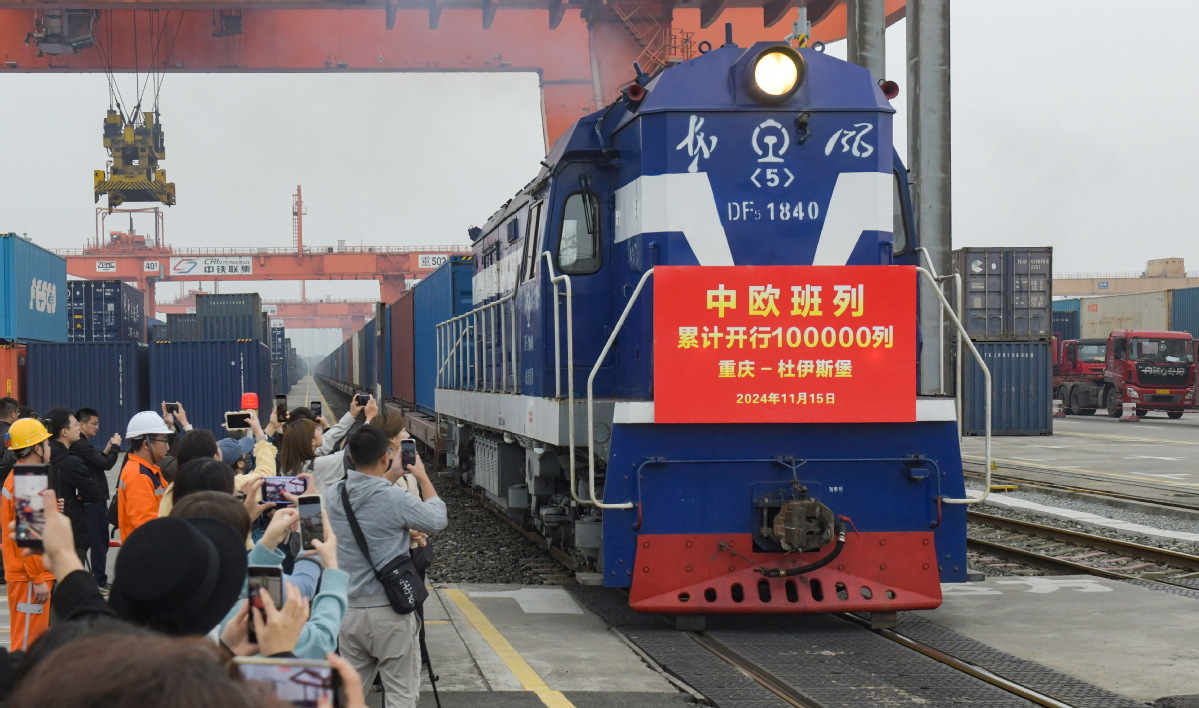
Rail traffic across the Eurasian continent has been proliferating this year. Cooperation between the countries along the route and significant improvements in both hard and soft transport infrastructure have contributed to this trend.
As a result, rail freight between China and Europe has become not only more reliable, faster and greener but also more cost-effective than shipping. By August this year, the cost of shipping a 40-foot container by train from the Chinese mainland to Poland was less than half the cost of shipping.
Besides, the freight train takes about nine days to reach the destination, compared with 35 to 40 days by sea.
The ongoing conflict in the Red Sea region has led to a 67 percent decline in shipping between China and Europe via the Suez Canal. Consequently, there has been a notable rise in sea freight rates, which is now higher than rail freight rates. For example, between January and mid-August this year, the cost of shipping a forty-foot equivalent unit (FEU) from Shanghai to Rotterdam increased by 78 percent, reaching $7,961, according to the Drewry World Container Composite Index.
In contrast, rail freight rates have remained relatively stable. By August, shipping rates between China and Europe were already 59 percent higher than the average rail freight rate, which held steady around $3,240 per FEU for most of 2024, according to the Eurasian Rail Alliance Index.
However, it is important to remember rail transport has a limited capacity compared with shipping. The average freight train from China to Europe typically carries about 150 twenty-foot equivalent unit (TEU) containers per trip, while the large ocean liners operating on this route can hold up to 24,000 TEUs, which about 160 trains would be needed to carry.
From January to September, the volume of rail freight between China and Europe continued to rise, with the trains making 14,689 round trips, up 13 percent year-on-year. These trains transported 1.57 million TEU of goods, an increase of 11 percent year-on-year. During the first seven months of the year, more than 50 trains operated daily.
These freight trains connect 224 cities across 25 European countries, and more than 100 cities in 11 Asian countries. The increasing trade between China and the European Union has been the primary factor driving the growth of transport. In 2023, trade between these regions reached €739 billion ($783 billion) for imports and exports, accounting for 15 percent of total EU trade. This figure is close to the 17 percent for the US.
In comparison, in 2000, the share of the EU's trade with the US was about 24 percent of the total, while the share of trade with China was only 5 percent. It should also be noted that China has become the largest exporter to the EU, with a 20 percent share of the total. The US, incidentally, has a 14 percent share.
The rapid development of rail transport between China and Europe has significantly accelerated the socioeconomic development of China's inland regions. A decade ago, the more developed coastal areas dominated international and regional trade thanks to their easy access to seaports. However, with the establishment of the Eurasian railway bridge, the less economically developed inland provinces of China have experienced a substantial boost in their development. These provinces have become vital logistics and trading hubs, and strong manufacturing bases.
Take the city of Xi'an and the province of Shaanxi. Since the launch of the China-Europe rail route from Xi'an in 2013, the number of trains serving the city has grown significantly. In the first year, there were 46 trains; by 2023, that number had surged to more than 5,300. Today, Xi'an International Port Station operates 18 regular international routes that span the entire Eurasian continent. According to China Railway, 2,372 trains passed through the Xi'an route from January to June this year, transporting 250,000 TEUs. These figures represent increases of 13.1 percent and 10.4 percent respectively compared to the previous year.
This year's customs data show that Shaanxi, Zhejiang and Jiangsu were the leading exporter-provinces through the China-Europe freight trains, while Shaanxi, Liaoning, and Fujian were the top importer provinces. In previous years, the eastern coastal provinces typically occupied the top 10 positions on the list of highest exporter-importer provinces, with Shaanxi ranking seventh or eighth.
Many of China's inland cities and provinces have experienced a similar transformation. New and efficient trade links have created new business opportunities in China's landlocked regions, attracting both domestic and foreign investment, promoting international trade, and expediting economic development. Additionally, the creation of millions of new jobs in the inland regions has increased the flow of migrant workers from the eastern and southeastern regions to the western and northwestern regions.
The relocation of numerous industrial companies to landlocked provinces has proven beneficial due to lower capital costs and wages, which in turn has enhanced their competitiveness. Additionally, the development of railways has enabled these companies to reduce transit time and deliver goods directly to their customers in Europe.
The Belt and Road Initiative, launched in 2013, has greatly contributed to the massive increase in rail freight across the Eurasian continent. Cross-continental freight between China, countries along the ancient Silk Road and Europe has increased substantially. And the further development of this route will enable rapidly growing China to effectively and smoothly trade with countries in Central Asia and Europe, and sharpen its competitiveness.
The writer is former prime minister of the Kyrgyz Republic, a professor at the Belt and Road School of Beijing Normal University.
The views don't necessarily represent those of China Daily.
If you have a specific expertise, or would like to share your thought about our stories, then send us your writings at opinion@chinadaily.com.cn, and comment@chinadaily.com.cn.