US again targets China with more curbs on chip-related exports









The outgoing Biden administration has again moved to restrict China's technological advance with a new round of semiconductor-related export curbs affecting nearly 150 companies internationally.
In the third round of sweeping technology restrictions in three years on China's companies, the US Commerce Department announced it would curtail exports to 140 companies by placing them on its Entity List.
The new restrictions not only will have an impact on American companies but on companies in other countries.
In the US, the curbs could hit companies like Applied Materials, KLA Corp and Lam Research, and ASM International, a chip-equipment maker in the Netherlands.
Applied Materials, which also makes chip equipment, reported that its net revenue from exports to China increased 86 percent in the nine months ending July 28 to $7.9 billion, or 40 percent of its total revenue, The Wall Street Journal reported.
New controls, including on software that increases the productivity of advanced machines or allows less-advanced machines to produce advanced chips, Reuters reported, and could affect companies like Germany's Siemens, which is the parent company of the former Mentor Graphics, based in Oregon.
Also affected is high-bandwidth memory used in artificial intelligence chips that correspond with what is known as "HBM 2" and higher, technology made by South Korea's Samsung and SK Hynix, and US-based Micron Technology, Reuters reported. The HBM rule compliance date was scheduled for Dec 31.
Industry sources expect only Samsung Electronics to be affected, according to Reuters. Analysts estimate that Samsung makes about 30 percent of its HBM chip sales to China.
HBM is crucial in artificial intelligence training and also is an important part of integrated circuits in advanced computing.
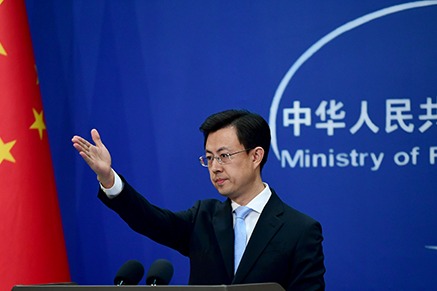
Lin Jian, a spokesperson for China's Foreign Ministry, told reporters on Monday that the export controls are detrimental to the interests of all countries.
"We have repeatedly made clear our position on this issue. China firmly opposes the US' overstretching the concept of national security, abusing export controls, and maliciously blocking and suppressing China," Lin said at a media briefing.
"This type of behavior seriously violates the laws of market economy and the principle of fair competition, disrupts international economic and trade order, destabilizes global industrial and supply chains and will eventually harm the interests of all countries," he said.
China's Ministry of Commerce called the restrictions "economic coercion" that "seriously" threaten the global supply chain.
The new entrants on the Entity List include semiconductor fabrication plants, also known as fabs; semiconductor tool companies, and investment companies allegedly "acting at the behest of Beijing to further China's advanced chip goals which pose a risk to US and allied national security", according to the US Commerce Department.
Chinese private-equity firm Wise Road Capital, tech firm Wingtech Technology Co and JAC Capital are on the list as are numerous companies based in Beijing, Shanghai and Shenzhen, with most of those companies having semiconductor in their titles.
Companies looking for licenses to sell to firms on the Entity List usually are denied.
The new rule also will expand US powers to curb exports of chipmaking equipment by American, Japanese and Dutch manufacturers made in other parts of the world to certain chip plants in China, Reuters reported, noting that equipment made in Israel, Malaysia, Singapore, South Korea and Taiwan is subject to the rule, while Japan and the Netherlands will be exempt.
An expanded "foreign direct product rule" will apply to 16 companies on the Entity List that are seen as vital to China's most advanced chipmaking goals.
The rule also will lower the amount of American content that determines when certain foreign items are subject to US control, which will allow the US to regulate any item shipped to China from overseas if it contains any American chips, Reuters reported.
US chip toolmakers had lobbied the White House and Congress to limit the reach of the new controls on Huawei Technologies Co Ltd fabs and had some support in Commerce, according to two US officials, The Washington Post reported.
But the White House and the State, Energy and Defense departments rebuffed Commerce, and the relaxation was rejected, the officials said, according to the Post.
"The news from a few days ago that Huawei's newest smartphone was created with the most sophisticated products was another reminder that China's biggest companies can take any tariff or import-ban punch and remain standing," Anthony Moretti, an associate professor in the Communication and Organizational Leadership Department at Robert Morris University in Pennsylvania, told China Daily.
"Washington continues to be on the defensive, acting in a way that suggests it knows Beijing has the upper hand, and is desperate to stop China's momentum," he said.
In an extensive report titled "The True Impact of Allied Export Controls on the US and Chinese Semiconductor Manufacturing Equipment Industries", published on Nov 26 on the Center for Strategic and International Studies (CSIS) website, Gregory Allen detailed China's efforts to build up its own semiconductor industry long before US sanctions.
"There is simply no policy that the United States could articulate that would persuade China to abandon its goals of de-Americanization and decoupling in the semiconductor equipment sector," wrote Allen, who is the director of the Wadhwani AI Center at CSIS in Washington DC.