


Top marks given to 75 years of educational progress
Higher education has played pivotal role in development










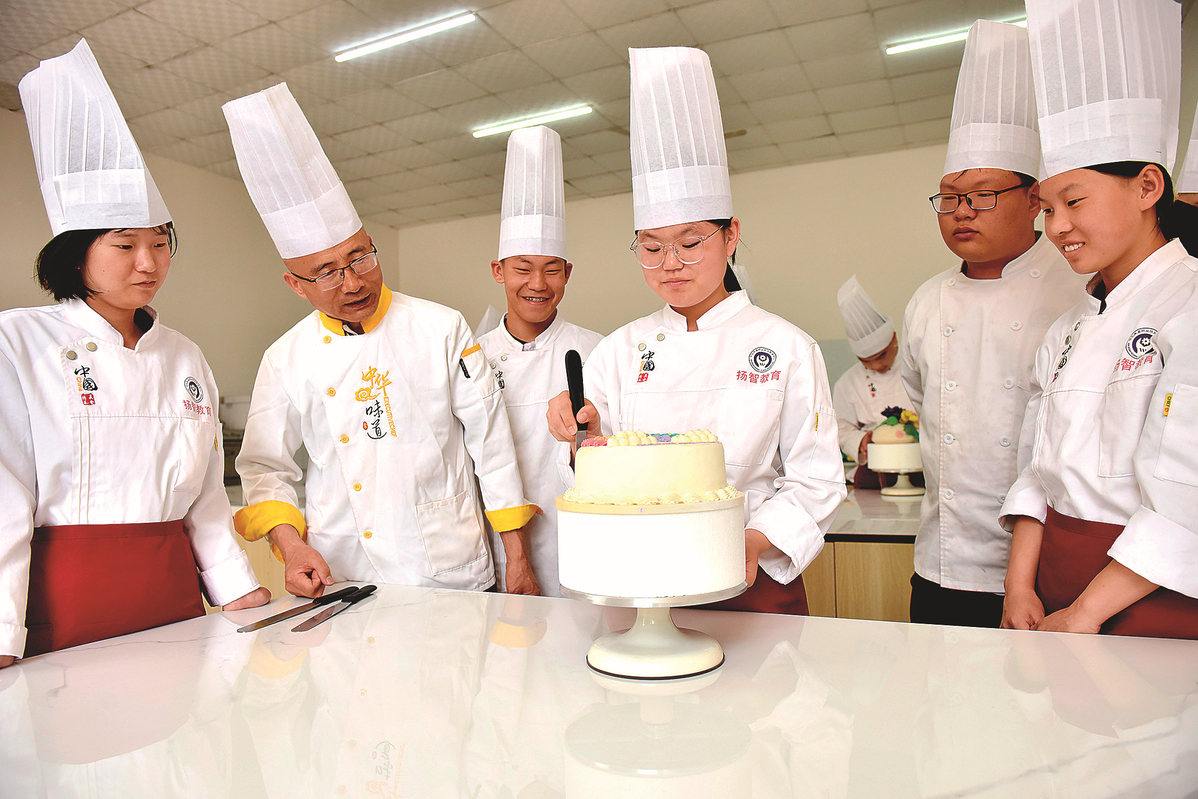
Liu Fuxing, a professor at Renmin University of China's School of Education, said China should integrate the current education and talent cultivation frameworks to create a system that is tailored to the needs of an innovative nation.
"Over the past 40 years of reform and opening-up, the education and talent development systems that were initially designed to meet the needs of a world-class manufacturing hub and a global factory are no longer fully compatible with the demands of socioeconomic development," Liu said.
"We need to innovate vocational education to cultivate application-oriented talent who can master and develop new types of productive resources," he said, adding that reforms should be deepened in vocational education to promote the integration of vocational and general education, as well as the collaboration between industry and education.
Universities are expected to innovate curriculum design, integrating vocational education and key industries that reflect the demands of new quality productive forces, such as the digital economy and green economy, Liu added.
According to the ministry, over 70 percent of new workforce entrants in modern manufacturing, emerging industries and modern services come from vocational institutions.
Meanwhile, the development of digital education in recent years has empowered the construction of a learning-oriented society.
Wang Guangyan, vice-minister of education, said the National Smart Education Platform has become the world's largest platform of digital education resources, and has been accessed over 50 billion times by users spanning more than 200 countries and regions.
Last year, the platform was awarded UNESCO's highest prize for education informatization — the King Hamad Bin Isa Al-Khalifa Prize.
In the past three years, China's global digital education development index has risen from 24th to ninth place, Wang said.
The country is further implementing artificial intelligence-powered education initiatives, which include establishing education evaluation systems supported by big data and enhancing the digital literacy of both teachers and students, he added.
After 75 years of effort, a new pattern of proactive international educational exchange and cooperation is taking shape, enhancing China's global influence in education.
Vice-Education Minister Wu Yan said the Chinese language has been incorporated into the national education systems of 85 countries, and there are now over 200 million international Chinese learners and users. Students from 195 countries and regions are studying in China, with over 60 percent of students pursuing academic degrees.
China's contribution to education is growing in the world, highlighted by the UNESCO Institute for STEM Education which was established in Shanghai, and the Luban Workshops that cooperate with African countries in vocational training, Wu said.
Chinese universities have already taken the lead in initiating two major international scientific projects. The "Deep-Time Digital Earth" program has attracted participation from scientists in over 100 countries, while the "Ocean Negative Carbon Emissions" program involves collaboration with scientists from more than 30 countries.
"Both of these large-scale scientific projects represent contributions to humanity, providing Chinese solutions to address the global challenges we all face," Wu said.
Over 75 years, education in China has evolved greatly. In the early days after the founding of the People's Republic of China, only 20 percent of the population had literacy skills. Last year, the average time spent in education for a new entrant into the labor force was 14 years.
University graduates have surged from 147,000 in 1980 to over 10 million in 2022.
There were about 300,000 students in vocational schools in 1949, while 10 million are now trained annually.
To keep the education evolution moving, the ministry said it plans to implement initiatives that combine higher education development with the establishment of scientific centers and innovation hubs, Huai said.
One such place that has already done this is Huazhong University of Science and Technology in Wuhan, Hubei province, which has established 25 joint laboratories with leading enterprises, gradually forming a national science and technology base cluster that spans basic research, key technological breakthroughs and technology application.
As a result, 130 high-tech enterprises have emerged from the university's technological innovations, supporting the development of China's "Optics Valley" with a business volume surpassing 600 billion yuan ($84.8 billion).
Recent efforts to create regional technology transfer centers to enhance university-industry collaboration aim to align educational outcomes with national strategic needs. "Such initiatives facilitate the integration of knowledge and practical problem-solving, enabling universities to play a crucial role in addressing real-world challenges and advancing economic development," Huai said.
East China's Jiangsu province plans to cooperate with the ministry to build a platform for regional technology transfer and to attract universities to engage in industries such as biopharmaceuticals and advanced materials.
The country will encourage younger educators to engage in long-term foundational research, focusing on not only yielding groundbreaking discoveries but also preparing a workforce equipped to meet emerging technological and industrial demands, Huai said.
zhaoyimeng@chinadaily.com.cn





