Xinjiang in one word









When posed the question, "Which word best describes Xinjiang?", my first reaction was confusion. Xinjiang is big, beautiful, hot, cold, dry, inclusive, exclusive, and the list goes on. Finding one single word to describe it is very hard. However, my final pick is, "Exemplary". Let me tell you why!
Aksu
My first few glances at Xinjiang happened during the landing of the plane in Aksu. From the plane window, Xinjiang was already proving to be breathtaking. Red and steep mountains alternating with vast sand dunes and random small patches of green. I was already amazed. The next best thing was the first breath of air that tickled my nose as we disembarked. It was different from the air in Beijing. It tasted fresh and soothing, embracing me in a warm cloth of gentle wind, whispering in my ears the long gone stories of the desert.
Xinjiang is so big that whenever we wanted to travel, we had to either take a plane or spend many hours on the bus. I must admit, the bus rides were rather enjoyable. The back seats had the possibility of opening the windows, which allowed me to really take in the air of this land. The initial ride was a long and straight single road, the kind that when you look ahead you can see the road merging into the horizon.
During this first trip, we were introduced to the diversity of Xinjiang. We met the flat yellow desert, the red and sharp mountains and the random appearance of green bushes. It screamed wild in my ears and my eyes believed it, it was truly a dry land where man does not set the rules, but must learn to adapt to the will of nature. It was indeed the ancient spirit of Xinjiang welcoming us, students and teachers from Peking University.
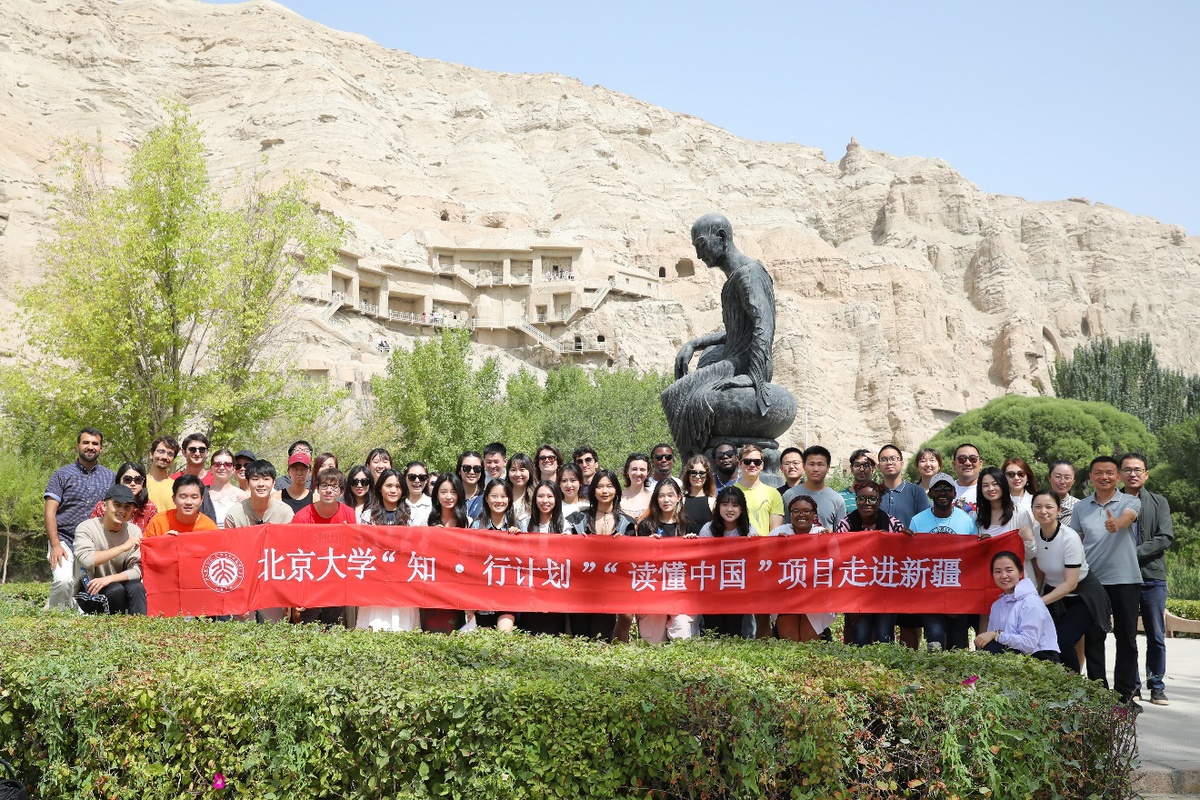
This part of the world has a very long and rich history. The Kizil Thousand-Buddha Caves are an example of the spiritual role of Xinjiang in the far away past. Here monks would create caves on the sides of mountains and enrich them with paintings depicting religious figures and myths. The place was very quiet and surrounded by a dry forest of different kinds of short trees. The caves turned out to be not only an attraction but also provided shade from the scorching sun above us.
Kuqa
Our arrival in Kuqa was shocking. One moment we were surrounded by the desert until where the eye could tell, and the next moment we witnessed cultivations, green, rich and productive land busy with the hustle and bustle of people, which we had not encountered until then.
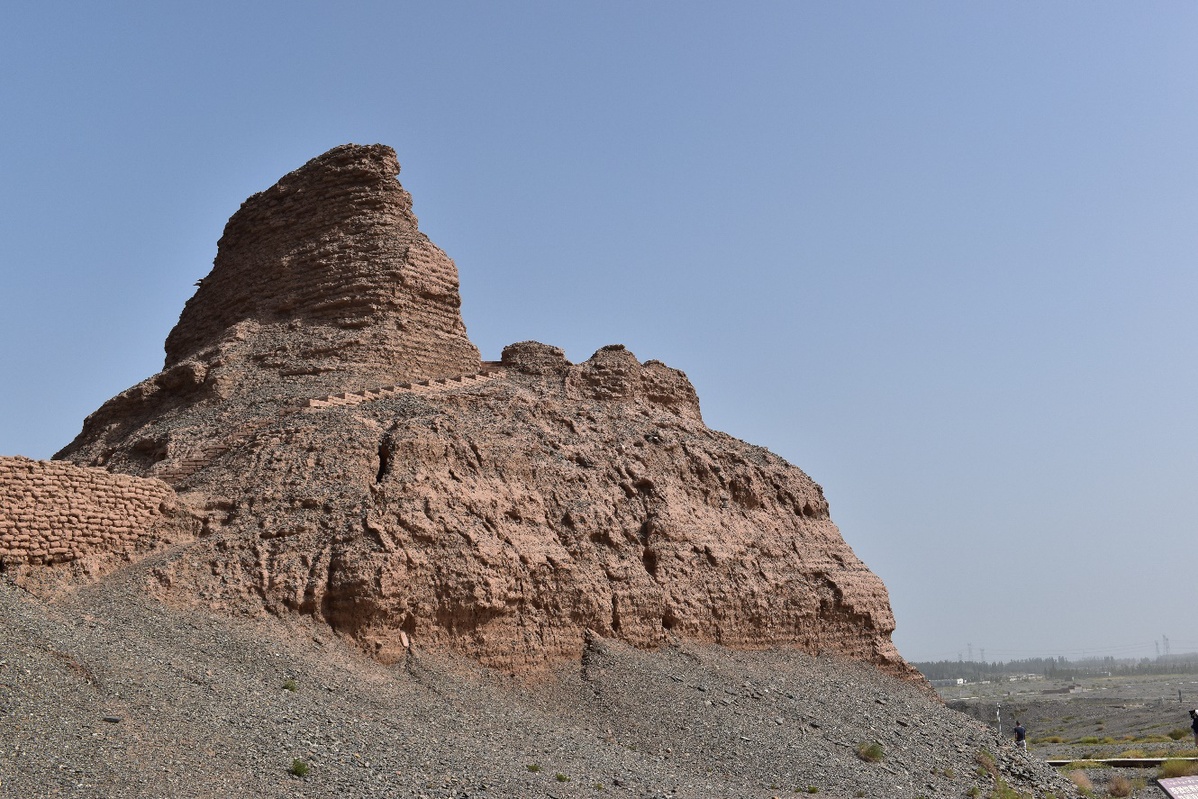
Kuqa is fun. This is a city with thousands of years of history, very close to the Subashi Ancient City that provide insights in the ways of life of the ancient peoples, as well as possessing a lively Royal Palace, now a major attraction for tourists, given the history narrated by its museum together with the captivating "dance of the Princess" right at the main gate, in which she had to find a worthy husband among the crowd, led by music and the people's clapping.
But Kuqa is also much more.
Once the sun sets, the buildings light up, the ferris wheel by the lake starts operating, projecting its colorful lights over the water surface. Kuqa’s nightlife economy attracts people who visit the food markets to enjoy the local delicacies, as well as catch a breather in a quiet place. I was lucky enough to be invited by a group of local people to sit down and chat in a language that mixed Chinese with English, so that we could understand each other. They shared their stories, traditions and culture, offering me delicious freshly cooked lamb chops. At that moment I felt that little by little, by addition of experiences, I was beginning to understand Xinjiang.
Urumqi
Urumqi is the capital city of Xinjiang Uygur autonomous region. It has a more modern silhouette with far more inhabitants than in Aksu and Kuqa. This directly translates to different ethnicities, with different cultures and traditions, living in harmony under the same sky.
The incredible part is the cohesion that these people have in their daily lives. But a far richer example is the Xinjiang International Grand Bazaar. In the first section, visitors can enjoy an open-air market of traditional tools and instruments, also musical; however, only on its second part can one really understand the magic of Xinjiang.
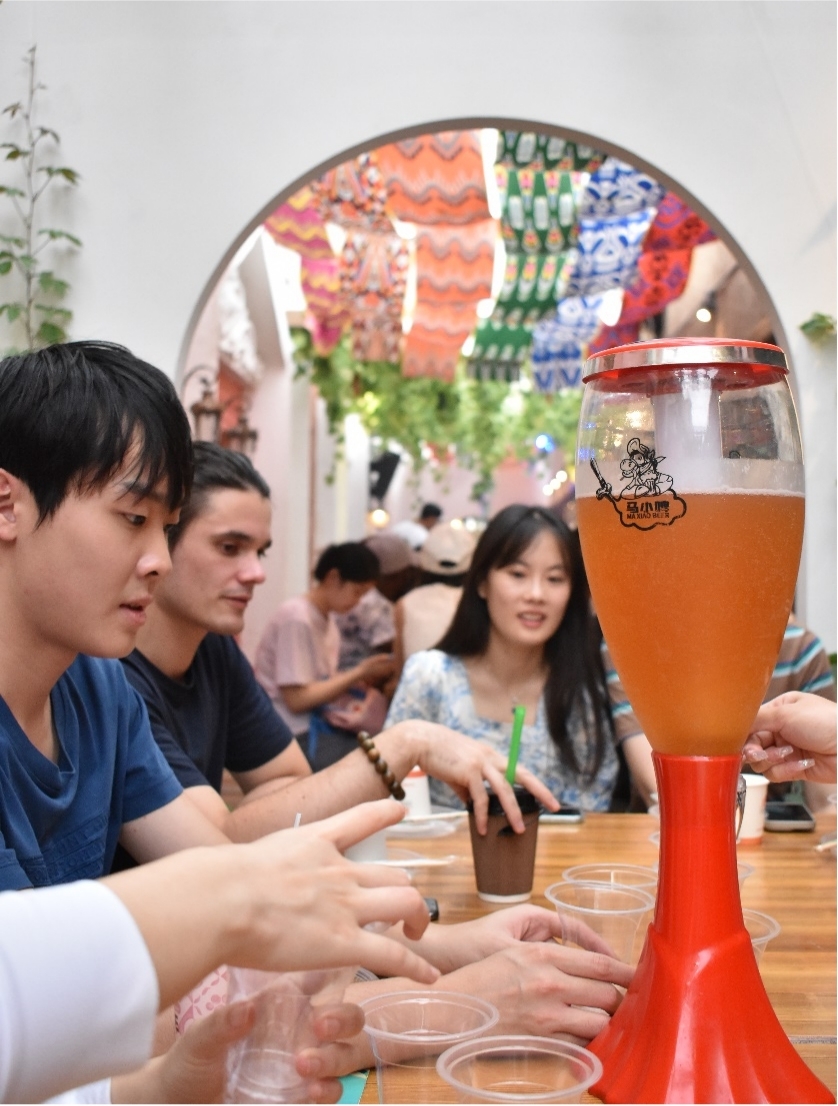
Here, food plays the leading role. Long skewers of lamb meat, typical spicy noodles, juicy local baozi and pigeon meat, are paired together with the local beer and a few varieties of milk, namely camel and horse milk. Horse milk has an unforgettable taste. In this second section of the Bazaar, everyone sits at a table under the same large and tall roof, talking, singing and dancing in harmony. The Xinjiang people have a saying, "When we can talk, we can sing; where we can walk, we can dance."
Yining
Nature has changed its appearance once more. Yining is green, fresh and vibrant (not only for the frequent honking of the drivers).
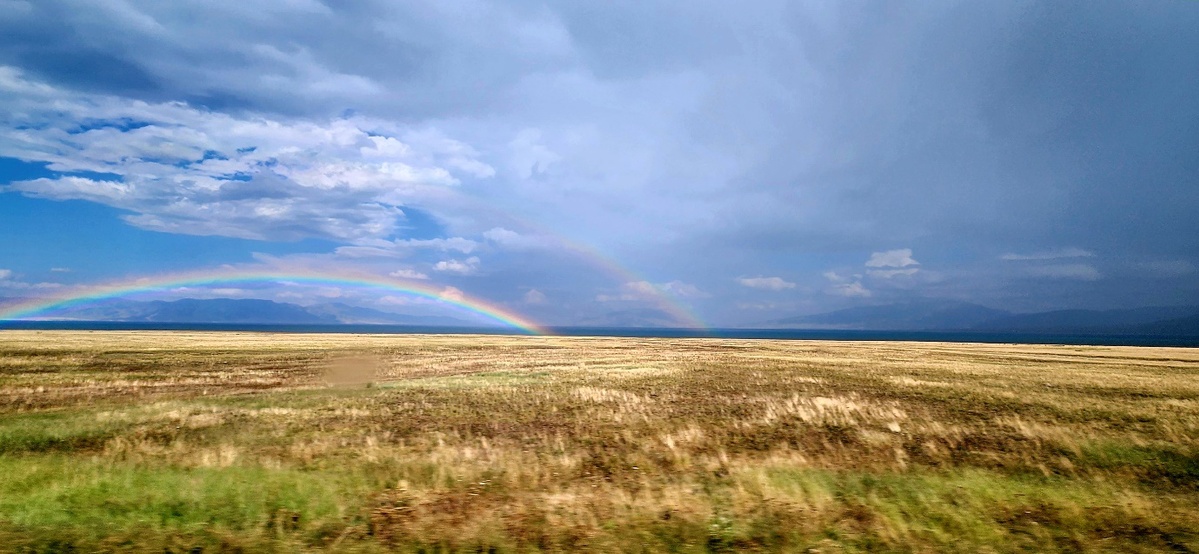
Such dynamism in nature is reflected in every aspect of life in Xinjiang.
Yining is also an example of progress and fast development. Because of its close proximity to Kazakhstan, trade is almost an obvious outcome. China and Kazakhstan have created a trade post on the border between the two countries. This not only shows the strong initiative to encourage economic exchanges with foreign countries, but highlights how fundamentally important Xinjiang's location is and will be, for many years to come.
Nowadays, maritime trade is problematic and lacks efficiency as well as speed. The Euro-China trains passing through Xinjiang are more than 70,000 allowing the Qingdao-Rome route to be done in just 12 days. Xinjiang is an example of the future of trade between the three interconnected continents of Europe, Asia and Africa.
Nowadays, the social unrest led by racial and ethnic differences in too many regions of the world is a cause for concern and uncertainty, but not here. Xinjiang is an example of a successful cohesion between different ethnic groups, all integrated into the society, and each given opportunities in education and in the workplace.
Nowadays, climate change is not a terrible nightmare anymore but a scary reality. Xinjiang is an example of how nature can be beautiful, powerful but also helpful. In the early 1950s in the proximity of the desert, the government decided to plant one specific kind of tree: the apple tree. This greatly reduced the desertification of land, provided a green oasis for human settlements and gifted us all the deliciously sweet apples of Aksu.
Before going to Xinjiang, you might think it is just another province at the border of a big country. After having been to Xinjiang, you will realize how economically, socially and naturally central it is, not only to China but to the whole Eurasian continent. Luckily, the Chinese government realized this much earlier, and supported the development of an ecosystem in harmony with nature and with the people. Xinjiang is indeed "exemplary"!
The China Deep Dive program endorsed by Peking University aims to help international students gain a comprehensive and realistic understanding of China's diverse cultures and Xinjiang's unique charms. By showcasing Xinjiang's role in China's grand narrative, it aims to enhance international students' grasp of China's development and achievements, strengthen sino-foreign cultural exchanges, expand international friendly relations, and provide a fresh perspective and platform for global cultural cooperation
"You must visit Xinjiang to really understand the greatness of China", said Zhang Ying, associate dean and professor at Guanghua School of Management.
The views don't necessarily reflect those of China Daily.
If you have a specific expertise, or would like to share your thought about our stories, then send us your writings at opinion@chinadaily.com.cn, and comment@chinadaily.com.cn.