



Vying for a pole position









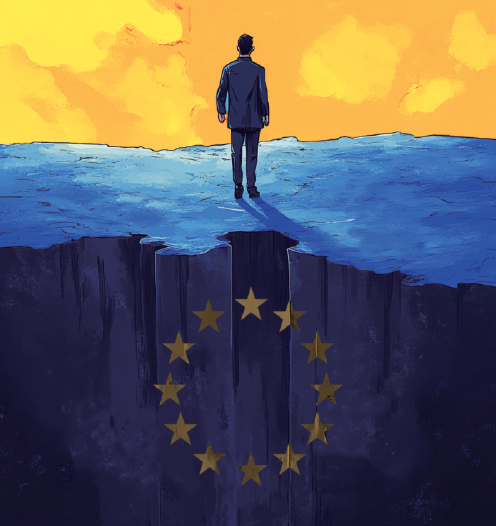
Europe's future in a rapidly changing world will be defined by not only transatlantic relations but also its ties with China
With intensifying major-country competition, growing geopolitical risks and the accelerating development of the new round of technological and industrial revolution, Europe's longstanding quest for strategic autonomy has taken on new features, with a new focus on enhancing Europe's competitiveness.
It is against this background that the European Commission released the Future of European Competitiveness report on Sept 9.
The report continues the European Union's pursuit of strategic autonomy, aiming to enhance its competitiveness by laying out a new industrial strategy.
Europe's pursuit of strategic autonomy has deep historical roots. Since the end of World War II, Europe has embarked on a quest for strategic autonomy. At the end of the 1990s, the EU pushed further for strategic autonomy. After the Kosovo War, at the Cologne European Council in 1999, member states reaffirmed the EU's willingness to develop capabilities for autonomous action. In 2016, the EU formally introduced the concept of "European strategic autonomy", an ambition that extends from the military and defence to the economy, energy, technology and industrial chains.
Since 2020, however, the EU has been facing crises that have hampered its quest for strategic autonomy. First is a competitiveness crisis. The rise of emerging economies and developing countries has posed an acute challenge to the EU's traditional competitive industries. At the same time, the EU is lagging behind China and the United States in cutting-edge technologies such as artificial intelligence and semiconductors.
Second is a vulnerability crisis. Supply chain disruptions triggered by "black swan events" such as the COVID-19 pandemic and regional geopolitical conflicts have dealt a blow to the operation of European enterprises, and the energy crisis caused by the breakdown of the EU's relationship with Russia has led to a new round of economic recession. Meanwhile, the unreliable US commitment to Europe's security and support for Ukraine in its hostilities with Russia have dramatically increased the military spending of member states. The EU is therefore in desperate need of growth and stability.
Thus, despite the promising vision set out in the report mentioned above, its proposals will be hard to put into practice. To restore the EU's competitive strength, an annual additional investment of over 750 billion euros ($792 billion) is needed. But given the gloomy economic and financial situation of EU member states, it is a huge challenge for the EU to raise such a large amount of money.
According to the report's assessment, the EU is completely behind China and the US in advanced technologies. In this sense, since Europe is unable to gain an advantage over China and the US in digital technology in the short term, it should give play to its strength as a "normative power" and gradually become a leader in digital standards and rules.
Specifically, security and defence have long been the weak points of Europe. The EU rolled out its first European Defence Industrial Strategy in March, in which it laid out a long-term vision to bolster Europe's technological and industrial base for defence. Despite the ambitious targets set out in the document, Europe still has a long way to go to become more resilient in defence.
Besides, some structural causes place limits on the EU's efforts to restore its competitiveness and pursue strategic autonomy — Europe relies on Russia for energy resources, China for trade, and the US for security. In these three areas, Europe cannot break its structural dependencies.
In terms of security, European countries are still heavily dependent on the US, which provides large amounts of weapons and military equipment to Europe. The EU has neither the capacity nor the will to break up the transatlantic partnership. Its quest for strategic autonomy does not mean freeing itself from the US influence and becoming independent or neutral in security or political affairs, but rather increasing its say in the China-US-Europe triangle of relations.
As for the economy and trade, a report released by the European Economic and Social Committee in November 2023, proposed to bolster the EU's supply chain security and reduce dependencies through "de-risking", and to choose trade policies that best serve the EU's interests based on the principles of openness and cooperation. The EU aims to diversify its supply and industrial chains so that it does not rely too much on the US or China. However, due to the close trade cooperation between China and Europe, it is almost impossible for the EU to completely decouple from China in the short term.
In the energy sector, before the Ukraine crisis fully escalated in February 2022, Russia had been the largest natural gas supplier of the EU. Since then, the EU has slashed natural gas imports from Russia, and turned to the US for LNG. As a result, the US has become the largest LNG exporter in the world. But according to the Brussels-based think tank Bruegel, the EU imported more natural gas from Russia than from the US from April to June, the first time in nearly two years it purchased more gas from Russia than from the US during a single quarter.
The next year will mark the 50th anniversary of the establishment of diplomatic ties between China and the EU. However, the growing China-US rivalry, the China-Russia strategic partnership and the China-Europe competition in the high-tech sector will combine to further complicate the China-Europe high-tech trade conflict. Europe is likely to impose more restrictions on China in semiconductors, chips and solar photovoltaic products.
Nevertheless, China is willing to support the EU's pursuit of greater strategic autonomy.
There are no acute geopolitical conflicts between China and Europe. And Europe's future will not only be defined by the transatlantic relations, but also by its ties with China.
In the short term, the EU's capacity to achieve strategic autonomy will be limited, and the continent will remain heavily dependent on the US for security and may continue following the US' steps to impose sanctions on China, which will definitely strain the China-EU relations to some extent. But in the medium to long term, the EU should base its China policy on its own interests instead of the US' needs.
Xu Jin is a senior research fellow at the Institute of World Economics and Politics at the Chinese Academy of Social Sciences. Lu Yinglin is a PhD student at the University of Chinese Academy of Social Sciences. The authors contributed this article to China Watch, a think tank powered by China Daily.
The views don't necessarily reflect those of China Daily.
Contact the editor at editor@chinawatch.cn.





