



Damage control
Uncertainty in the global economic outlook has put a brake on the engine of global growth and led to the rise of statism









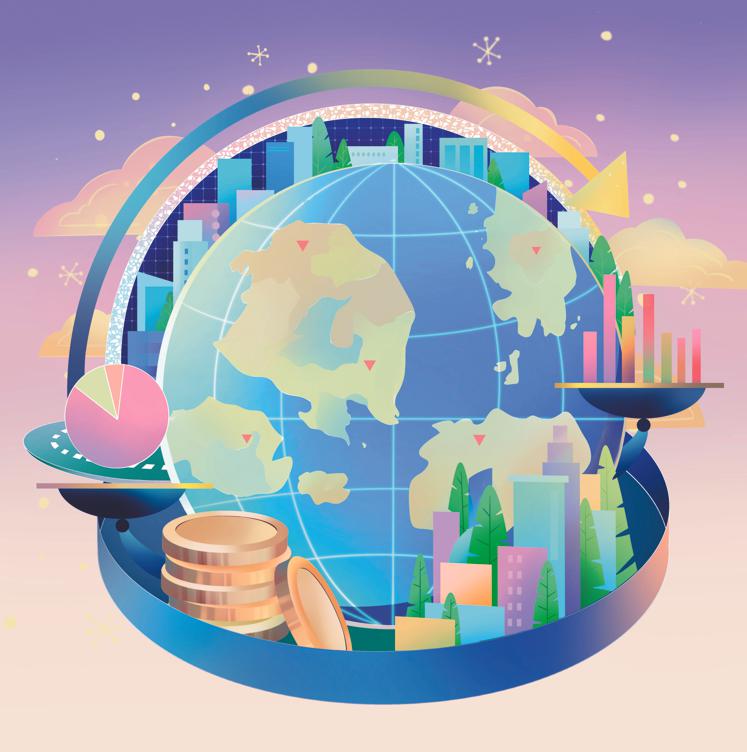
For more than a decade, elections taking place in the world's major countries, such as the United States, have not only intensified political divisions, but also increased their external influence. This reflects a remarkable feature of the world — it is undergoing a period of adjustment. Statism, which is playing an increasingly important role, has become a new tool to achieve global economic circulation and a rebalancing of national power. Its core objective is to safeguard and enhance national interests in the context of economic globalization.
The year 2024, hailed as a "super election year", has witnessed national elections in more than 70 countries across the world. It has served as a "thermometer" and "weather vane" for the world.
This year's elections have continued the existing trends. First, the traditional big parties, such as the center-left and center-right parties, have embraced far-right policies in certain sectors, for instance, putting in place stricter immigration policies and higher trade barriers, and justifying them in the name of "national security".
Second, the priority of livelihood issues has been significantly increased. Major parties in different countries are paying more attention to responding to the needs of the people. This year, the parties that have won elections with a large increase in votes, including some far-right parties, have downplayed extreme nationalism and put forth new propositions on economic issues and redistribution issues such as taxation, education, medical services, income, employment and immigration, thus winning the support of the middle-income and lower-income groups.
Third, the lack of a leading political party that can control the situation and the fact that "large parties are not strong, while small parties are not weak" have made policymaking a political game with high uncertainty.
Since the 1990s, globalization has accelerated and national economies have become highly interconnected. International trade, capital flows, technology transfer and multinational corporations have made countries increasingly dependent on global markets.
The global economic circulation driven by global capital flow has benefited many countries, especially emerging economies, which have enjoyed rapid development. But while enjoying the economic growth brought about by the global market, many countries have also faced new challenges. The increasingly extended global industrial chains have exacerbated the wealth gap and structural imbalances.
These problems have become more acute in recent years. In particular, global supply chain disruptions caused by the pandemic, frequent global trade frictions and intensifying geopolitical tensions have led to the soaring prices of daily goods and energy. Moreover, many countries and regions that rely on external markets have more fragile economic structures. These issues have led to the debate on whether national sovereignty has been weakened. Major political parties in many countries have an increasing tendency to advocate statism in their campaigns. The outcry to adjust and change the existing global economic rules has become increasingly strong.
Statism does not entirely mean opposing globalization or moving toward isolation. Rather, it means using national sovereignty to create protectionist policies and industrial policy tools, reset international trade rules and reshape the global industrial chains by forming new regional markets, alliance-driven markets and domestic markets, so as to maintain a country's advantageous position in the global value chain and foster domestic industries that are competitive in the global economy.
At the same time, the national tax policy should be innovated, by cultivating new tax sources for new forms of economic business, innovating fiscal and tax tools, such as rectifying tax evasion and increasing windfall profits tax. These measures could enhance a country's financial resources, improve the national redistribution capacity and beef up fiscal expenditure to improve people's livelihoods, so as to more effectively enhance national competitiveness and improve social welfare.
Statism, which has accompanied the process of globalization, has undergone four waves. The first wave was before the Industrial Revolution. Back then, Western Europe promoted colonial expansion and established a global economic circulation system in which colonies provided resources for the industrialized countries. The state machinery directly served capital accumulation and overseas expansion.
The second wave was when some countries turned to the "war state" model to serve their military buildup, in order to compete for colonial resources and international markets, which eventually led to the two World Wars.
The third wave, after World War II, saw the rise of national liberation and independence movements across the world, which completely disintegrated the colonial system.
The fourth wave began in the 1960s, when developed countries dominated the global market by virtue of their technological innovation and capital advantages, and established "welfare states". East Asian countries achieved rapid growth through export-oriented economies, benefiting other developing countries and boosting their growth too. This wave of statism was characterized by countries' active participation in and promotion of economic globalization, which promoted the formation of "hyper-globalization".
Statism is once again on the rise across the globe because the "hyper-globalization "system cannot be sustained. Under this model, the markets of developed countries are the terminals of global economic circulation, and the global production and supply chain of goods and services is ultimately designed to meet the needs of developed countries. In the global industrial chain, developed countries profit from their dominance of the design, research and development and other high value-added links, while developing countries are mainly responsible for low-end production and raw material supply. The final income and consumption demand are concentrated in developed countries.
Since 2008, there has been a serious crisis in the global economic circulation that centers on the market and technology of developed countries. Since then, Western countries led by the US have tried to "decouple" from China and promote the transfer and return of industries. However, they have failed to solve their internal problems, with their national fiscal deficit widening and fiscal austerity leading to the increasing poverty of the middle-income and lower-income groups.
Judging from the rise of far-right parties, if this problem is not effectively solved, the conservative wave will continue to gain strength in Europe and the US. Under this pressure, mainstream political parties in Europe and the US have promoted the adjustment of interests domestically.
The rise of statism in European nations and the US, which stand in the center of the global economic circulation, is more destructive than constructive. The global industrial chains and supply chains have been severely disrupted, and countries have suffered huge economic losses. Global economic development is facing the danger of interruption and stagnation. Uncertainty in the global economic outlook has put a brake on the engine of global growth.
In the face of this situation, more and more political parties in developing countries are vigorously seeking to enhance national political stability and governance effectiveness, optimize domestic economic and social order, foster internal growth momentum, and promote international cooperation for common development.
The author is a researcher at the Institute of Political Science at the Chinese Academy of Social Sciences. The author contributed this article to China Watch, a think tank powered by China Daily. The views don't necessarily reflect those of China Daily.
Contact the editor at editor@chinawatch.cn.





