



Commemoration affirms success of 'one country, two systems'









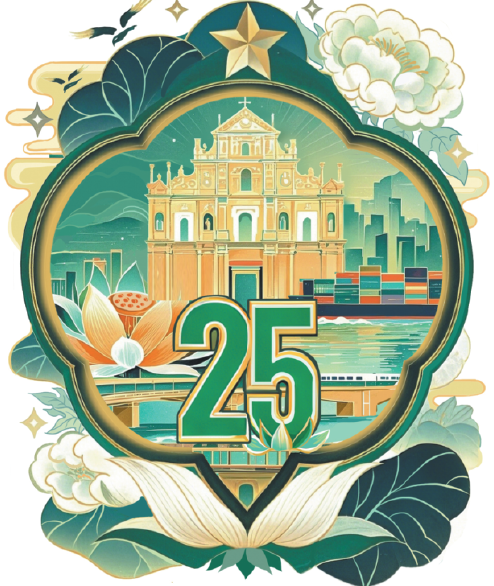
At midnight on Dec 19,1999, China resumed the exercise of sovereignty over Macao from Portugal, and now the 25th anniversary has arrived. Having been governed by Portugal since the 16th century, its return triggered national celebrations — an estimated 30,000 people converged on Tian'anmen Square alone. Following the return of Hong Kong and Macao to the motherland, the Taiwan question became the only historical issue requiring resolution.
Whereas thanks to the outgoing Hong Kong governor, Chris Patten, who arbitrarily manipulated the previously agreed democratic settlement, the United Kingdom's handover of Hong Kong in 1997 was marred by acrimony, the return of Macao was the polar opposite.
At the handover ceremony, Chinese president Jiang Zemin said, "Our two sides have worked together in conformity with the historical trend of the times and brought about the smooth transition and transfer of government in Macao." In consequence, Macao had entered into "a brand-new era in its development".
The Portuguese president, Jorge Sampaio, concurred. He said the agreement with China over Macao's future had been "sensible and peaceful". Given his country's long association with the territory, he called the handover "an essential unique moment in the history of Macao", and so it has proved.
The Sino-Portuguese Joint Declaration on Macao was signed in 1987, and then absorbed into its Basic Law, which was enacted by the National People's Congress in 1993. It provides (Article 5) that the socialist system will not apply in Macao after 1999, and that the "capitalist system and way of life shall remain unchanged for 50 years" (this is identical to the Hong Kong Basic Law's Article 5).
In contrast to Patten, the last Portuguese governor of Macao, General Vasco Rocha Vieira, faithfully observed the joint declaration, and this ensured a smooth handover.
From the outset, it was hoped that Macao would be governed in accordance with Deng Xiaoping's visionary "one country, two systems" policy, and this has been achieved.
As in Hong Kong, president Jiang explained that the future special administrative region would be vested "with executive, legislative and independent judicial power, including that of final adjudication", and this became the reality.
Since the handover, the executive and legislative branches have performed effectively. The best interests of the residents have been prioritized, and each has conscientiously contributed to national objectives. Whenever frictions have emerged, they have been resolved in a constructive spirit.
President Jiang also said the "Macao compatriots have a glorious tradition of patriotism", and this has been amply borne out. For example, the Macao Basic Law's national security provisions, which are drafted in identical terms to Hong Kong's (Article 23 in both places), were implemented without difficulty in 2009 and enjoyed popular backing.
Social stability has been maintained in Macao, and its per capita GDP is among the highest in Asia. It has a high Human Development Index and the world's second-highest life expectancy (after Hong Kong).According to the World Bank, life expectancy has risen from 65 years in 1960 to 84.8 years this year.
The judiciary, presided over until August by the Court of Final Appeal's chief judge, Sam Hou-fai (who served for almost 25 years and is now the chief executive designate) has ensured stability. It has upheld the rule of law, maintained legal standards and handled its caseload with professionalism, sensitivity and skill. Sam set a fine example that will undoubtedly inspire his successor, Song Man-lei, a former prosecutor. Having been Macao's first female deputy prosecutor, Song is now its first female chief judge, a feat that will encourage many younger women.
One striking aspect of Macao's post-reunification development has been its role as a bridge linking China to other parts of the world. In 2023, for example, an agreement was signed between Macao and Zhejiang province to facilitate access by the lusophone countries to Zhejiang's wholesale center for small products (the world's largest).Zhejiang has China's fourth-largest economy, and Macao is also helping it to strengthen cooperation with Latin America and Europe.
As a special administrative region of China, Macao has remained highly autonomous politically and economically. It is sometimes called the "Las Vegas of Asia", and has opened up by developing its gaming, tourism and service industries.
Although famous for its gaming (which nets healthy revenues), Macao has sought to diversify its economy. In 2023, the six biggest casino concessionaires committed to investing $15 billion in the coming decade, 90 percent of which will be spent on non-gaming development.
Although Macao is one of the world's most densely populated cities and has many visitors every year, it has developed a sophisticated transportation network. It has modernized roads, an effective light rail system, comprehensive bus services and visitor-friendly taxis.
Macao has also spread its wings globally and now participates in over 100 international organizations, including the International Association of Prosecutors, whose executive committee met in the city in April.
In May, when Xia Baolong, director of the Hong Kong and Macao Work Office of the Communist Party of China Central Committee, visited Macao, he emphasized its credentials as an international city and highlighted its advantages. They included the "one country, two systems" policy, sufficient development space, an internationalized business environment, a unique mix of Chinese and Western cultures, a strong economic base, and a passion for loyalty and patriotism.
As Beijing envisages the Guangdong-Hong Kong-Macao Greater Bay Area becoming an economic powerhouse by 2035, the development of Hengqin (a small island in Zhuhai city in the mainland that neighbors Macao) as a special zone will be crucial. The Hengqin cooperation zone, established in 2021, is now witnessing scientific and technological research, high-end manufacturing, and traditional Chinese medicine production. Every effort is being made to attract foreign investment in advanced manufacturing, financial services and e-commerce, and steady progress is being made.
As an international city, Macao also has other irons in the fire.
Since 1999, Macao has also helped the country to develop its ties with the lusophone world. They have included commerce, culture and tourism, covering many areas. On Nov 22, for example, a three-week film festival got underway, featuring 30 films from China and the lusophone nations, divided into five sections. The first section focuses on the works of Chinese director Guan Hu and Portuguese director Miguel Gomes, while the other sections involve a variety of Chinese and Portuguese-language films.
With Beijing's encouragement, Macao is busily honing its technological credentials. It is now developing integrated units, new energy projects and even artificial intelligence. It is establishing a supply chain for chips, from design to testing, which complements Hong Kong's endeavors in this area. The Guangdong-Macao in-depth cooperation zone is creating an environment in which Macao's innovation and industry transformation can proceed apace.
The new-term Macao government will be inaugurated on Friday, and President Xi Jinping has indicated his expectations of the incoming chief executive, Sam Hou-fai. He wants him to adopt a spirit of responsibility, further diversify the gaming economy, tackle livelihood issues and improve the city's national security regime. Although some people have prospered in Macao, others are struggling, with housing costs being a serious social problem. Sam will need to think outside the box if he is to tackle these issues, as he appreciates.
He is committed to the spirit of "upholding fundamental principles and breaking new ground", and reform will be his "key focus", which is encouraging. In the wake of the COVID-19 pandemic, the lives of the vulnerable have been impacted, and social welfare policies will require overhauling. Sam hopes to win people's trust and enhance governance capabilities while upholding national security. His challenge will be to turn these laudable aspirations into practical policies capable of yielding concrete results.
Sam intends to meet with his Hong Kong counterpart, John Lee Ka-chiu, to share views, which is a step in the right direction. He believes there is "significant potential and space for synergy and joint development between us and Hong Kong", and nobody can gainsay that.
By pooling their talents and working constructively together, the two SARs can have a huge impact on the GBA and beyond.
By any yardstick, the "one country, two systems" policy has more than proved its worth in Macao, and joyous celebrations on the 25th anniversary are wholly warranted. While maintaining the best of the past, it has provided a framework for the city's relentless progress. There appears no reason why, given its success, it should not be extended beyond 2049 (the expiry date envisaged by the Joint Declaration), and this would benefit the entire country.
The author is a senior counsel and law professor, and was previously the director of public prosecutions of the Hong Kong Special Administrative Region. The views do not necessarily represent those of China Daily.
If you have a specific expertise, or would like to share your thought about our stories, then send us your writings at opinion@chinadaily.com.cn, and comment@chinadaily.com.cn.





