



Hope for stability amid the turbulence in the Middle East









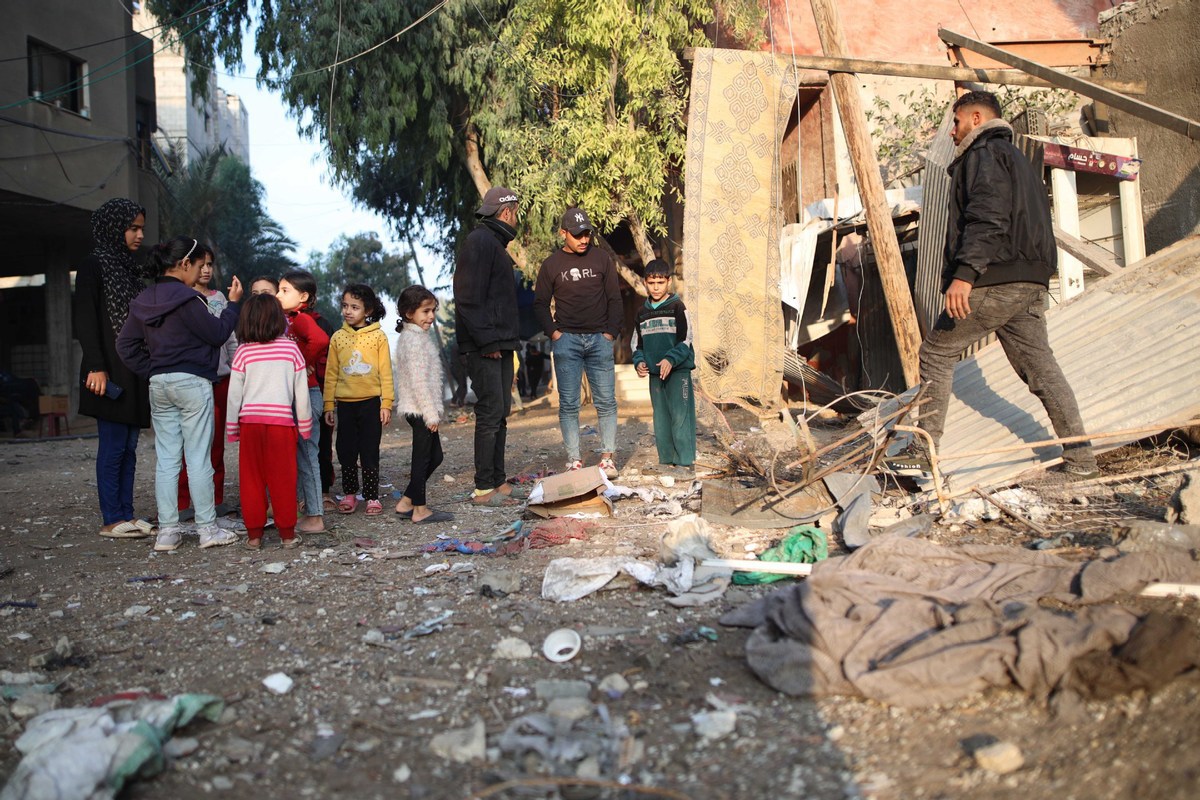
A prominent feature of the Middle East's development in 2024 is the increasing bifurcation of the Middle East, one marked by rising turmoil and unrelenting conflicts, and another characterized by stability, steady progress, and increasingly active international cooperation. This dichotomy urgently needs to be resolved. We hope for the disappearance of the turbulent and conflict-ridden Middle East and the expansion of the stable and developing Middle East, merging into a new, stable, and flourishing region.
Since October 2023, the Middle East has increasingly exhibited two opposing blocs: one led by the United States and Israel, and the other represented by Iran and its regional resistance axis. The outbreak of a new round of the Israel-Palestine conflict has been the primary trigger for this confrontation, while the conflict between these two axes has become the main source of widespread instability and violence in the region. In 2024, the confrontation between the two camps has intensified, with the conflict centered in Gaza spreading outward — from Lebanon to Yemen, from Syria to Iran — as clashes and hostilities escalate, expanding the scope of the turmoil in the Middle East.
Over the past year, a series of significant events have exacerbated regional instability and conflict. For instance, two rounds of direct military conflicts between Iran and Israel nearly sparked a regional war. Israel's killing of Hamas leader Ismail Haniyeh and Hezbollah leader Hassan Nasrallah has been the most prominent, but it has virtually eliminated the political and military leadership of both Hamas and Hezbollah. The Israeli military has continued to target locations in Lebanon and Syria, while the Bashar al-Assad government in Syria suddenly collapsed after the opposition forces launched a rapid offensive.
Over the past year, the trajectory of the Middle East's turmoil has increasingly deviated from old patterns and frameworks. The linkage between regional developments and the Israel-Hamas conflict is being progressively broken, and their interdependence is diminishing, showing signs of decoupling. Hezbollah no longer insists on halting attacks against Israel only if there is a ceasefire in Gaza, having reached a ceasefire agreement with Israel on Nov 27. The overthrow of the Syrian government by opposition forces has removed Syria from the anti-Israel axis, if only temporarily.
The United States is finding it increasingly difficult to restrain Israel, whose increasingly bold and reckless military actions have not only created numerous challenges for the Joe Biden administration but also introduced uncertainty into regional developments. Notably, Israel's continued strikes against Hezbollah and Syrian targets have significantly weakened Hezbollah and the Syrian military, creating new variables in the situation in Lebanon and Syria.
The collapse of the Assad government in Syria and Hezbollah's retreat have also dealt a severe blow to Iran, leaving its regional resistance axis on the brink of collapse and forcing Iran to adopt a more defensive strategic posture. Meanwhile, the Hayat Tahrir al-Sham has unexpectedly taken control of Syria. The future trajectory of Syria under HTS leadership remains highly uncertain.
Between the two warring blocs exists a third camp, led by Arab nations such as Egypt, Saudi Arabia, and the United Arab Emirates. While they support the Palestinian cause, they do not align with the resistance axis, maintaining a largely neutral stance. This camp represents a pragmatic and stable Middle East focused on economic development and industrial transformation. Despite facing the challenges of a turbulent Middle East, this bloc has largely maintained stability. Moreover, the stable camp is expanding, with countries such as Iraq, Tunisia, Algeria, and Libya witnessing improving political stability.
According to an October 2024 report by the International Monetary Fund, most of these Arab nations are sustaining economic growth. The UAE is projected to achieve a GDP growth rate of 4 percent, Saudi Arabia 1.5 percent, Algeria 3.8 percent, Tunisia 1.6 percent, and Qatar 1.5 percent in 2024. The Gulf Arab nations, in particular, are not only maintaining stability but also experiencing rapid economic development, increasingly positioning themselves as engines of growth in a stable Middle East. The international community is increasingly optimistic about the Gulf's economic prospects, with substantial foreign direct investment flowing into the region. Saudi Arabia, in particular, has attracted global investors' attention with sweeping reforms and large-scale investment projects. Standard Chartered Bank predicts that growing FDI inflows, along with public capital expenditures and private sector investments, will drive Saudi Arabia's economic growth, with FDI expected to reach $24 billion in 2024.
The current state of the Middle East can be understood as "half is seawater, half is fire". The year of 2024 has been a year of dramatic ups and downs for the region, with major conflicts continuing to erupt and the ripple effects of the new round of the Israel-Palestine conflict gradually unfolding over time. At the same time, there are glimpses of hope for stability amid the turbulence. Examples include the temporary ceasefire between Hezbollah and Israel, changes in Syria's political landscape, Iran's increasingly pragmatic foreign policy, and the ongoing ceasefire negotiations between Hamas and Israel.
It is anticipated that conflicts in the Middle East will likely persist into 2025, with turbulence and uncertainty continuing to plague the region. However, we hope that the scope of conflict gradually shrinks, the areas of stability continue to expand, and a peaceful, stable, and prosperous Middle East will emerge in the near future.
Tang Zhichao is a researcher of the Institute of West Asian and African Studies, Chinese Academy of Social Sciences. Liu Xuejie is an associate researcher at the same institute. The views don't necessarily represent those of China Daily.
If you have a specific expertise, or would like to share your thought about our stories, then send us your writings at opinion@chinadaily.com.cn, and comment@chinadaily.com.cn.





