



Property biz requires more policy moves
Officials looking to unlock pent-up housing demand via urban renewal









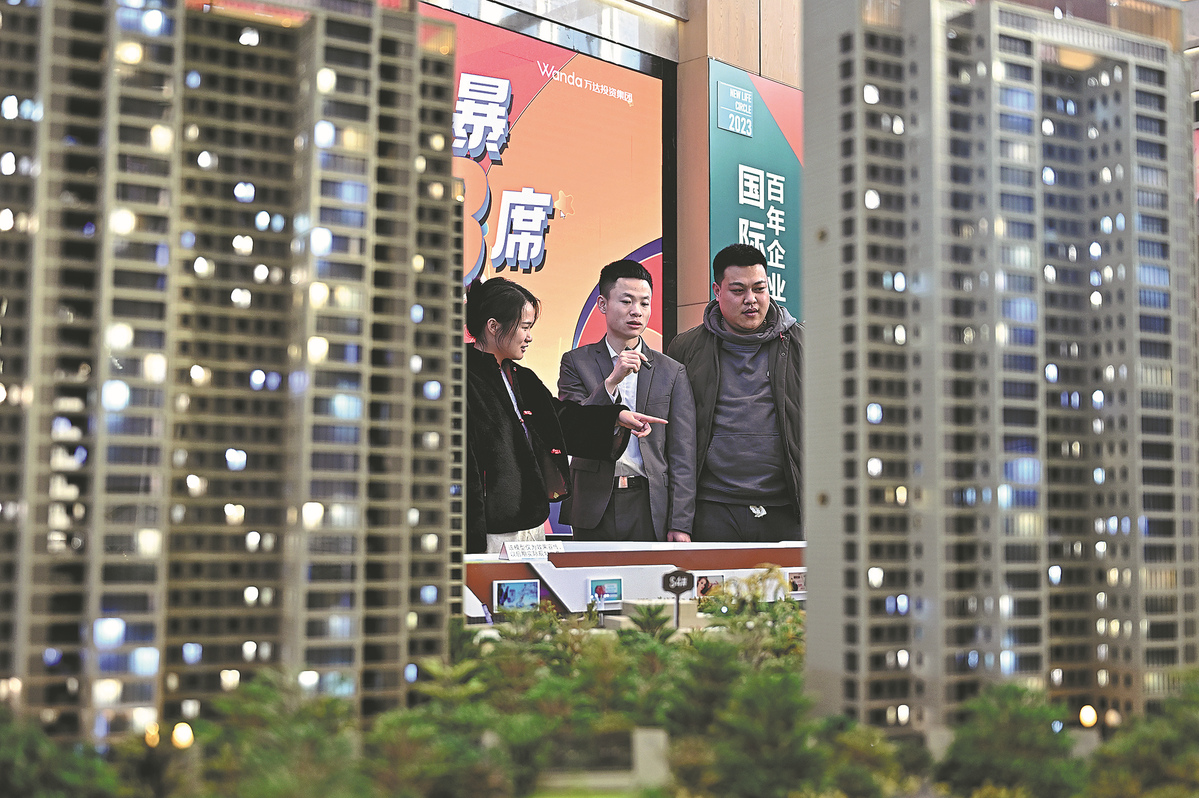
The new measures came after a raft of policy changes for the property sector at the end of September, including a cut in the minimum down payment ratio to 15 percent for all housing categories and a relaxation in home purchase restrictions.
Foot traffic at new home sales centers, as well as the number of viewings for pre-owned properties, have seen notable upticks in recent weeks, which could be translated into potential sales activity, said Chen Wenjing, director of market research at the China Index Academy.
This signals that consumer sentiment toward the real estate market has been improving after an extended period of uncertainty, Chen added.
Looking ahead, it's imperative to exert sustained efforts to ensure a stable recovery next year, as outlined during the annual Central Economic Work Conference where the nation's policymakers set the policy agenda for the world's second-largest economy in mid-December.
Luo Zhiheng, chief economist at Yuekai Securities, said that the central government could establish a real estate stabilization fund amounting to 2 trillion yuan ($274 billion), financed through government bond issuances.
The fund should be deployed across several key areas, with a top priority to ensure that homes under construction are finished and handed over to buyers, as well as acquire existing home inventory and land reserves from struggling developers, Luo said.
Local governments are not able to handle this alone. Therefore, the national-level stabilization fund will provide much-needed firepower to address developer defaults and restore household confidence, thus further helping stabilize the downward spiral in home prices, Luo said.
As of the end of November, a total of 297 cities had established real estate financing coordination mechanisms, and the total amount of loans approved for real estate projects on the white list had exceeded 3.6 trillion yuan, according to the Ministry of Housing and Urban-Rural Development.
In addition to the delivery of pre-sold homes, policymakers are now turning their attention to a critical lever — unlocking pent-up housing demand through urban renewal initiatives.
A key focus will be ramping up the redevelopment of run-down urban villages and dilapidated housing in cities across the country. This effort aims to not only improve living conditions for millions, but also stimulate fresh demand for residential properties, analysts said.
In a major policy shift, China is expanding its support for urban village redevelopment to nearly 300 cities from the previous 35 major ones, according to a notice issued by the Ministry of Housing and Urban-Rural Development and the Ministry of Finance in November.
Prior to the notice, Chinese authorities had rolled out an initiative to renovate 1 million more homes in urban villages and dilapidated housing in October, noting that the number of homes in urban villages alone that require redevelopment in 35 major cities had already reached 1.7 million units.
With the program's scope broadened to encompass more cities, the potential for transformative impact is vast. The expanded initiative could pave the way for the redevelopment of an additional 1 million homes, said Chen, who is with the China Index Academy.
Monetary compensation, housing vouchers and government-led acquisitions of existing commercial housing units for resettlement purposes have been rolled out by various localities for residents displaced by urban village and dilapidated housing renovation projects, Chen said.
In particular, the authorities are also ramping up subsidies and incentives for residents to utilize housing vouchers, which can be used as payments for new home purchases, Chen added.
The goal is not only to improve living conditions for millions by upgrading run-down urban areas, but also to channel this unlocked demand into actual home sales — a critical imperative to further stabilize China's property market, Chen said.
In addition, China's urbanization trend shows no signs of abating, and analysts believe it will continue to translate into a steady flow of housing demand in the years ahead.
According to data from the National Bureau of Statistics, China's urban population accounted for 66.16 percent of the total by 2023. And, with a new plan, issued by the State Council in August, targeting a nearly 70 percent urbanization rate by 2029, this demographic shift is poised to accelerate even further.
Each one percentage point increase in China's urbanization rate will translate into 14.09 million agricultural residents migrating to urban areas. Assuming an average living space of 30 square meters per person, this equates to around 420 million square meters of residential demand, according to E-house China R&D Institute.
However, a sizable segment of the migrant population simply doesn't have the income or accumulated wealth to immediately access private rental or home-buying markets, said Yan Yuejin, deputy director of the institute.
To this end, a key component of this approach involves ramping up the supply of affordable rental housing and government-subsidized homes, which will help facilitate the acquisition of existing commercial properties for conversion into public housing, Yan said.
Localities should further lift restrictive measures on home buying in line with their conditions, coupled with the implementation of existing housing credit and tax policies to effectively reduce financial burdens on home buyers, Yan said.
China's policymakers indicated during the economic conference that further reductions in bank reserve requirements and interest rates are in the cards for next year.
The prospect of sustained monetary easing points to lower borrowing costs for both new home buyers and existing mortgage holders, which will provide a much-needed boost to housing demand and affordability, Yan added.
wangkeju@chinadaily.com.cn




















