Brewing rich legacy of tea culture
Time-tested traditions backed by 10 centuries of expertise









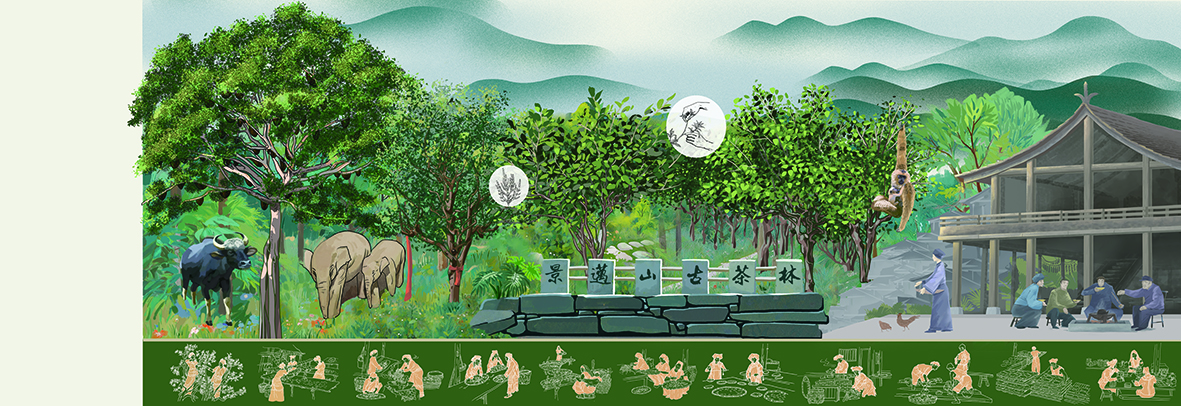
United ethnic relations
Su said that according to legend, the Blang ethnic group migrated to Jingmai Mountain from the southwest of Yunnan around the 10th century, and initially lived off hunting. Later, the wild tea trees saved the people from an epidemic, leading them to recognize and remember the miraculous plant they called "la".Subsequently, the Blang ventured into the vast forest to retrieve wild tea seedlings and seeds, initiating the domestication of wild tea trees. The generational "tea ancestor's legacy" passed down among the Blang people says: "I won't leave you with cattle and horses, fearing they might perish in disasters; I won't leave you with gold and silver treasures, fearing you might exhaust them. Therefore, I will only leave you with tea trees, for your descendants to use endlessly."
In the 14th century, the Dai people arrived at Jingmai Mountain, bringing traditional tea-making techniques that greatly improved storage and long-distance transportation. Since then, Jingmai Mountain tea has been used as both a medicine and a delicacy, becoming an integral part of daily life.
During the Ming (1368-1644) and Qing (1644-1911) dynasties, the tea of Jingmai Mountain was designated as tribute, leading to the gradual expansion of the ancient tea forest planting area and increased production, thereby becoming an important economic source for the various ethnic groups living there. Today, walking down from the ancient tea forests to the mountainside, one arrives at Nuogang ancient dwelling, which preserves the traditional layout and historical appearance of the Dai ethnic villages. Two-story wooden frame houses are built against the mountainside, surrounded by streets and alleys leading to the village center. Nine similar villages are spread across the tea forests, with nearly 5,000 residents and 530 traditional dwellings — 321 of which have been designated as National Priority Protected Buildings. In Jingmai Mountain and the surrounding areas, ethnic groups such as the Blang, Dai, Lahu, Wa and Han live in harmony with each other and with nature. The locals establish village regulations and agreements, loving, inheriting and developing the ancient forests as a part of their lives. For example, when opening up the tea forests in the early days, villagers delineated buffer zones around the periphery. Cutting down tall trees without permission was punishable, fallen leaves served as fertilizer and only 70 percent of the tea leaves were allowed to be picked.
The people of Jingmai Mountain are grateful for the blessings of the land. Village construction adheres to the principle of intensive land use, leaving the best of it for tea trees. At lower altitudes with abundant water sources, farmland is cultivated and modern ecological tea gardens are developed outside the ancient forest. In each protected tea forest area exists a mysterious tree known as the "tea spirit tree" by the Blang people and the "tea god tree" by the Dai people. "When people begin to cultivate new land, the first tea tree planted is considered the tea spirit tree. Each year, if the tree is flourishing, they feel at ease; if the tree falls ill, they hold a ritual," said Xiong Dengkui, a researcher at Lancang County Museum.
Efforts to apply for UNESCO World Cultural Heritage status for the Cultural Landscape of Old Tea Forests of the Jingmai Mountain in Pu'er kicked off in 2010, stimulating protection and management measures that are continually upgraded. With the attention and protection of the government and natural villages, nearly 200 plaques and explanatory signs have been installed in the forest, and a system combining online intelligent monitoring and offline manual monitoring has added new "guardians" to the mountain.
Initially, local residents were unaware of the world heritage application and did not understand what changes the process would bring. Later on, they realized the original ecological methods of tea cultivation and tea plantation management needed better action. Since 2010, around 90,667 hectares of tea plantations in Pu'er city have completed ecological management, and since 2013, local projects have been implemented for the protection and display of village cultural relics, fire prevention and lightning protection and monitoring of the ancient tea plantations.
Wang Gang, mayor of Pu'er, said that the city will continue to enhance its reputation as an "ecological and organic hub", empowering the tea industry with tea culture and tea technology. Moreover, the city will explore the cultural inheritance and historical significance of the ancient Tea Horse Road to tell the good stories of the Chinese tea culture. Research will also be conducted on Pu'er tea gene editing, genetic breeding and variety selection to enhance the competitiveness of the modern tea industry.
By the end of 2023, per capita net income of the villages in Jingmai Mountain exceeded 20,000 yuan ($2,750).
The 45th session of the World Heritage Committee believes that the Cultural Landscape of Old Tea Forests of the Jingmai Mountain in Pu'er meets World Heritage Site standards. This ancient tea forest protection and management system respects local climate conditions, terrain features, and animal and plant populations, achieving the protection of cultural and biological diversity as well as the sustainable use of natural resources. It demonstrates the original traditions of the Blang, Dai and other indigenous people's complementary use of natural resources in the mountainous environment. The villages and traditional residential buildings also reflect the understanding of the ecological environment in terms of site selection, layout and architectural style.




- China unveils flexible urban planning rules to improve lives, foster new industries
- Ex–China Construction Bank executive gets 18 years for bribery, loan violations
- First batch of eco-friendly pioneer zones for construction of beautiful countryside unveiled
- Woodpeckers, finches captured in Jilin winter scenes
- Mainland reiterates 1992 Consensus as foundation for resuming cross-Strait dialogue
- PLA drone training near China's Dongsha island lawful: spokesperson