


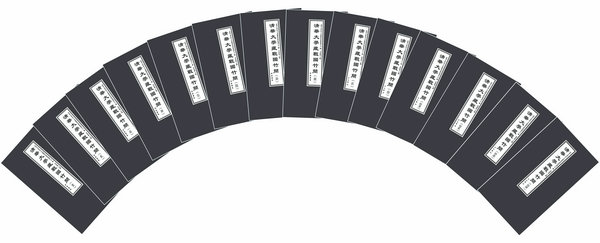
Researchers of the Tsinghua Bamboo Slips announced the latest findings that revealed three newly organized bamboo manuscripts at a recent launch event of the Tsinghua University Warring States Bamboo Manuscripts (Vol IVX) at Tsinghua University.
Previously unknown and never seen before in surviving historical literature, the three bamboo manuscripts record the political thoughts of the early Western Zhou Dynasty (c. 11th century-771 BC), offering important historical insights into the pre-Qin era.
In 2008, Tsinghua University received an alumni donation of nearly 2,500 pieces of bamboo slips, making it the largest-known collection of the Warring States Period (475-221 BC) relics.
The collection, covering a wide range of subjects, including Confucian classics, historical records and philosophical texts, is hailed as one of the most significant archaeological finds in recent decades.
Since 2018, the research team at Tsinghua University has been releasing annual reports on its research, with 13 volumes already published.
The recently released 14th volume contains three bamboo books titled Chenghou, Zhaohou and Liangzhong, all of which are previously unknown texts that were lost to history for centuries.
Researchers have found for the first time in Chenghou and Zhaohou the materials on governance and political thoughts during the reigns of King Cheng and King Zhao in the early Western Zhou Dynasty. Meanwhile, Liangzhong offers the latest-known record of the second king of the Xia Dynasty (c. 21st century-16th century BC), Xia Qi, who reigned as the ruler of "all under Heaven".
Originally, Chenghou, consisting of nine slips, and Zhaohou, seven, were compiled into a single bamboo volume, with each slip measuring about 41 centimeters long and 0.6 cm wide.
Literally, Chenghou and Zhaohou refer to King Cheng and King Zhao of Western Zhou, respectively. Both bamboo books, written in ancient Chinese, discuss early Western Zhou history and the political ideas of kings Cheng and Zhao, identified as important historical literature transcribed in the state of Chu that has been lost for a long time.
Chenghou traces the legacy of ancient sage kings and praises the virtues of the previous kings of the Zhou Dynasty — King Wen, founder of the Zhou Dynasty, and his son King Wu, including King Cheng's governance principles.
Zhaohou recounts King Zhao's reign, where he emulated past kings, cared for his people, reformed governance, respected the power of heaven, constantly reminded and corrected himself, learned from the mistakes of the Xia and Shang dynasties, diligently handled political affairs, and ruled as a virtuous king.
The two manuscripts, although narrated from different perspectives, are related in content, reflecting the governance ideas of the two kings. They corroborate other ancient texts such as the Shangshu (Book of Documents), inscriptions on bronze vessels and bamboo slips and silk manuscripts, offering a better understanding of politics during the reigns of the two kings.
The text of Liangshu is longer, originally consisting of 88 bamboo slips, though one is now missing. Framed as dialogues between Xia Qi and two other figures, Gui Zhong and Xiang Zhong, it delves into the governance and political thoughts of the early Xia Dynasty.
In the dialogue, Xia sought advice on governance, to which Gui Zhong and Xiang Zhong emphasized the importance of balance, virtue and adherence to heavenly laws. Including content such as historical legends in early Xia and ancient political thoughts, the text is of great value for research in these areas.
The entire organization work of the Tsinghua Bamboo Slips will be completed in the next two to three years, according to Huang Dekuan, director of the Research and Conservation Center for Unearthed Texts of Tsinghua University.
Over more than a decade, the preservation, organization and research of the Tsinghua Bamboo Slips have become increasingly difficult as the slips become more fragmented, he says.
For example, the bamboo slips of Liangzhong are rather fragmentary without serial numbers, forcing researcher Jia Lianxiang with the university to spend considerable efforts in restructuring them.
Organizing these bamboo slips is just the first step, Huang says, adding that the center has already begun research into the bamboo manuscripts' deeper meanings and promoting their transmission and application.
Like the previous 13 volumes, the latest volume of the Tsinghua University Warring States Bamboo Manuscripts is also published by Zhongxi Book Company. An indigo thread-bound book in a six-panel format, it weighs more than 2.5 kilograms.
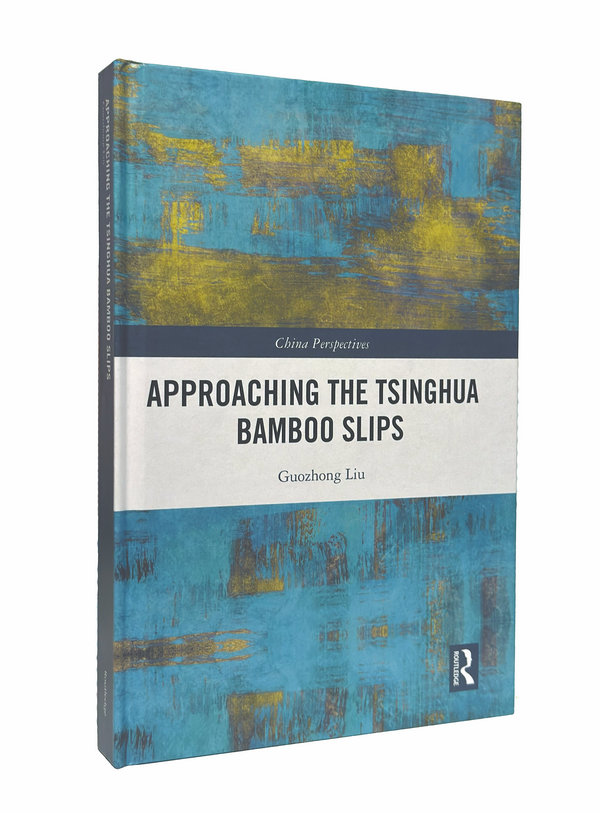
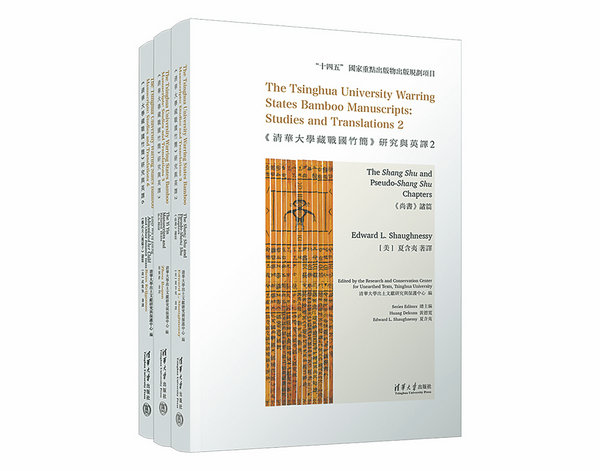
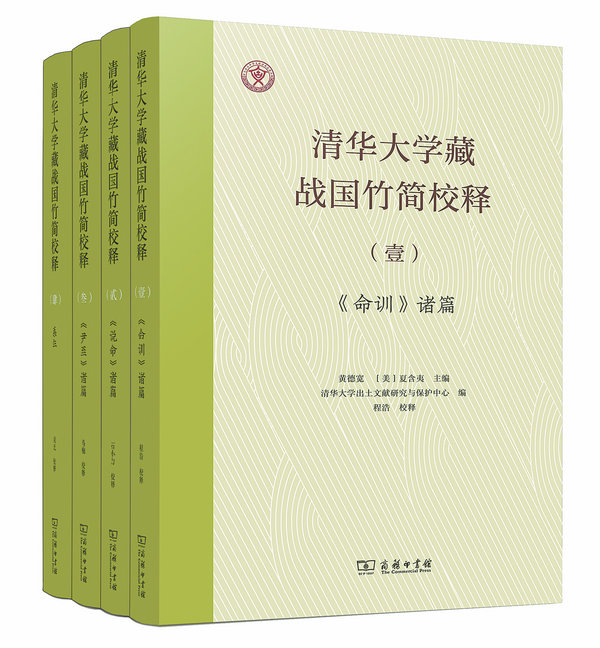
To help the research results reach a wider audience, especially global readers, the research team also launched the first four volumes of Annotations to the Tsinghua University Warring States Bamboo Manuscripts, the second, third and sixth volumes of The Tsinghua University Warring States Bamboo Manuscripts: Studies and Translation and the English translation of Approaching the Tsinghua Bamboo Slips.
Published by Commercial Press, Annotations to the Tsinghua University Warring States Bamboo Manuscripts, containing a total of 18 volumes, covers all the Tsinghua Bamboo Slips that have been organized and published. Based on the latest studies, the book offers a comprehensive revision and annotations to the original text and translates obscure Warring States bamboo manuscripts into clear, modern Chinese.
The series, The Tsinghua University Warring States Bamboo Manuscripts: Studies and Translation, is published by Tsinghua University Press, with a planned total of 18 volumes. Each volume presents the latest research in the field and includes annotations and translations of the bamboo manuscripts. The original Tsinghua bamboo manuscript text, its transcription into clerical script, modern Chinese characters, and the English translation will all be provided.
This series is the result of a collaboration between scholars from around the world. The process involved 30 video conferences and a series of offline workshops to convert the Chu script into modern Chinese characters and then into English, which was a very challenging task.
"Sometimes, even after we complete a report, we haven't fully understood it and there's no choice but to rely on continuous research by future generations," Huang says. "However, when translating into English, you can't avoid the issue — you must have a clear explanation. Therefore, we especially want to express our respect to the team of US Sinologist Edward Louis Shaughnessy."
Xie Weihe, former vice-president of Tsinghua University, says that the books are greatly significant to the evidence of China's over 5,000-year-old civilization and to preserve and promote China's rich traditional culture.
The ongoing publication of the English translation series will help scholars around the world understand and use the Tsinghua bamboo slips. It will also increase the international influence of these and other unearthed Chinese documents, fostering greater exchange and mutual learning between Chinese and global civilizations, he says.








