



An exhausted empire
Without the "safety valve" of sustained outward expansion, political and social decay is accelerating in the US









Samuel Huntington's book The Clash of Civilizations and the Remaking of World Order has retained significant influence. However, it also continues to face criticism for its broad generalizations and controversial assumptions, along with the rising global interconnectedness of economies and cultures that challenge the inevitability of Huntington's vision.
But there is an often overlooked yet critical argument in the work, where Huntington asserts: "The West won the world not by the superiority of its ideas or values or religion … but rather by its superiority in applying organized violence. Westerners often forget this fact; non-Westerners never do." This statement foster a deeper understanding of the historical dynamics of US hegemony.
Huntington's statement emphasizes that Western global dominance in modern world history stems not from any inherent cultural or moral superiority but from its mastery of military technology, strategy and state organization. This proficiency allowed European powers to colonize extensive territories, outmaneuver rival nations and dominate global trade and the distribution of resources. Technological advancements, especially in organized warfare — such as firearms, naval forces and later air power — were pivotal in establishing and sustaining Western hegemony on the global stage.
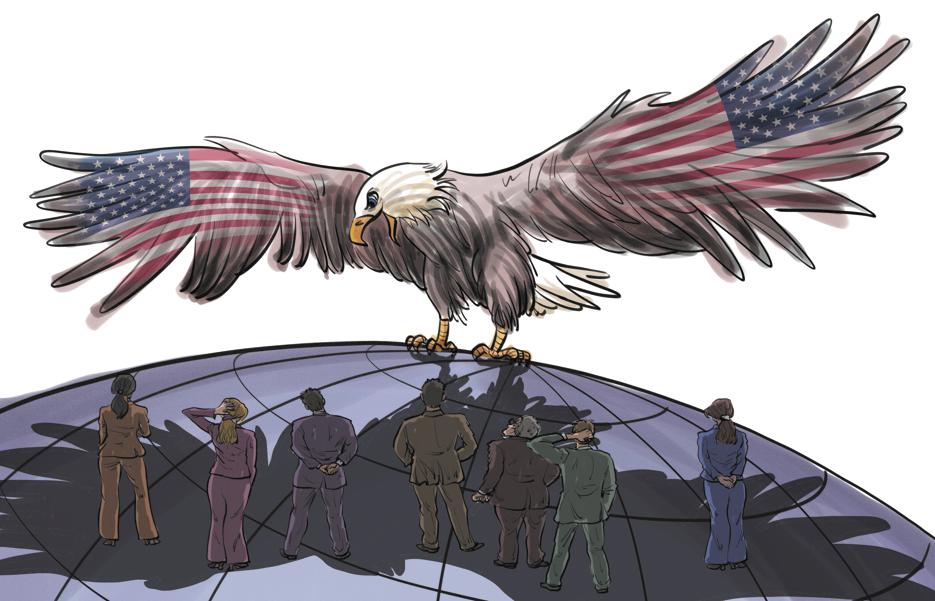
The fact that Western dominance has historically been rooted in organized violence rather than cultural or ideological superiority, undermines claims that universal values such as democracy or human rights are the primary drivers of its global influence. Huntington's assertion explains why global military alliances such as NATO, the "Five Eyes" alliance, the quadrilateral security dialogue (the Quad) among the US, Japan, India and Australia and worldwide military bases, armed interventions in the Ukraine crisis, the Middle East and Afghanistan, as well as ruthless containment of China, are integral to the geopolitical strategy of the United States in the nexus between the "internal and external dimensions of its reliance on organized expansionist violence as its foreign policy tool".
The current international order is designed to uphold the capacity and sustainability of US hegemony across economic, trade and security domains, as well as in cultural leadership, norm-setting and value projection. The architecture of this order was built with an unspoken yet clear underlying objective, explicitly articulated by George Kennan, a US diplomat: "We have 50 percent of the world's wealth but only 6.3 percent of its population ... In this situation, we cannot fail to be the object of envy and resentment. Our real task in the coming period is to devise a pattern of relationships which will permit us to maintain this position of disparity. We should cease to talk about vague and ... unreal objectives such as human rights, the raising of the living standards and democratization. The day is not far off when we are going to have to deal in straight power concepts. The less we are then hampered by idealistic slogans, the better. "
Kennan's candid statement revealed that the strategic objective of US foreign policy during the Cold War was less about engaging in an ideological battle against the "communist threat" and more about embedding a "reward mechanism" within the US-led international "rules-based order". This mechanism aims to preserve the vast economic and political inequalities of the international system and the immense privilege and power this global wealth disparity afforded the US. More importantly, this mechanism requires and perpetuates a reciprocal dynamic: the US has to align its internal social, political, economic and defense systems with the external imperatives of imperial armed expansion, while ensuring that its global strategies reinforce its internal structures of power.
As Greg Grandin, a Pulitzer Prize-winning historian, rightly points out: "One of the things that has made America exceptional — compared to other crisis-prone and class-conflicted countries — is that it has long enjoyed a benefit no other modern nation in the world could claim: the ability to engage in ceaseless, endless movement outward."
Greg's observation accurately captures the essence of the argument that the US' pursuit of endless expansion — whether through militarism or markets — has been instrumental in alleviating domestic tensions and establishing resilient institutions.
Recognizing the inseparable connection between US imperial expansion — military, economic and ideological — and its domestic stability provides key insights into how the US legitimized and sustained its global identity as the embodiment of the "American dream" and "American exceptionalism".
By creating external outlets for economic surplus, fostering ideological cohesion, and promoting social stability and democracy at home, imperial expansion enabled the US to maintain its image as a unique and aspirational global power. This dynamic illustrates a positive connection between outward armed expansion and the preservation of the rewards mechanism, where military intervention and imperial expansion help maintain internal stability and support the broader geopolitical and economic interests of the dominant power.
The rise of Trumpism in 2016 should be seen as signaling the exhaustion of US imperialism. The imperial expansion and interventionist foreign policies that once helped diffuse domestic contradictions had been in retreat since the Iraq War, the Afghanistan War and the financial crisis. Now, the multifaceted challenges posed by the rise of emerging powers and the Global South — such as the BRICS — along with the Ukraine crisis and China's comprehensive rise, have forced a reckoning with domestic social and economic contradictions that were once displaced outward. In other words, the internal-external rewards mechanism — the "safety valve" of empire — has been exhausted. This inability to project and sustain outward expansion has exacerbated domestic crises, deteriorating systemic inequalities and political decay.
If the victory of Donald Trump in 2016 symbolized the emerging decline of US imperial overstretch and its impact on domestic politics, the question arises: Will his return to the White House represent a deeper structural crisis linked to the weakening of the US' ability to project power and channel domestic conflicts outward through expansion, resulting in a more inward-looking America-firstism?
The new Trump administration is expected to reshape US foreign policy, resulting in the intensification of great power rivalry, the waning influence of neoliberal economics, and the retreat from neoconservative militarism. This transformation may be marked by a pendulum swing between two competing approaches: a revival of internationalism and exceptionalism on the one hand, and a resurgence of nationalist and authoritarian tendencies on the other. Furthermore, it is argued that the US under Trump represents, among other things, a renewed critical rethinking that imperial "organized violence" alone will not ensure continued American dominance.
In this new context, the US' allies in Europe and Asia must prepare for a shifting international order, one where hegemonic superiority in outward organized violence no longer serves as the foundation of dominance.

The author is a Yunshan leading scholar and a distinguished professor at Guangdong University of Foreign Studies, and an adjunct professor of international relations at Aalborg University, Denmark. The author contributed this article to China Watch, a think tank powered by China Daily. The views do not necessarily reflect those of China Daily.
Contact the editor at editor@chinawatch.cn.





