Solidarity can steady the ship










Last year was one of turmoil and uncertainty, and the international community must act collectively to foster greater global stability
Reflecting on the turbulences and upheavals in global politics last year, it is evident that 2024 was a year of profound significance in shaping and transforming the trajectory of international development. The numerous events of the year signal that the global community is navigating an era of heightened uncertainty and transition.
On Nov 5, Donald Trump was elected the 47th president of the United States. The advent of Trump's new term marks the return of a country driven by interests-centered unilateralism, protectionism and populism. Since the dissolution of the Soviet Union in December 1991 and the end of the Cold War, successive US administrations have espoused policies of liberal internationalism, emphasizing the primacy of US-led international rules and a "rules-based order" as central to its national strategy.
However, Trump's campaign rhetoric, in which he repeatedly threatened to launch trade wars and signaled intentions to withdraw from global governance mechanisms such as the World Health Organization and the Paris Agreement, has raised widespread concerns that a Trump-led White House not only seeks to "reshuffle "international rules based on hegemonic power and self-serving interests but also poses a renewed challenge to multilateralism and global governance systems.
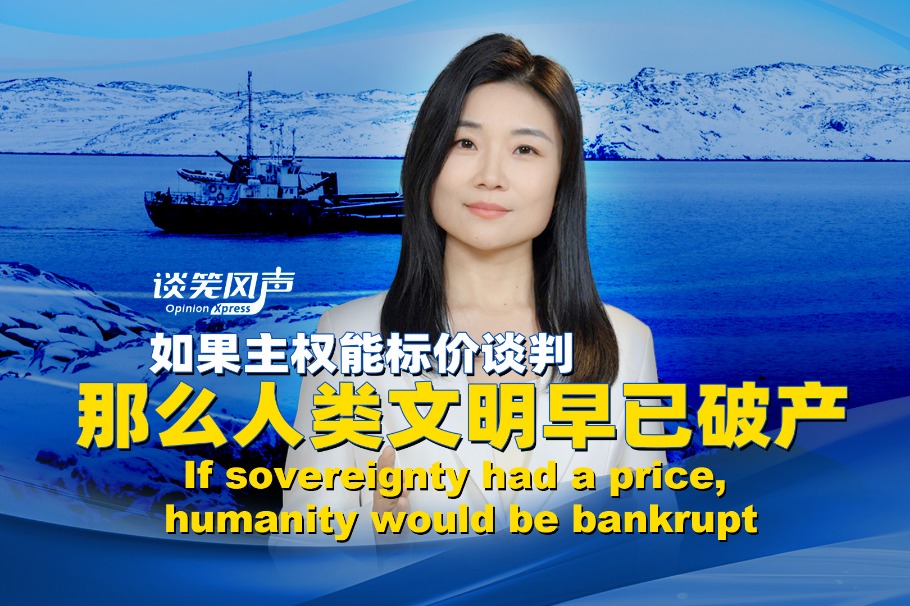
What has become even more concerning are Trump's two proposed geopolitical expansionist ambitions. One involves controlling Greenland, an autonomous territory of Denmark, and the other seeks to exert control over the Panama Canal. He even dramatically suggested that if the economy of Canada continues to falter, the nation should consider becoming the 51st state of the US. Greenland, located at a pivotal position along Arctic shipping routes, is gaining strategic importance as global warming enhances its accessibility. Moreover, Greenland is home to significant reserves of strategic minerals, including rare earth elements. Should the US aggressively pursue control over Greenland, it would signal a return to imperialist expansionism in the 21st century. While the likelihood of a US military occupation of Greenland is slim, attempts to pressure Denmark politically and economically to sell the island would present a catastrophic challenge to global geopolitical stability.
Throughout 2024, the world also witnessed the unrelenting continuation of the Ukraine crisis. Casualties among soldiers and innocent civilians continued to climb amid the relentless military operations. Ukraine's spring offensive in April saw Ukrainian forces penetrate Russian territory, a new development that captured global attention. However, by the year's end, the tide had decisively turned against Ukraine. Ukrainian incursions into Russian territory had been decisively thwarted, and Russian advances within Ukraine's borders expanded significantly, enlarging the occupied territories in eastern Ukraine. The battlefield dynamics have become increasingly unfavorable for Ukraine. Although Trump has expressed intentions to initiate dialogue with Russia upon assuming office and pursue a ceasefire agreement accommodating various interests, Russian Foreign Minister Sergey Lavrov insisted that the US must take the first step toward resuming dialogue and respect Russia's legitimate interests.
Regarding the crisis in Ukraine, Lavrov emphasized that Russia seeks not merely a ceasefire but a lasting peace. As 2024 has drawn to a close, the conflict showed no signs of de-escalation. As the Joe Biden administration authorizing Ukraine to use US-provided medium- and long-range missiles against Russian targets, the move risks escalating hostilities to catastrophic levels. The dispatch of troops by the Democratic People's Republic of Korea to assist Russian military operations in Ukraine, as part of its comprehensive security cooperation agreement with Russia, has further internationalized the conflict. As the world has stepped into 2025, questions remain about whether the Ukraine crisis will move toward dialogue and ceasefire or spiral into broader military confrontation. In a bid to secure leverage in future negotiations, it is possible that the conflict could witness a dangerous escalation.
The Middle East experienced unprecedented transformations in 2024, marking the most disruptive developments in the region since the end of the Cold War. The Israeli government under Benjamin Netanyahu has repeatedly ignored United Nations General Assembly resolutions demanding a halt to military offensives in Gaza. In July, Israel's sustained attacks on Palestinian residential areas in Gaza destroyed critical healthcare infrastructure, leaving civilians without medical facilities. Meanwhile, Israel's retaliatory strikes on Iran, coupled with continued offensives against Hezbollah in Lebanon and Houthi forces in Yemen, have further deepened the turmoil that began on Oct 7, 2023. The Israel-Palestine conflict has now spread beyond Gaza to neighboring regions. In mid-November, Syria witnessed the overthrow of the Assad regime after 12 days of attacks on Damascus by the nation's opposition forces. Forced into exile in Russia, former president Bashar al-Assad left behind a fractured country now governed by an interim administration led by Abu Mohammed al-Jolani. The collapse of the Assad regime has severed the "Iran-Syria resistance axis", a key "Shiite linkage" that has contained Israel for the past three decades. The new Syrian government has garnered support from the US, Turkiye and Israel, and Russia's naval base and military presence in Syria now face significant vulnerabilities. At the beginning of this year, the new administration in Syria has proposed domestic dialogues to rebuild political structures through elections. However, questions loom over whether post-Assad Syria will resemble Afghanistan, which is governed by the Taliban, or the fragile coalition governance of Iraq. The trajectory of Syria's political future will undoubtedly influence the broader reorganization of the Middle Eastern geopolitical landscape.
Global instability in 2024 extended beyond the Ukraine crisis and the Israel-Palestine conflict. Myanmar and South Sudan continued to grapple with severe domestic conflicts. In Somalia, Al-Shabaab's insurgency prompted the African Union to deploy a stabilization mission. Meanwhile, countries such as Bangladesh and Georgia experienced waves of public protests. On Dec 27, the UN Security Council approved an African Union-led task force to combat Al-Shabaab, set to be deployed in January 2025. Additionally, political unrest in Ethiopia and other nations underscores the fragility of governance across parts of Africa in 2025. There remain uncertainties over whether the Global South can maintain political stability and achieve sustained economic growth.
However, despite all the transformations and turbulences in the global landscape, fostering mutual respect, equal cooperation and joint actions among countries remain an essential principle for the international community to sustain an open, inclusive and mutually beneficial global system rooted in genuine multilateralism.
President Xi Jinping has emphasized the traditional Chinese cultural value of "sharing weal and woe together like passengers in the same boat" to confront challenges and threats. In today's interconnected world, this philosophy extends to the spirit of "shared responsibility as residents of the same planet" for various countries and their people. Looking ahead to the rest of this year, the international community must act collectively, inspired by this spirit of global solidarity, to overcome difficulties and build a brighter future.
The author is dean of the School of International Studies at Nanjing University. The author contributed this article to China Watch, a think tank powered by China Daily. The views do not necessarily reflect those of China Daily.
Contact the editor at editor@chinawatch.cn.