



China to help spur innovation of NEVs
New policies aim to boost tech advances of automotive sector









China is expected to push the high-quality development of its leading new energy vehicle sector with a slew of policies ranging from electrifying bus fleets to drafting battery swapping standards, according to a senior official.
Zhang Yunming, vice-minister of industry and information technology, said on Tuesday that the ministry will take targeted measures to boost the growth of the sector, which has made remarkable progress over the past decade.
He said the authorities will implement national research and development plans to accelerate breakthroughs in key technologies such as new battery systems.
Also, policies like vehicle trade-ins and tax exemptions for NEVs will be promoted to boost consumption. Such policies have worked to spur vehicle sales over past years, said the China Association of Automobile Manufacturers.
Zhang said the Ministry of Industry and Information Technology will release guidelines to promote battery swap models.
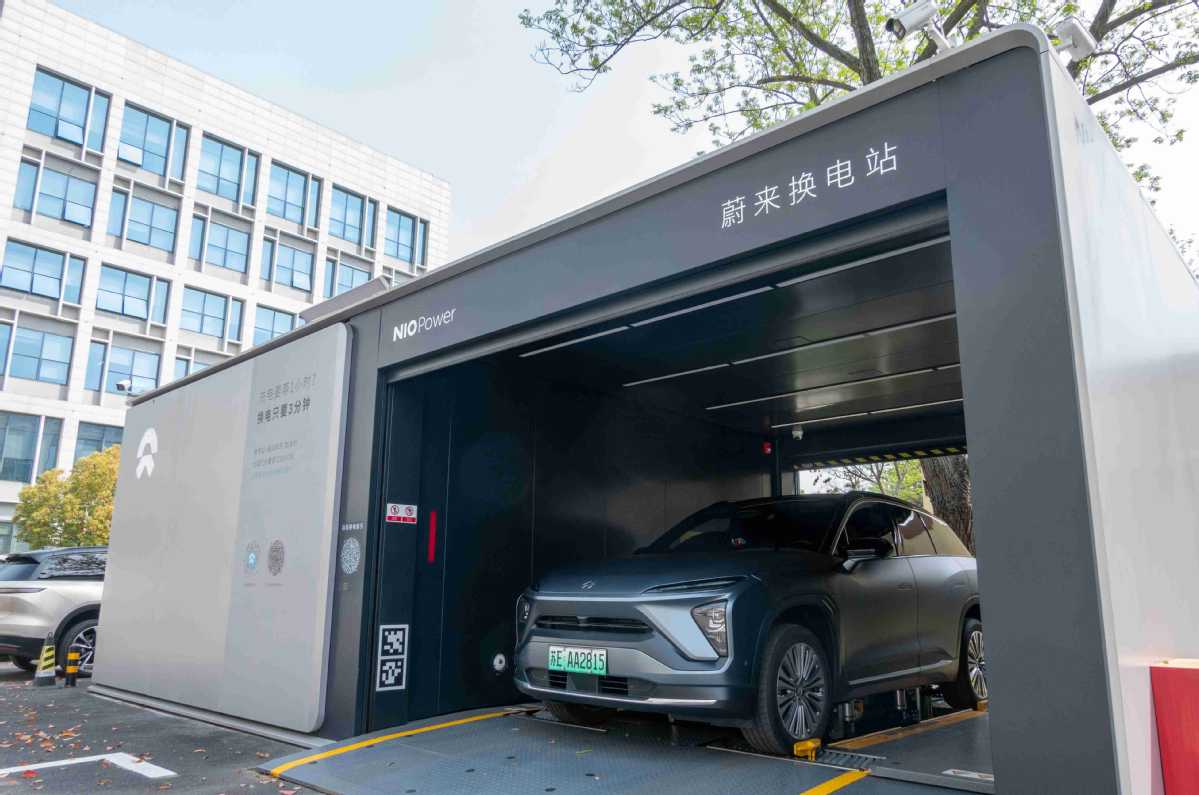
Chinese NEV startup Nio has been an advocate of battery swap technology. It has built a network of more than 3,000 battery swap stations in the country, which enable vehicles to get a fully charged battery pack within minutes.
This convenience has wooed a number of carmakers including Geely, Changan and Chery.
Nio CEO William Li confirmed that Chery and Nio are jointly developing a new battery swap model, which is currently undergoing winter testing and is expected to hit the market this year.
Another major player in the battery swap ecosystem is CATL, the world's leading battery manufacturer.
In late 2024, CATL announced partnerships with several automakers, including Changan, GAC, BAIC, Wuling and FAW, to launch 10 battery swap models by the end of 2025.
CATL has developed two standardized swappable battery packs, available in both lithium iron phosphate and ternary lithium versions, with ranges between 400 and 600 kilometers.
The battery maker plans to build 1,000 new swapping stations this year, with a midterm goal of establishing 10,000 stations in collaboration with partners.
Another move is to expand pilot programs for full electrification in public transport, said Zhang.
Luca de Meo, CEO of French automaker Renault, praised China's efforts in electrifying fleets.
In an interview earlier this month, he said that European fleets lag behind in electric vehicle adoption due to the absence of regulatory mandates.
"Nobody demands fleets to have a certain EV mix in Europe. Nobody. The mix of EV in fleet is actually lower than retail sales in Europe, but you know the fleet is 50 percent of the market," said de Meo.
"If you don't force companies to achieve at least a certain percentage of EV (in fleets), you will never make the big number," he said.
Also, Zhang said the "dual-credit" policy will be optimized, and efforts will be made to standardize carbon footprint calculations for vehicles and batteries, aiming for international recognition.
The dual-credit policy, put in place in 2018, is a market-based regulatory mechanism to promote NEV development and improve fuel efficiency in the automotive industry.
It includes Corporate Average Fuel Consumption Credits, which are designed to regulate the average fuel consumption of vehicles produced by automakers.
Companies are required to meet specific fuel efficiency targets for their fleets. If a company's actual fuel consumption exceeds the target, it generates negative credits.
But these credits can be offset by NEV credits, which are awarded to automakers based on the number and type of NEVs they produce and sell.
Under the policy, companies that excel in NEV production or fuel efficiency can earn and sell excess credits, generating additional revenue. Companies that fail to meet the requirements must purchase credits, which can be costly.
Zhang said the MIIT will encourage industry consolidation and regulate market competition to create a healthier industrial environment.
China has been the home to the world's largest NEV segment since it surpassed the United States in 2015.
China's NEV sales reached 1.29 million units in 2024, representing 40.9 percent of the total vehicle sales in the country and more than 60 percent of the global NEV market, respectively.
Also, NEVs made in China are now exported to more than 70 countries and regions across the world. Some carmakers, including Renault, are developing EVs in China for overseas markets.
Zhang highlighted significant advancements in product performance, with average driving ranges now approaching 500 kilometers per charge.
Innovations in intelligent driving assistance and human-machine interaction have made driving more comfortable and enjoyable.
Such features, which were reserved for vehicles priced more than 300,000 yuan ($41,200), are expected to be available in vehicles priced from 100,000 to 200,000 yuan this year, according to the China EV 100, a Beijing-based industry think tank.
Technologies — such as active suspension — once reserved for high-end vehicles are also becoming more widely available.
Zhang said the country has also established a comprehensive industrial chain covering basic materials, components, vehicle manufacturing and equipment production.
China supplies 70 percent of the world's battery materials and 60 percent of its power batteries.
In terms of infrastructure, China has built the world's largest charging network, with 12.82 million charging piles and 4,443 battery swap stations by the end of 2024.
Fast-charging technology that can recharge up to 80 percent in 15 minutes has also been commercialized, he said.




















