How's China's youngest scientific research station in Antarctica after one year of operation









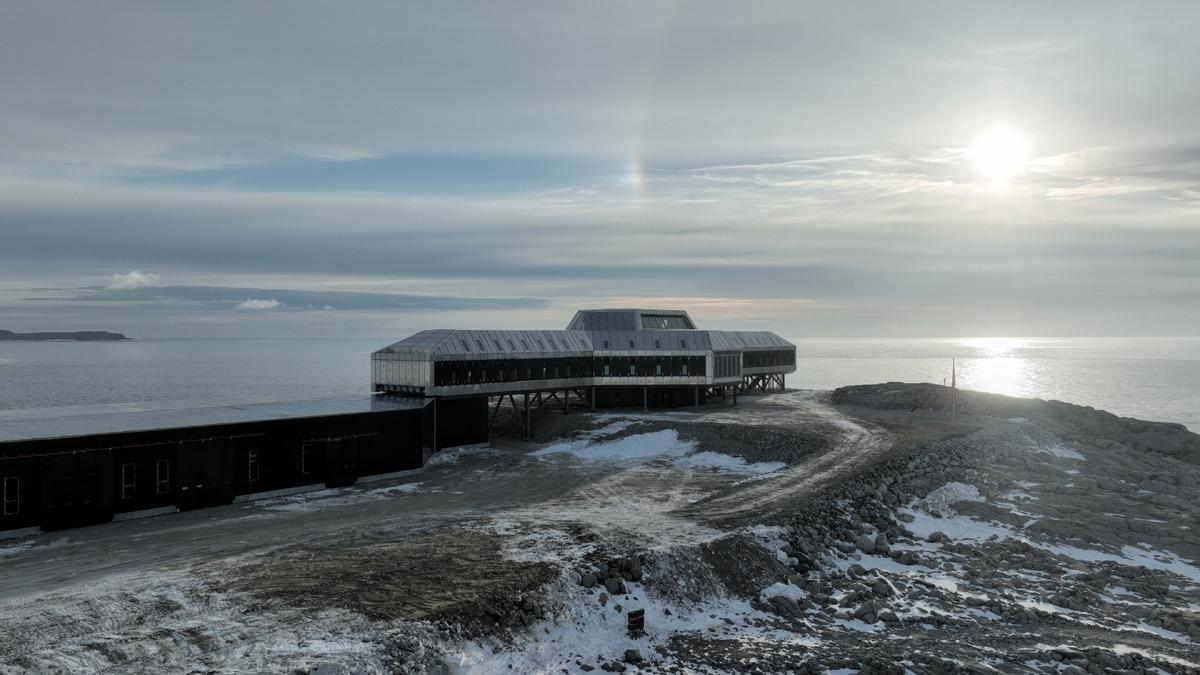
BEIJING -- As China's Qinling Station, the youngest of the country's five scientific research stations in the Antarctic, marked its first anniversary of operation on Friday, scientists are celebrating that it has proven itself as a resilient scientific hub in one of Earth's most extreme environments.
Nestled on the Inexpressible Island in the Ross Sea, the station has survived the Antarctic's brutal climate and delivered cutting-edge innovations in green energy, water sustainability and polar architecture.
Its main building covers an area of 5,120 square meters, making it the largest single structure among China's existing research stations, capable of accommodating 80 researchers in summer and 30 researchers in winter.
Since its inauguration on Feb 7 last year, the station has entered a critical phase of infrastructure development. China Media Group (CMG) reported that China's 41st Antarctic expedition team has unloaded a 5,960-tonne shipment of supplies, including construction materials and scientific equipment, providing a solid foundation for the construction of the station's supporting facilities.
GREEN ENERGY
By the anniversary date, key systems such as wind turbines, solar panels, hydrogen energy units, communication platforms, and seawater pumping stations were fully assembled.
"We've installed 10 wind turbines so far and are currently setting up photovoltaic supports and panels," Wang Zhechao, head of China's 41st Antarctic expedition team and the Qinling Station in Antarctic, was quoted by CMG as saying.
The station's hybrid energy system, the first of its kind on the continent, combines wind, solar, hydrogen, and diesel power. Compared to traditional diesel-dependent bases, it has greatly reduced carbon emissions.
Notably, its hydrogen energy setup, now fully installed, can provide 30 KW of uninterrupted power for 14 days during polar nights. It marks China's pioneering step in clean energy adoption on the icy continent, Wang Bin, a member of the expedition team, said in the CMG report.
Next, the expedition team will focus on constructing indoor supporting equipment and research facilities at the station.
WATER FROM THE SEA
Another area of innovation is the water supply at the Qinling Station. Without natural freshwater sources, the station relies entirely on desalinated seawater for living and research purposes.
The station's water intake and supporting power systems have already been installed. The overall projects for seawater heating, pretreatment, water purification, and disinfection systems are approximately 80 percent complete, Shao Tianbao, lead engineer of the desalination project, told CMG.
"We estimate that about 35 days of work remains to complete the installation and commissioning of the entire system," said Shao.
Two desalination systems are on-site, one as a backup and the other in regular operation. Each can produce 20 tonnes of fresh water every 10 hours. Combined with storage containers, this setup can provide an adequate freshwater supply.
"There is no need to worry about the quality of drinking water. The treated water meets stringent drinking standards and is safe to drink," said Shao.
RESILIENCE AGAINST NATURE'S WRATH
The Ross Sea region, notorious for its strong downslope winds and extremely low temperatures plunging below minus 40 degrees Celsius, poses relentless challenges. Yet, the station's elevated, aerodynamic design, aligned with wind patterns to minimize snow buildup, has withstood the test.
"After a full year of extreme conditions, the structure remains intact, and its safety has been proven," said the station's chief designer, Duan Meng, in the same CMG report.
However, the real trial lies ahead.
"The upcoming challenge will primarily be during the wintering period, as our station becomes fully operational, leading to greater discrepancies in internal and external environmental conditions, including temperature, air tightness, and noise levels," explained Duan, adding that his team is collecting data to optimize the station's performance during prolonged isolation in the pitch-dark polar winter.
Duan said that after another full year of operational assessment, the accompanying construction work at the station is expected to be fully completed.
Once finished, he said the station will serve as a pivotal scientific platform for international scientists and researchers in the Ross Sea region, playing an essential role in addressing global climate change research initiatives.
Before the Qinling Station, China established four research bases in Antarctica over the past nearly 40 years -- the Great Wall Station, the Zhongshan Station, the Kunlun Station and the Taishan Station. The Great Wall Station was the first to be built in February 1985.
China's 41st Antarctic expedition team set sail on Nov 1, 2024, starting a mission expected to last nearly seven months. During the period, researchers will build the supporting infrastructure for the Qinling Station, investigate the impact of climate change on the Antarctic ecosystem, and conduct international research and logistics cooperation.




- Over 7.3 million people recorded as registered organ donation volunteers in China
- China says Nipah outbreak poses limited risk
- PLA's aerobatic jets arrive in Singapore to take part in air show
- China's garbage sorting drive still has a long way to go in many cities
- Former Chengdu official Bao Hui under investigation
- Bouncy fish ball captures the attention of Guangdong deputies