


Shipwreck highlights Hong Kong's key role in maritime trade










HONG KONG — In a ship-themed exhibition hall in Hong Kong, artifacts from the Song Dynasty (960-1279) laid out in glass cases tell the story of the ancient merchant ship Nanhai I.
The exhibition Launch From Greater Bay Area: Nanhai I Shipwreck & the Maritime Silk Road, co-organized by the Development Bureau of the Hong Kong Special Administrative Region government, the National Cultural Heritage Administration, and the Office of the Secretary for Social Affairs and Culture of the Government of the Macao Special Administrative Region, opened at the Hong Kong Heritage Discovery Center in the Tsim Sha Tsui district on Aug 16 last year.
By the end of December, it had attracted over 50,000 visitors from China and abroad.
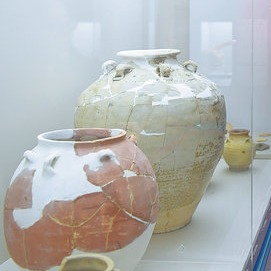
The Nanhai I is the most complete ancient Chinese merchant ship discovered to date. Since it was salvaged in 2007, over 180,000 artifacts have been retrieved. Among the 255 exhibits were Kwangtung jars, mainly used for holding wine. They became the highlight of the exhibition, as they reveal Hong Kong's role in the historical development of the Maritime Silk Road since the Song era.
After extensive research, Lee Hiu Wai, the assistant curator at the Hong Kong Heritage Discovery Center, found that wine-related inscriptions on shards unearthed at the Sacred Hill site in Sung Wong Toi in the Kowloon district were similar to the ones on the jars aboard the Nanhai I.
"It's really exciting to see the similarities. They are related," Lee says, adding that it indicated Hong Kong was once a transit point on the Maritime Silk Road and participated in trade along its length.
Mainly produced in southern China, Kwangtung jars have been used in maritime trade since the Tang (618-907) and Song dynasties, and have been found in Southeast Asia, East Asia and Africa.
According to the exhibition guide, a trade system centered on Guangzhou Port (the city being the capital of Guangdong province), which used Hong Kong and Macao as transfer stations, gradually took shape during the Qin Dynasty (221-206 BC) and Han Dynasty (206 BC-AD 220).
The exhibition provides new perspectives on the history of Chinese maritime trade, and allows visitors to learn about the shared heritage and cultural connections between Guangdong, Hong Kong and Macao, Bernadette Linn, secretary for Development of the HKSAR government, said at the opening ceremony.
The exhibition was free to the public. Visitors showed particular interest in the intricate process and challenges involved in salvaging the Nanhai I a decade ago.
Artifacts found include porcelain, copper and ironware, gold and silverware, and lacquerware.
"The assistance of our mainland partner was very helpful," Lee says. The Nanyue King Museum in Guangzhou, which had previously held an exhibition on the Nanhai I, provided valuable suggestions to the Hong Kong curatorial team.
"Big jars are too heavy, but I can hold the small pottery shards in my hand," Lee smiles and spreads her palm when talking about the transportation process. "It's like holding a part of history."
Lee has been engaged in the preservation of artifacts since graduating with a degree in archaeology. She says on-site visits help cultivate an interest in archaeology and history, especially among the young.
In addition to detailed textual descriptions, the curators also mocked up several sailor logbooks that would have been used to tally supplies, in a bid to bring the past to life.
An interactive multimedia device revealed the timeline of the shipwreck. According to archaeologists, the Nanhai I probably sank in the waterway from Guangdong to the South China Sea around the 10th year of the Chunxi period (1183) of the Southern Song Dynasty (1127-1279).
Lee says that in exploring the past, one can understand the present. Through the exhibition, which ended on Wednesday, she hoped to re-create the history of the Greater Bay Area and shine a light on the courage of those who explored the ocean almost 1,000 years ago.