Chunyun: Tradition on the fast track
Management, transformation of Spring Festival travel rush a microcosm of China's modernization efforts










Editor's Note: China Daily presents a comprehensive series of articles that meticulously dissect Chinese governance across various domains such as politics, society and livelihood. These stories will thoroughly explain the essence of Chinese governance, the rationale behind its unique characteristics and its remarkable adaptability to China's specific national circumstances. The first article will delve into the cultural heritage, historical practices, contemporary evolution and societal implications of the Spring Festival travel rush, which is considered to be the "world's largest annual human migration".
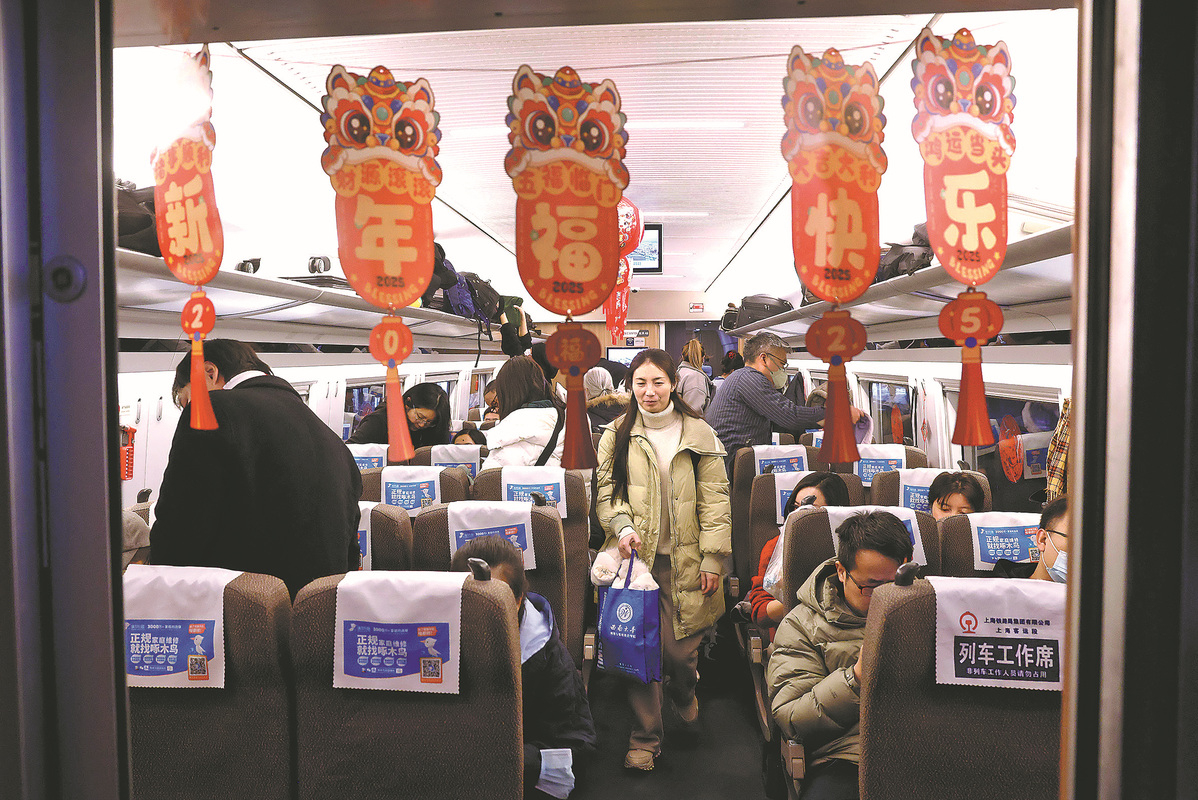
Every year, as Spring Festival approaches, China embarks on the largest annual human migration on Earth — chunyun, or the Spring Festival travel rush.
During the travel rush each year, millions of people, from migrant workers to white-collar professionals and students, head to their hometowns to reunite with loved ones, upholding a tradition deeply rooted in Chinese culture. This year's 40-day travel rush, which began on Jan 14 and will conclude on Saturday, is expected to facilitate a staggering 9 billion trips.
The sheer scale of the annual movement not only challenges transportation networks, but also reflects the evolving socioeconomic landscape of the country. At the same time, the transformation and management of chunyun is a microcosm of China's rapid development and its unique path to modernization.
'We must be home'
For many Chinese people, Spring Festival represents the most important holiday of the year, as it's generally the only time most go back home to spend time with their families. It's a difficult time to travel, with so many people hitting the roads in their cars and others striving to secure seats on trains and planes at once, but many say the hassle is worthwhile.
Wu Jianwei, a 39-year-old migrant worker in Beijing, exemplifies this need. His train was scheduled to depart from Beijing Chaoyang Railway Station at 12:30 pm on Jan 14, the first day of the travel rush, but he left home at 7 am to ensure he arrived early.
This year's Spring Festival fell on Jan 29, and the holiday lasted from Jan 28 to Feb 4. The travel rush usually starts 15 days ahead of the festival and lasts 25 days afterward.
"I was afraid of morning traffic," Wu said. Taking a high-speed train, he could reach Ningcheng county in the Inner Mongolia autonomous region, his hometown, in just over two hours — a journey that once took over 10 hours.
"The bullet train made a huge difference," he said. "In the past, I wouldn't have dared to dream of such speed. Now, I can leave at noon and have dinner at home the same day."
If he hadn't secured a train ticket on the 12306 booking platform, he would have had to endure a 7-to-8-hour bus ride instead.
"The trip is tiring, but when I think about seeing my two children and having a reunion dinner at home, it's all worth it," he said.
For Wang Qiuxia, a native of Jining, Shandong province, who works in Chongqing, the journey was even longer. Wang and her husband spent 17 hours driving home before the festival and nearly 20 hours returning to work.
"It's worth it," she said. "Spring Festival is the most important reunion — we must be home."
A Beijing resident surnamed Zhang took to the skies with his family, departing from Beijing Capital International Airport on Jan 27 to Chongqing. He specifically booked a flight on the domestically developed C919 jet for the experience.
"It was our first time flying on the C919," he said.
While his family was alternating between traveling and hosting their parents in Beijing, one thing remained unchanged: "The most important thing is that the family is together during Spring Festival."
Despite their differing modes of transport and destinations, Wu, Wang and Zhang were all heading to the same place — home — and for the same reason — reunion.
The tradition of family reunion during Spring Festival is an integral part of Chinese culture, making it an occasion that cannot be missed.
"Chunyun is a unique cultural spectacle of modern society, fully demonstrating the immense emotional power of Spring Festival," said Xiao Fang in a commentary article, a sociology professor at Beijing Normal University.
"Returning to hometowns and families during this time provides emotional nourishment through reunions and celebrations for Spring Festival for Chinese people, while also allowing us to reflect on the progress of both our families and the nation," he said. "The deep-rooted sentiment of home and country embedded in this tradition plays a crucial role in fostering social stability and harmony."
This emotional and cultural significance is mirrored in the logistical marvel that chunyun represents. Xie Yurong, a researcher from the Academy of Macroeconomic Research (AMR), highlighted the unique aspects of China's Spring Festival migration.
"Mass holiday travel and traffic jams exist in many countries, such as Japan's New Year and Christmas in the West, but China's chunyun is truly unique," she said.
"First, China's massive population results in an unparalleled surge in travel over a short period. Second, China's rapid urbanization has led to large-scale labor migration, with millions longing to return home during the festival, creating an unprecedented short-term surge in movement — a phenomenon not seen in other populous nations," she said.
Ji Jialun, a distinguished professor from Beijing Jiaotong University, said the uneven distribution of population and resources historically led to huge movements of people during a very short period of time in China.
"China had a large population with an uneven distribution and had witnessed large-scale population movements under national policies," he said. "As early as the 1950s, many people were dispatched to the southwest and northwest regions to support frontier development and large-scale construction projects. Later, campaigns such as those encouraging urban youth to go to rural areas also led to significant population movements.
"In the 1980s, with economic development, more rural residents migrated to cities for work, mainly from inland areas to more economically developed regions such as the capital city Beijing and the Pearl River and Yangtze River Delta regions, including Guangzhou, Shenzhen, Shanghai and Hangzhou," he added.
Additionally, by the late 1990s, the expansion of higher education enrollment had significantly increased the number of university students.
During Spring Festival, all these groups, whether working or studying in other cities, would return to their hometowns, creating immense pressure on transportation systems, Ji said.
The uneven distribution of resources further exacerbated the situation. From the fourth quarter of each year until Spring Festival, which also coincided with the peak period for coal transportation, the overlap of freight and passenger transport had placed tremendous strain on the transportation system.