



MSC mirrors EU's diversified diplomacy needs









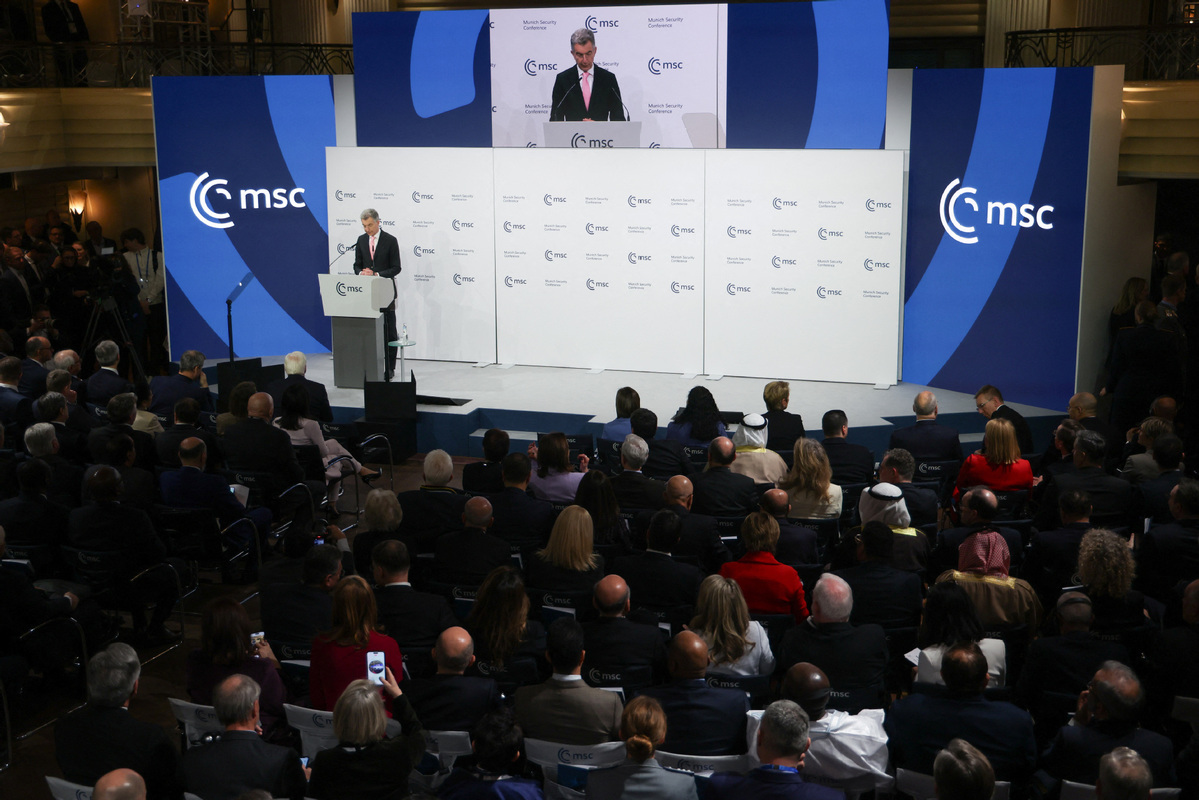
I arrived early at the conference hall of Hotel Bayerischer Hof on Feb 14 to attend the three-day 61st Munich Security Conference, but the 200 seats had mostly been taken and I found a seat at the back of the hall.
The MSC Chairman Christoph Heusgen, who declared the conference open, praised the expanding range of issues and the growing diversity of participants at the conference. Talking about the Ukraine crisis, he emphasized the MSC's goal of peacefully resolving conflicts, saying that the pursuit of peace through dialogue should be based on the rule of law, not the rule of strength. Earlier, on Feb 10, the MSC Report, insightful as ever, used data and graphs to illustrate humankind's transition toward a multipolar world.
MSC report warns of risks of chaos
The report said "the opportunities for more inclusive global governance and greater constraints on Washington, (has been) long seen as too dominant a power by many". It also warned of the risks of chaos and internal divisions, which could lead to disorder, intensified competition, and even a new arms race, both nuclear and conventional.
While the opening session appeared calm on the surface, US Secretary of Defense Pete Hegseth's speech two days earlier (on Feb 12) at NATO created a stir. Hegseth proposed a solution to the Ukraine crisis, excluding the need to consider the 2014 border line and Ukraine's NATO membership.
He also suggested a post-war non-NATO peacekeeping force from the Europe, and urged European countries to take the responsibility for continental defense by increasing defense spending to 2-5 percent of GDP. European participants were already expressing shock over the dramatic shift in the US policy when I arrived at the venue.
The first speeches at the conference were delivered by European Union leaders. The German president, the Bavarian governor and the European Commission president all emphasized the importance of maintaining strong transatlantic relationship. They responded to the US' call for increased defense spending by saying they are considering legislative measures to that effect.
This year's conference was attended by more than 50 heads of state or government, about 150 ministers, and leaders of major international organizations from more than 110 countries — and over 350 forums and side events were held during the conference.
Vance's speech reflects US-EU divides
US Vice-President J.D. Vance's speech was scheduled at 2:30 pm on Feb 14. Arriving five minutes late, Vance started with some pleasantries. But soon he shocked the audience by lecturing about democratic values, citing cases concerning freedom of speech and other matters in some EU countries. He did not address issues like the transatlantic relations or the Ukraine crisis.
Vance criticized EU governments of being afraid about public opinion, blocking opposition parties, and straying from the shared values that the US upholds. He urged the EU to bolster its defense capabilities and address the immigrant issues.
His speech shocked the European audience. Over the next two days, the MSC agenda was more or less reshaped, with the focus shifting to the crisis in transatlantic relations.
There was a time when people in Europe were losing interest in transatlantic ties; there was even talk of "Westlessness". Washington, which was becoming increasingly anxious about "China's rise", became worried about the drifting away of its European allies. The former Joe Biden administration made it a priority to restore and rebuild the transatlantic relationship. Former US secretary of state Antony Blinken even said, "we have to start by approaching China from a position of strength, not weakness..." After the Russia-Ukraine conflict broke out, the US leveraged the Europe's fear of Russia to strengthen the transatlantic bonds.
But while Europe was wholeheartedly supporting Ukraine, although Ukraine failed to gain an upper hand in the conflict, the US abruptly, and without consulting its allies, floated a ceasefire proposal, saying the post-war responsibilities should be shouldered by the Europe alone.
European analysts have tried to dissect Vance's speech. Some say that it was more about US domestic politics than addressing the audience. Others suggest that US President Donald Trump, still nursing his grievances from what he perceived as European humiliation during his first term, is seeking retribution. Another theory posits that Trump wants to end the Ukraine conflict, and the Europe's reluctance pushed him to bypass their concerns. Some even said the US is no longer the uncontested leader of the "free world" and this is "the end of an era".
It may be observed that the biggest challenge to Trump's ambition to "Make America Great Again" is probably the US' economic reality. The US national debt has surged to a staggering $36 trillion, or 124 percent of its GDP. Deindustrialization is difficult to reverse and infrastructure is aging and rebuilding is difficult, with the resurging inflationary pressure increasing the burden.
Perhaps Trump can see better than others the economic strains and feels an urgent need to address the challenge. The administration's priority is clear: reducing expenditure and creating new channels of revenue. According to the latest data, the US accounts for 68 percent of NATO's $1.47 trillion annual budget, and by the end of 2024, US Congress had approved $175 billion in aid to Ukraine. Trump is unwilling to keep shouldering these financial burdens.
However, reducing Vance's speech to mere economic calculations would be an oversimplification, because it also highlights a growing ideological rift between the US and Europe. The Republican Party sees its election victory as a mandate of the people — a rejection of entrenched liberal ideologies and a backlash against the neglect of public grievances.
What are options before Europe?
Europeans, accustomed to being in the warm arms of the US, initially reacted with dismay, even anger. Some European officials condemned Vance for his criticism of European systems and policies, and reaffirmed support to Ukraine, warning that without their commitment, long-term peace could be at risk. Some still hope to convince the US to change its mind, by arguing that if the US withdrew from Europe, China would seize the opportunity and become an increasingly potent threat.
However, more pragmatic voices are considering whether it is possible to adjust European countries' budgets to increase military support to Ukraine and whether the Europe could build its own army. Many suggest that direct negotiations with the US on the responsibilities in post-conflict Ukraine should begin immediately. For example, if European countries are tasked with sending peacekeepers, which country or organization should take the command? And will they receive US air cover, intelligence sharing and security guarantees?
Addressing the conference on Feb 15, Ukrainian President Volodymyr Zelensky said that Kyiv will not accept any peace accord without the Europe and that the Europeans should adapt to the new reality and act quickly to achieve the goals.
European leaders are worried that the US may not consult them before making decisions that will directly affect their security future. However, the fact that they divided and are confronted with economic difficulties may hinder their ability to resolve the crisis. The European position on Ukraine is complicated: despite strong rhetoric, the EU is yet to come with a feasible peace plan, leaving the bloc in a precarious position — caught between ambitious objectives and practical limitations.
After the MSC, French President Emmanuel Macron convened an emergency EU summit in Paris to consolidate Europe's position and focus on a unified response which is followed by a series of consultations. It is not clear how Europe and the US will find a compromise. In the meantime, given the difficulty in bridging the gap between US and Russian demands, finding an overall resolution will not be easy.
Although the original agenda of this year's MSC agenda was somewhat sidetracked, discussions on the global "multipolarization" trend remained vibrant in certain circles. In these conversations, the Europeans often place China alongside the US, acknowledging the unstoppable rise of China. There are chances of equal cooperation and dialogue between the Europe and China though biases and misperceptions exist.
In the discussions on the Russia-Ukraine conflict, China was frequently mentioned, with the participants keen to find out what role China might play in the peace process. Would China join other countries to provide security guarantee for Ukraine? Foreign Minister Wang Yi's speech on Feb 14 at the MSC was cited by many as a "sober voice". But some US scholars voiced concerns about the possibility of China seizing the opportunity to influence Europe and strengthen China's ties with it, potentially undermining Western unity.
Chinese scholars attending the conference, in general, believed that, according to China's diplomatic tradition, it would not adopt an opportunistic stance and exploit the US-Europe divide. Nor would China naively assume that the political, value-based and security systems between the US and the Europe would collapse with a single shock.
For China-Europe relations, the developments offer both opportunities and challenges. If China and the Europe engage in proactive dialogue and if the Europe is able to independently consider its policies with China, the two sides should be able to focus on cooperation. That would benefit both parties and contribute to the building of a multipolar world.
In his speech in Brussels on Feb 12, Hegseth defended the US' policy shift by saying that it is "prioritizing deterring war with China in the Pacific". This rhetoric mirrors the Biden administration's justification for its hasty withdrawal from Afghanistan, claiming it was necessary to shift focus to the strategic competition with China. Essentially, all these moves reflect the US' strategic withdrawal and reallocation of resources in response to its diminishing overall strength.
China needs to stay vigilant, and observe the adjustments the US makes in Asia. Will it manipulate regional conflicts and disputes to pose challenges to China, heighten Sino-US friction, or even provoke conflict? The US' strategic competition with China stems from a misjudgment of China's intentions.
As Wang emphasized in his speech, China's policy toward the US remains consistent, reflecting the strategic resolve and international credibility of a responsible power. China will continue to act to provide certainty and strive to be a steadfast constructive force and promote equal and orderly multipolar world.
The author is former Chinese vice-foreign minister. The views don't necessarily reflect those of China Daily.
If you have a specific expertise, or would like to share your thought about our stories, then send us your writings at opinion@chinadaily.com.cn, and comment@chinadaily.com.cn.





