Revised law better protects cultural relics
Measure's comprehensive approach to boost heritage development in new era









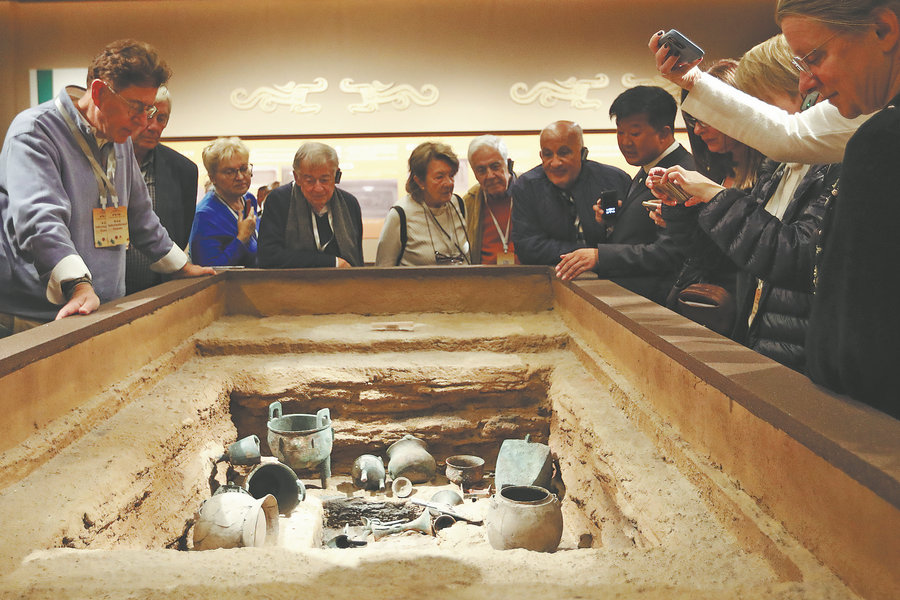
Following years of thorough and systematic amendments, the newly revised Law on Protection of Cultural Relics is set to take effect on Saturday, signifying a new era of legal governance in the protection of China's cultural heritage.
According to the National Cultural Heritage Administration, revising the law was an important step in turning proven practices into legal regulations. It also strongly supports the modernization of the governance system and capabilities in the field of cultural relics.
In November, the Standing Committee of the National People's Congress, China's top legislative body, approved the revision. This is the second time the law has been updated since it was introduced in 1982; the first time was in 2002.
Chen Xingcan, a member of the 14th National Committee of the Chinese People's Political Consultative Conference and also president of the Archaeological Society of China, said the revision will meet the needs of the cultural relics sector's development in the new era.
The newly revised law consists of eight chapters and 101 articles, with very detailed and specific provisions, which Chen said reflects the central government's great emphasis on the protection of China's cultural heritage.
"The law is very detailed and resembles a regulatory document. This revision is both comprehensive and systematic, and it may not require such large-scale amendments for the next 10 years or so," said Chen, who has participated in the law's two revisions.
The veteran archaeologist added that President Xi Jinping has given many instructions on the protection of cultural relics and emphasized the importance of protecting the relics on many occasions.
Since the 18th National Congress of the Communist Party of China in 2012, Xi has toured more than 100 historical and cultural locations and issued many instructions related to cultural relics and archaeology. He said that historical and cultural heritage is a valuable resource that is neither renewable nor replaceable, and its protection should always be given top priority.
Xi also said that we must properly handle the relationship between urban reconstruction and development and the protection and utilization of historical and cultural heritage, and ensure that urban development and heritage protection are well coordinated.
In 2022, reflecting the president's guidance, the nation's new principles of cultural relic work were released. These put protection first and urge enhanced management, value exploration and effective utilization, call for making cultural relics "alive", and aim to promote a deep integration of cultural heritage protection with modern society.
The new law added articles saying that before starting construction in old urban areas or large-scale land development projects, a survey of cultural relics must be done first. For land that might contain underground cultural relics, archaeological surveys and explorations must be completed by law before the local government sells or makes plans for the land.
"It's a milestone revision that will greatly aid future archaeological work. Many cultural heritage sites have disappeared during urban development in the past decades," said Chen.
The veteran archaeologist said that without legal protection, his team's archaeological work was often obstructed by developers and residents in the past.
Now the entire society places high importance on cultural relics and heritage. This is significant progress and a reflection of our respect for our own history and culture," Chen said.
Penalties act as deterrent
Another notable change is the significant escalation in administrative penalties for the destruction of cultural relics. The maximum fine for damaging cultural heritage has been increased from 500,000 yuan ($68,790) to 10 million yuan, a revision that should effectively discourage illegal damage.
For Song Yan, deputy director of the Nanjing Museum Administration and also a deputy to the 14th National People's Congress, it is noteworthy that the revision frequently emphasizes the protection of ungraded "immovable" cultural relics and clearly outlines specific protective measures.
According to the third national census on cultural relics in China, conducted from 2007 to 2011, the country has more than 766,000 immovable cultural heritage sites, such as historical monuments, ancient architecture and rock carvings, among which 80 percent remained ungraded. The revision makes it clear that they should also be effectively protected.
"These detailed provisions could potentially enhance the broader protection and management of these immovable cultural relics," said Song.
She also said the revision added numerous regulations and guidelines related to her work in the museum, especially regarding the effective utilization of cultural relics collected by museums. This responds to Xi's call for making cultural relics "alive", an instruction reflected in the revision.
Last year, the Nanjing Museum Administration held 40 exhibitions and conducted more than 1,200 educational activities. Centered around the theme "Growing Up in the Museum", it has introduced 108 exciting activities for teenagers, including exhibitions, educational programs, study tours and summer camps.
Song's team also collaborated with primary and middle schools to offer innovative experiences for students, aiming to attract more young people to visit the museum and learn about the culture behind the relics.
"The law encourages us to offer good services to a wider audience. We now need to train more professional staff to deal with the increasing public demand," Song said.
Wei Xiaolong, director of the Famen Temple Museum in Baoji, Shaanxi province, said he was impressed by the revision's emphasis on the use of high technology in research work, relics protection, digital collection and immersive shows.
The emphasis is indeed very instructive, providing some direction for the development of museums in the new era," he said.
The museum has many antique pieces made from delicate and fragile materials such as silk, wood and glass, particularly from the Tang Dynasty (618-907). Wei hopes to use high technology to better protect them, and the revision clearly supports such measures.
As the newly revised law facilitates international exchanges and cooperation in archaeological work, restoration, exhibitions, scientific research, law enforcement and judicial matters related to cultural relics protection, it also asserts the right to repatriate lost cultural relics and actively fulfills obligations under international conventions.
Wei noted that the law also explicitly prohibits the trade of cultural relics that are stolen or illegally obtained. It strengthens the regulation of companies involved in the sale and auction of cultural relics, requiring them to meet information disclosure obligations and banning false advertising.
Wei said this will help clean up the cultural relics market and reduce the risks associated with the legality of the sources of relics that are collected by museums.
"The new law also encourages individuals or organizations to donate or lend cultural relics to museums for the first time. We need to thoroughly review these new revisions to better carry out museum work," Wei said.
Contact the writers at dengzhangyu@chinadaily.com.cn






- Woman executed for abusing and killing stepdaughter
- Zhangjiakou academy students hit Olympic ski slopes as winter break begins
- Chelsea legend Gianfranco Zola visits Chongqing fans
- Winter storm transforms Zhangjiajie's Tianmen Mountain into frosty wonderland
- Wuhan receives first snow of year, images go viral
- China steps up emergency response as temperatures drop sharply