



China stays strong in the face of US tariff wars









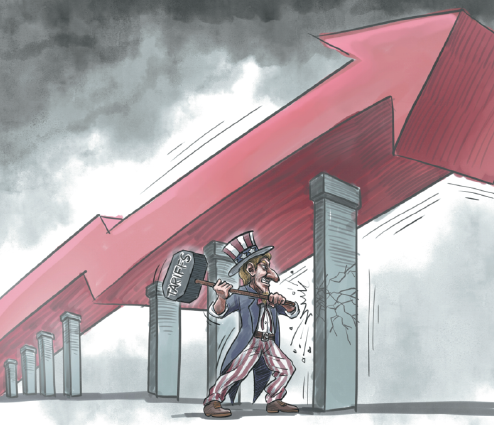
US President Donald Trump announced on Tuesday an additional 10 percent tariff on all Chinese imports, citing the fentanyl crisis as justification. The move marks a continuation of his administration's tariff strategy, despite mounting evidence that such measures have failed to achieve their intended economic goals.
According to trade surplus data for January released by the Commerce Department's Census Bureau, the US trade deficit soared to $153.3 billion—far exceeding the market forecast of $116.6 billion by an unexpected 31.5 percent. This figure represents the largest monthly trade deficit in US history.
Concurrently, China's State Administration of Foreign Exchange reported a total surplus of $65.6 billion in January, with a goods surplus of 634.2 billion yuan and a narrowed services deficit of 163.1 billion yuan.
Despite repeated tariff hikes aimed at curbing the trade imbalance, the United States has witnessed a paradoxical outcome: a record-high deficit. Meanwhile, China has sustained stable growth in its trade surplus, with its total trade volume continuing to expand.
Since Trump's first term, he has championed tariffs as a means to rectify trade imbalances. Now, in his second term, the Trump administration is extending these measures to major trading partners—including China, Canada, Mexico, and the European Union—in an attempt to reinvigorate US manufacturing and "Make America Great Again."
Rather than reducing the deficit, the trade war has led to higher import costs for American businesses, forcing them to raise prices, eroding their competitiveness, and constraining exports. Additionally, tariffs have driven up the cost of consumer goods, further burdening American households.
China, by contrast, has emerged from the trade war stronger. Its trade surplus has expanded significantly, approaching the $1 trillion threshold by 2024. Conversely, the US good trade deficit reached a record high of $1.2 trillion in 2024.
More critically, China has continued to optimize its trade structure, transitioning from a reliance on low-cost, high-volume goods to dominance in high-end manufacturing. The country has become a global leader in sectors such as solar panels and electric vehicles, further solidifying its position in the global economy.
Moreover, China now boasts a highly integrated industrial chain, making it increasingly resilient to US economic pressure. In response to Washington's tariff escalations, Beijing has implemented countermeasures, including retaliatory tariffs on American goods, restrictions on US companies, and formal complaints lodged with the World Trade Organization.
China's confidence has also been buoyed by a fundamental shift in its trade relationships. Whereas the United States once served as China's primary export market, trade with Belt and Road Initiative (BRI) countries now constitutes over 50 percent of China's total trade. This diversification has reduced Beijing's dependence on US markets and mitigated the impact of American tariffs.
As Trump extends his tariff campaign to additional trading partners, the broader implications for global trade are becoming clear. By targeting Canada, Mexico, the EU, and others, his administration is disrupting international supply chains, increasing operational costs for businesses worldwide, and inviting retaliatory measures that threaten to isolate the United States.
While Washington's trade policies strain traditional alliances, Beijing is leveraging its economic initiatives to attract new partners. Through projects like the BRI, China is fostering deeper trade ties across Asia, Africa, and Europe. The global balance of power is shifting, and the United States risks finding itself increasingly isolated in a trade war of its own making.





