Novel surgery helps paralyzed patients get back on their feet
'Nerve bypass' pushes spinal cord injury treatment into a new era









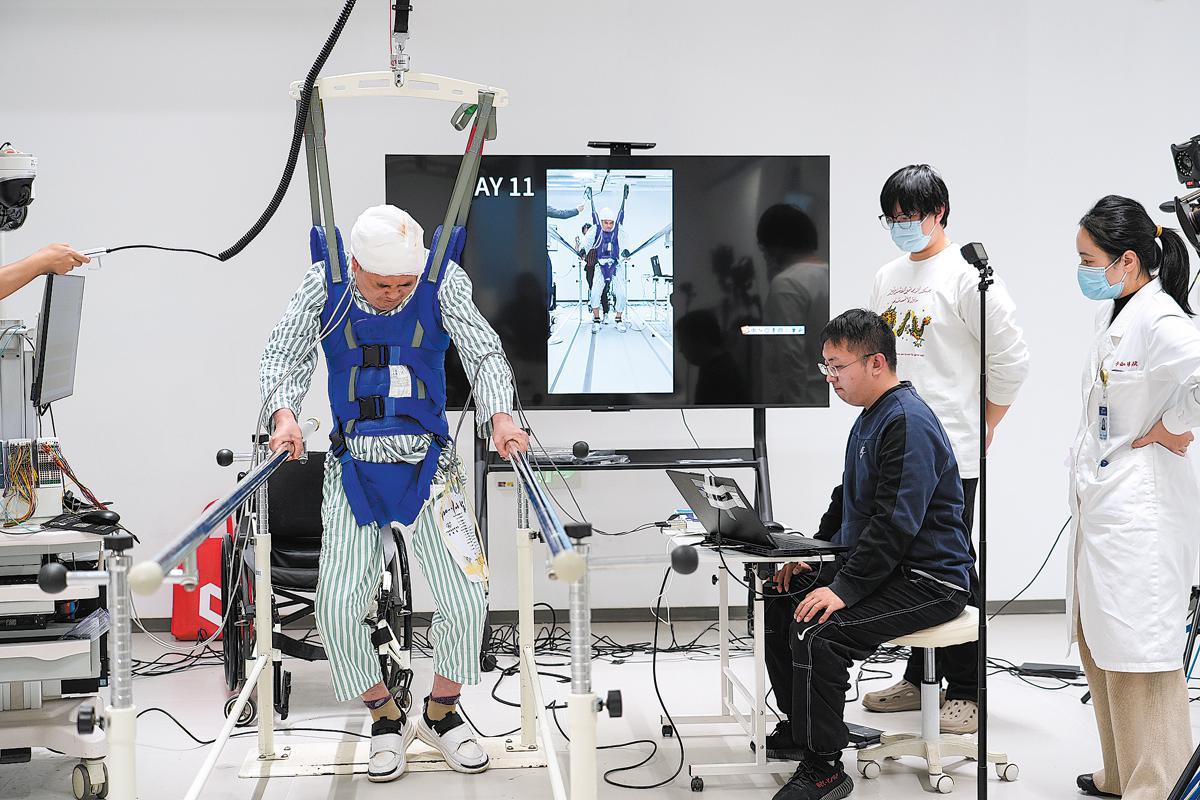
Four paralyzed individuals have undergone groundbreaking surgery to implant electrodes in their brains and spinal cords in Shanghai, creating a "nerve bypass" that has restored their ability to walk independently.
The Institute of Science and Technology for Brain-Inspired Intelligence at Fudan University, which developed the technology, said Tuesday that the patients underwent the procedures between Jan 8 and Monday at Zhongshan Hospital and Huashan Hospital in Shanghai. Their conditions have improved to varying degrees, researchers said.
With a synchronized implantation of electrodes that took just four hours, the patients were able to move their legs with the assistance of artificial intelligence within 24 hours, according to the researchers.
Based on the post-operative progress of the first three patients, individuals with severe spinal cord injuries were able to achieve independent leg control and take steps within two weeks, pushing spinal cord injury treatment into a new era of neural function reconstruction, the team said.
"The post-operative status of the patients means we have preliminarily confirmed our scientific concepts in clinical patients," said Jia Fumin, the team's lead researcher. "For the next step, we plan to optimize technology based on the data we have obtained so that the next batch of patients can experience better and faster recovery."
The spinal cord serves as a crucial pathway connecting the brain and peripheral nervous system. When damaged, motor commands from the brain cannot reach the spinal cord to control muscles, potentially leading to lifelong paralysis.
Jia's team has been working to develop brain-spinal cord interface technology to build a "neural bridge" between the brain and spinal cord. This involves collecting and decoding brain signals and providing spatial-temporal electrical stimulation to specific nerve roots, enabling paralyzed individuals to regain limb control.
Researchers said the surgery involved implanting a chip integrating electroencephalography collection in the skull and spinal cord stimulation in the spine, along with two electrodes about 1 millimeter in diameter implanted in the left and right brain and a paddle lead implanted in the thoracic or lumbar epidural space.
Jia highlighted the scarcity of global research focused on restoring lower limb mobility through such technologies, noting that decoding a patient's brain signals in real time remains a key challenge.
"Our technology currently demonstrates a delay of about hundreds of milliseconds in action after the brain sends a command," Jia said. "We aim to shrink this delay to a level almost indistinguishable from that of a healthy individual."
All four patients are men in their 30s who became paralyzed due to work-related accidents. Except for the most recent case, who underwent surgery on Monday, the other three were able to control their leg movements and walk independently with the support of suspension devices after the procedure.
"One patient, upon being able to stand again after the surgery, was so excited that he wanted to send pictures to his mother," said Ding Jing, chief of neurology at Zhongshan Hospital Affiliated with Fudan University.
As the research progressed, the team encouraged patients to attempt new movements. For example, the second patient was able to lift and extend his legs while seated on the third day after surgery, while the third patient achieved leg lifts within an hour of the procedure. By the seventh day, he could stride between parallel bars with the support of suspension devices and step over obstacles.
"They made progress day by day, which is crucial for instilling confidence in their rehabilitation," Jia said.
The first patient, a 34-year-old from Guangdong province surnamed Lin, expressed amazement at his regained abilities. He had been paralyzed for two years and had been told he would never stand again.
"I was able to walk for over 5 meters depending on my own movement intentions on the 14th day after the surgery," he said. "It was something I wouldn't have dared to dream of."
The research team said their ultimate goal is for patients to walk independently without suspension support, a process that may take about six months to a year.
Notably, sweating in the legs has been observed in the first three patients.
"This indicates that the brain-spinal cord interface has stimulated nerve reshaping within the patients' bodies," Jia said. "If this continues, the ideal scenario in the long run will be patients walking independently without our devices."
Globally, about 20 million people are paralyzed and currently rely on passive rehabilitation and care. No approved product exists worldwide for restoring the gait of paralyzed patients.
zhouwenting@chinadaily.com.cn






- Why do China's cultural and creative products go viral?
- Aviation sci-fi park Nantianmen to open in 2027
- Chinese researchers make breakthrough in green cooling technology
- Former head of national forestry and grassland body under investigation
- A new lease of life: Providing dialysis access in rural China
- China's grain output hits new high in 2025