Pondering the future over a coffee
Jiangmen, famed for its huge overseas Chinese diaspora, is making a mark for itself in building up its beverage business worldwide, adding immensely to the cultural infusion. Luo Weiteng reports.









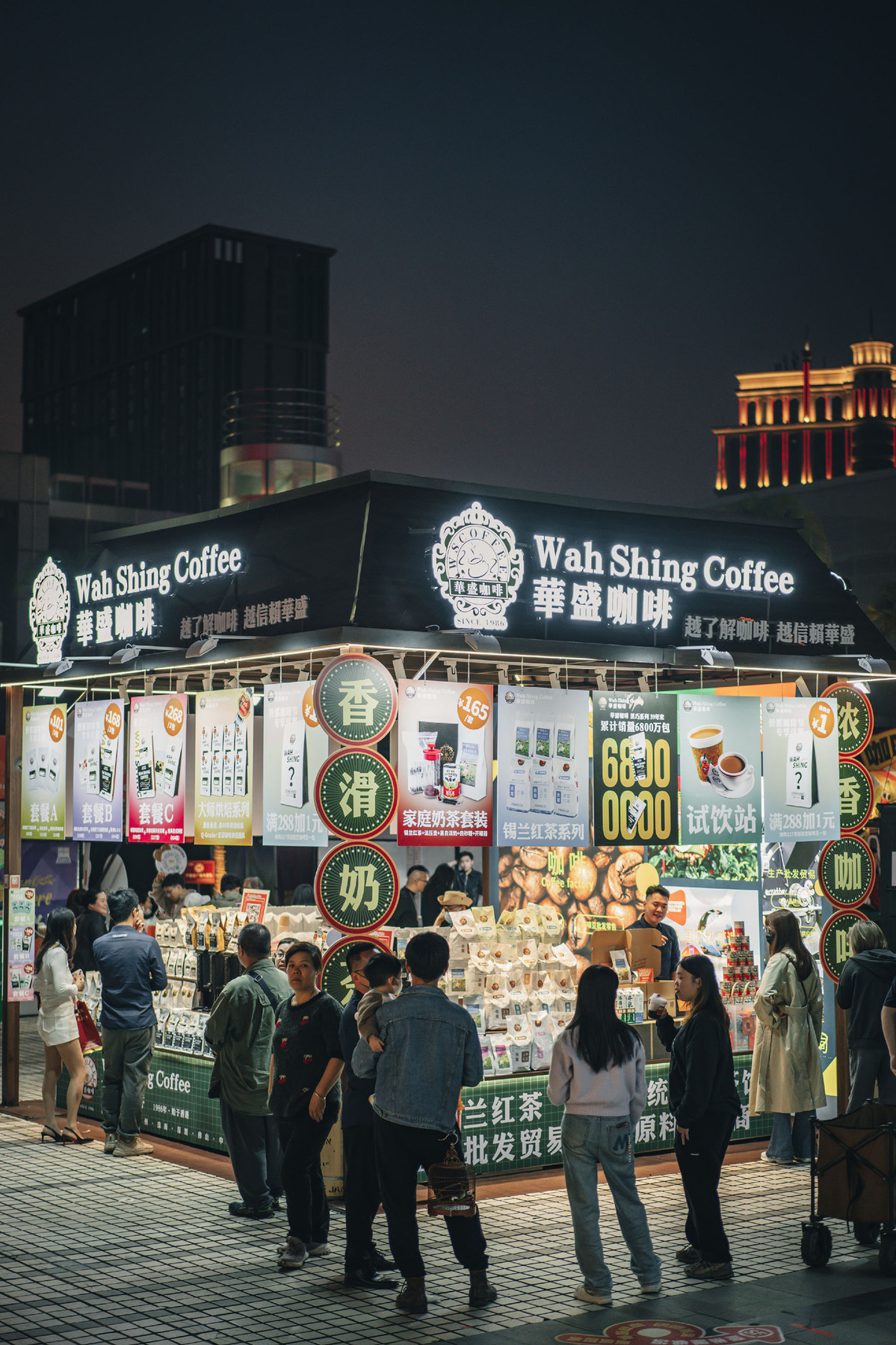
When Hong Kong-based entrepreneur Chung Tat-wing took over the coffee business from his father at the turn of the 21st century, having a "front shop, back factory" was common practice among Hong Kong's coffee companies capitalizing on the Pearl River Delta as a low-cost manufacturing powerhouse.
Chung made a bold move by relocating the business headquarters of Wah Shing Coffee to Jiangmen city in Guangdong province. For coffee manufacturing in the region, Jiangmen is really something else. Known as the hometown of 5.3 million overseas Chinese and compatriots from Hong Kong, Macao, and Taiwan dispersed across 145 countries and regions, Jiangmen is where their roots are, with the Chinese diaspora having left an indelible mark on the city's character through coffee culture.
"Geographical proximity and infrastructural connectivity, along with the cultural and linguistic similarities behind the emotional connection Chinese diaspora feel for their ancestral hometown, drove us to set up a branch in Jiangmen in 2002," says Li Guoxiong, director and general manager of Hiang Kie Coffee (Jiangmen), recalling the decision made by the 89-year-old beverage group based in Hong Kong.
At that time, many business heavyweights in Hong Kong's coffee industry had their ancestral roots in Jiangmen, says Chung, who is originally from the city himself. As he traveled around the globe looking for coffee beans, just like hardworking Chinese who had ventured across oceans in search of prosperity at the turn of the 20th century, he came across Chinese migrants settling in all corners of the world, with Jiangmen as their ancestral home, and got their sincere help.
Coffee — one of the most beloved international beverages — has become a lucrative business estimated at more than 310 billion yuan ($43 billion) in China last year. The average per capita annual consumption of coffee in the traditionally tea-drinking country exceeded 16 cups in 2023 — more than double the amount consumed five years earlier — according to data from Statista.
Over the past decades, Jiangmen has obscured its enabling role in the rise of the coffee business in the world's second-largest economy. As one of the earliest coffee roasting bases in China, Jiangmen now commands 10 percent and over 20 percent, respectively, in the nation's production and export of roasted coffee products.
On the back of the city's traditional predominance in hardware manufacturing, Jiangmen has also cemented its role as one of the world's major coffee equipment production bases, with an annual output worth well beyond 2 billion yuan, and 70 percent of home-made, pour-over coffee kettles shipped overseas.
Just like Jiangmen's harmonious blend of Chinese and Western architectural styles with UNESCO World Heritage Site, Kaiping Diaolou and Villages, coffee has added a compelling footnote to such cultural infusion. The city of 4.8-plus million residents is famous for its high density of cafes, with 1,715 market entities engaged in the burgeoning coffee industry and 318 newly registered last year.
The Jiangmen municipal government has, in recent years, strived to promote the local coffee industry under a broad-based brand — coffee from the homeland of overseas Chinese. It is worth noting that the Jiangmen coffee culture week concluded last month, giving the city's coffee industry resonance and reach among a much broader mix of visitors.
However, it isn't a walk in the park when it comes to self-branding and original design. Many industry players don't even bother to try due to lingering worries about intellectual property protection, or they just feel happy with the hard-earned money under the OEM (original equipment manufacturer) model, says Cai Zeyu, general manager of coffee equipment manufacturer, Jiangmen Keming Metal Products.
When Lin Weiqiang, who founded Parton Coffee, started building a Jiangmen-based coffee brand in 2002, the local market was dominated by Hong Kong and Macao brands. More than two decades on, he has seen Jiangmen establish the entire coffee industry chain from seeding to the cup. But the city's booming coffee sector has no shortage of unbranded small- and medium-sized coffee companies and mom-and-pop stores.
"Self-branding and original design cannot happen overnight. It is a rite of passage for local coffee business essentially becoming Jiangmen's calling card on the national and global map," says Lin.
Today, homegrown milk tea brand Heytea is indeed one of Jiangmen's calling cards.
Lin Wencong, secretary-general of the chain catering professional committee of the Jiangmen municipal commercial association, calls Heytea's self-made success a "living embodiment of the can-do spirit "urgently needed for the city's coffee sector.
"Heytea has made a meaningful brand impact on Jiangmen's beverage industry and laid a solid foundation for its talent pool," Lin notes. "This calls for concerted efforts and the industry-wide sharing spirit to nurture more indigenous brand names."
In Lin Weiqiang's view, coffee from the homeland of overseas Chinese is a good starting point. Looking ahead, Jiangmen has what it takes to polish its brand of coffee from the Guangdong-Hong Kong-Macao Greater Bay Area and beyond in China.
Collaboration and integration are the name of the game. Neighboring cities in Guangdong, like Dongguan and Foshan, have also made a name for themselves in the coffee industry chain. Lin believes this is where coffee-themed, region-based tourism products could come in by integrating the coffee business with the overall tourism scene and setting Jiangmen and the wider Greater Bay Area apart from other competitors.
Collaboration also contributes immensely to cultivating talent. In December, Jiangmen hosted the first pilot evaluation of baristas under the One Examination, Multiple Certification (OEMC) system (Level 4/Intermediate Worker) in the Greater Bay Area.
Li sees the OEMC making a bigger difference, providing professional certification recognized on the Chinese mainland and in the Hong Kong and Macao special administrative regions for various occupations in the coffee industry chain.
"It could also strengthen Jiangmen's unique role as a would-be training and examination center for the great story unfolding in the coffee industry," says Lin Weiqiang.
Lin Wencong, who is involved in the branding, marketing and business planning of the beverage industry, eyes closer cooperation between the 200-billion-yuan, new-style tea market and the coffee business through bold action and thinking out of the box.
For rich productive cities like Jiangmen, chenpi, or dried tangerine peels, from Xinhui district, bitter gourd from Duruan town and various kinds of locally-grown tea could be smartly used in producing a variety of beverages, including coffee, making them genuinely unique to Jiangmen and stand out from the crowd, says Lin, adding there are indeed some successful, creative attempts to learn from.
"We are on the cusp of embracing more disruptive star companies to do something different and lead the change," he says.
Amid a sea of change, Lin Weiqiang says Jiangmen has all the elements it needs to invite big brand names to set regional or international bases in the city, with the impact of a headquarter economy as a catalyst for the coffee sector making the switch.
Chung has been waiting for this to happen for years. He has high hopes of turning Jiangmen into a trading center for southern China's coffee business — a mega project that can't go without a can-do spirit, joint efforts and strong commitment.
"There is so much to anticipate in the coffee industry in Jiangmen and beyond. This is a vast market to leave our own mark on," he says.



- Ancient pressure cooker making a stir
- Ten photos from across China: Jan 16 – 22
- China moves to set national standards for pre-made dishes
- Chinese company unveils plans for commercial space flights
- Latest addition to Shiziyang Bridge constructions brings main tower above 300 meters
- Hebei's 'ancient pressure cooker' setting internet ablaze