Study finds 'oasis of life' thrived in NW China during Earth's worst mass extinction









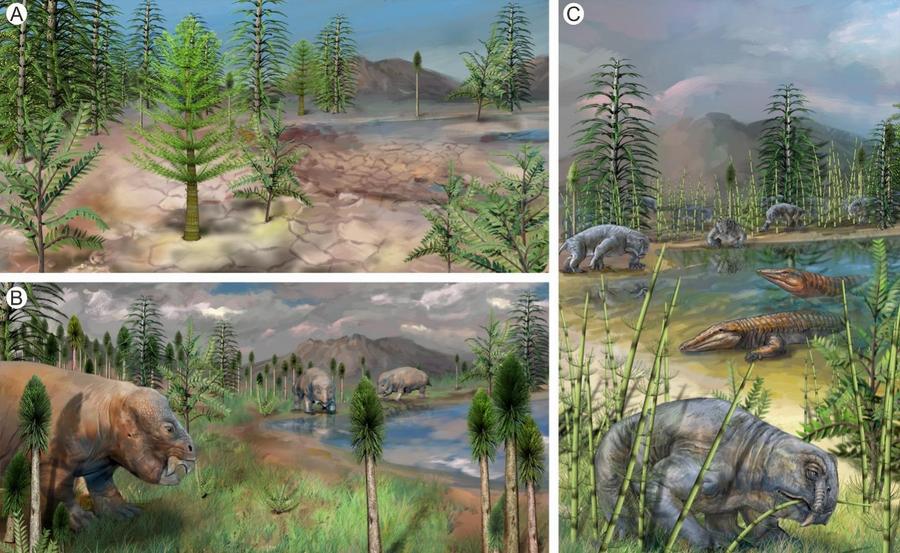
NANJING -- A new study has revealed that a region of the Turpan-Hami Basin in Northwest China's Xinjiang Uygur autonomous region was an "oasis of life" for terrestrial plants during a catastrophic biological crisis that occurred on Earth about 252 million years ago.
The study, led by researchers from the Chinese Academy of Sciences' Nanjing Institute of Geology and Palaeontology, was published in the Science Advances journal on Thursday.
The mass extinction event, which took place at the end of the Permian Period 252 million years ago, wiped out over 80 percent of marine species. Its impact on terrestrial ecosystems has been a subject of intense debate. A dominant theory posits that massive volcanic eruptions in Siberia caused widespread devastation on land through wildfires, acid rain, increased UV-B radiation and toxic gases.
Challenging this widely accepted view, the new study presents the first definitive fossil evidence of a terrestrial plant community that remained largely undisturbed throughout the extinction event. This resilience allowed for continuous evolution and facilitated a rapid ecological recovery in the aftermath.
By analyzing fossils unearthed from the South Taodonggou section of the Turpan-Hami Basin, the researchers discovered that the overall extinction rate of spore and pollen species in this region was approximately 21 percent -- far lower than the marine extinction rate during the same period. Furthermore, they uncovered a continuous record of riparian fern fields and coniferous forests that thrived from 160,000 years before the extinction began until 160,000 years after it concluded.
The study highlights the critical role that this stable vegetation base played in the swift recovery of the local ecosystem. Fossil evidence indicates that within just 75,000 years following the extinction event, diverse tetrapods such as lystrosaurus and chroniosuchians inhabited the area. This rapid resurgence of a complex food web is in stark contrast to previous estimates that ecosystem recovery post-Permian extinction took over a million years. The new findings suggest that ecological diversity in this region rebounded more than 10 times faster than in other areas.
The researchers attribute this remarkable resilience to the region's stable, semi-humid climate. Analysis of paleosol matrices reveals that the area consistently saw about 1,000 millimeters of rainfall annually during this period. This consistent precipitation made South Taodonggou more verdant and habitable than other regions following the mass extinction at the end of the Permian Period, providing essential support for migrating animals.
Despite its proximity to the volcanic activity that triggered the extinction event, the Turpan-Hami Basin emerged as a sanctuary for terrestrial life.
"This demonstrates that even seemingly perilous locations can harbor vital biodiversity," noted Wan Mingli, a professor at the Nanjing Institute of Geology and Palaeontology.
"This discovery underscores how local climate and geographic factors can create surprising pockets of resilience, offering hope for conservation efforts amid global environmental changes," said Liu Feng, another professor at the institute.





- Xi says China's high-quality development to provide more opportunities for cooperation with Brazil
- China Coast Guard rescues 13 Filipino sailors in the South China Sea
- Xi holds phone talks with Lula
- Chinese mainland reaches 5.32m invention patents, trademarks close to 50m
- Chongqing railway attendants undergo training ahead of travel rush
- China's railway gears up for Spring Festival travel rush