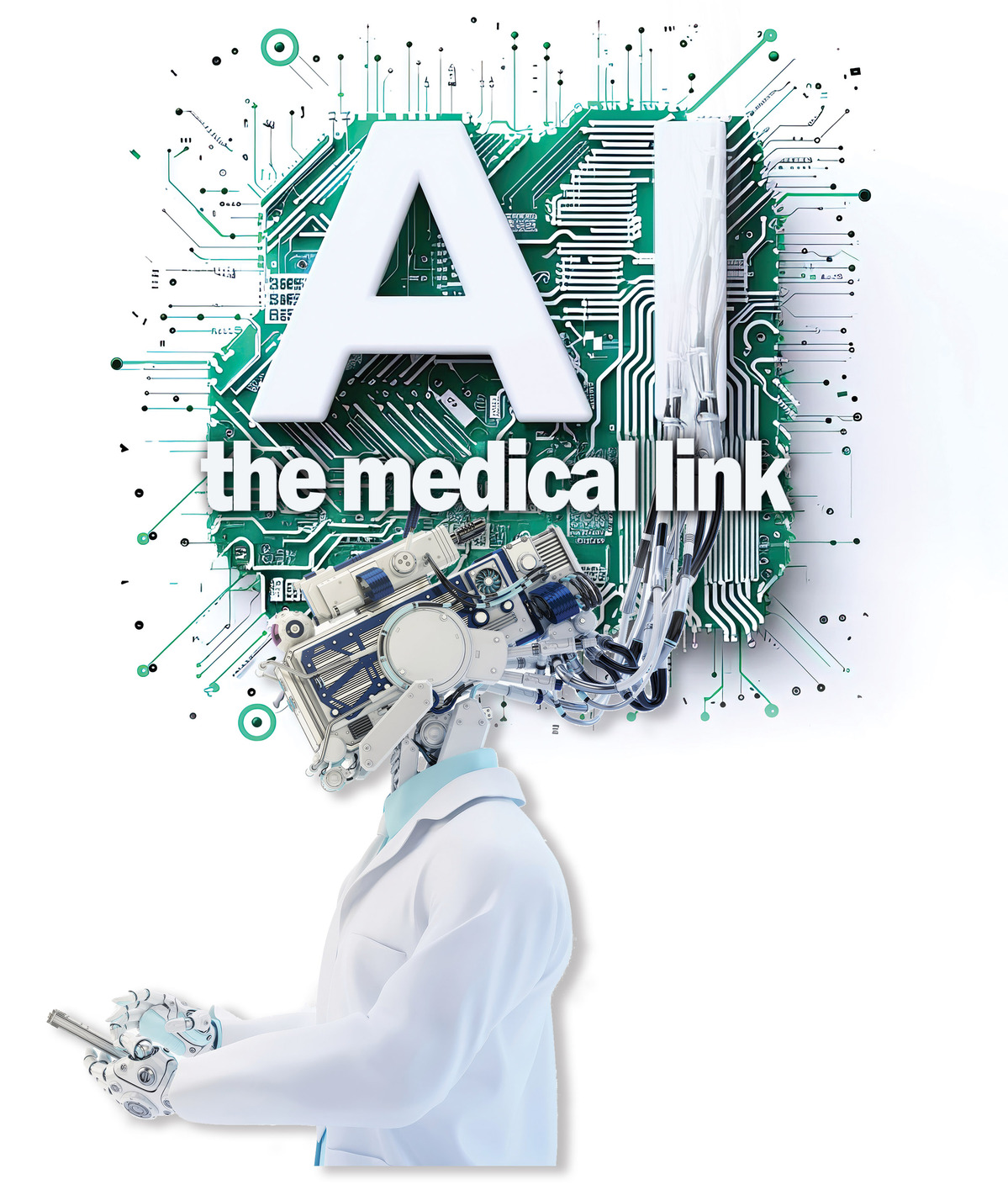
AI the medical link
Can artificial intelligence fully replace doctors in the near future? Medical experts believe there is still a long way to go in integrating the technology with healthcare. Wu Menglei reports from Hong Kong.









When Huang Yuan set up her business in Hong Kong in 2023, her ambition was to harness innovative technologies for the prevention and treatment of chronic diseases.
Her dedication stems from years of experience as a medical professional during which she encountered serious challenges when treating stroke patients.
"The options are often limited when it comes to managing stroke patients. Existing clinical treatment can only prevent strokes rather than dealing with the problem effectively," Huang says.
The bottleneck has made her realize the urgency of applying technology in the medical field. "Medical innovation can solve many problems systematically. So I decided to switch my role - from a doctor to an entrepreneur."
Huang's startup, Quantum Life, is a medical platform using artificial intelligence to help patients with chronic diseases nip it in the bud.
"This year is AI's inaugural year in healthcare," says Huang, the company's founder and CEO. "In this AI wave, previous perceptions have changed a lot. This is demonstrated in two aspects. First, as data owners, such as medical institutions, have realized the need to use data to help people. Second, more medical professionals are willing to cooperate in training AI models."
Huang's efforts epitomize Hong Kong's AI push as part of the city's bid to make itself a global technology and innovation hub. In his 2025-26 Budget speech, Financial Secretary Paul Chan Mo-po highlighted the role AI plays in empowering traditional industries, and vowed to make it a "core industry".
However, when it comes to integrating AI with healthcare, there is still a long way to go.
AI limitations
"Relatively speaking, the medical industry isn't moving as fast as other sectors in adopting AI because clinical work requires great caution, no matter what technology is used," says Joanna Pang Yuk-wa, chief medical informatics officer of the Hospital Authority's Information Technology and Health Informatics Division.
The Hospital Authority - a statutory body founded in 1990 to manage all public hospitals in Hong Kong - is eyeing a breakthrough in predicting chronic diseases, based on analyses of its patient database.
"Before AI emerged, we had done lots of forecasts on chronic diseases. But AI caught our attention in 2019. For specific tasks like analyzing X-ray films, AI is faster and more accurate," Pang says.
However, AI's analytical results aren't absolutely correct. "What concerns us most is the technology's hallucinations. This means the results, sometimes, may seem correct. But, in fact, they're wrong," she says.
Pang says such errors are hard to eliminate. "AI's basis is big data, while a database needs humans to build it up step by step."
The HA's database was established by generations of doctors. Even so, missing data and errors are still inevitable. "When AI models encounter such problems, they will fill the missing data randomly. This is where analysis errors might occur," she says.
Pang and her colleagues say they believe that AI can be used only as an "assistant" at this stage, with the ability to provide evidence from a different perspective, while diagnostic decisions can be made only by doctors.
"Any diagnosis needs evidence, and for any diagnostic decision, humans are responsible," says Billy Chiu Chi-fai, chief medical executive of Adventist Medical Center, a private medical institution in Hong Kong.
Chiu, who has been a doctor for over three decades, says that only when doctors combine their professional skills with AI's strengths can the risk of misdiagnosis be minimized. Edith Lau Ming-chu, founder of the Hong Kong Center for Clinical Research, agrees that AI lacks the ability to show empathy for patients. Sometimes, patients may want to chat with doctors, and such kind of human connection is hard to be replaced by machines.
"Data cannot reflect the whole picture. In clinical practice, if a patient says he or she feels pain and his or her face turns red, how can that be recorded?" Pang asks. As such, many doctors see AI as just a tool, and some may even think it isn't useful at all, she says.
'A powerful helper'
Despite the limitations in AI's application in medical services, some experts agree that the cutting-edge technology has more advantages besides being "faster and more accurate".
"AI's thinking method is different from that of humans. It can figure out unexpected connections that seem irrelevant to us," Lau says. "Moreover, it's good at data mining. If you want to do a deep analysis in clinical practice and the amount of data to be analyzed is large, AI is a powerful helper."
Chiu says he believes Hong Kong doctors shouldn't stay in their comfort zone. "Our goal is to provide better services for patients. Be aware that AI's role in helping to achieve this goal is the first step. Whether it's right or wrong is something for us to consider in the next stage."






- 10 dead and 84 injured in explosion at steel plant
- China unveils flexible urban planning rules to improve lives, foster new industries
- Ex–China Construction Bank executive gets 18 years for bribery, loan violations
- First batch of eco-friendly pioneer zones for construction of beautiful countryside unveiled
- Woodpeckers, finches captured in Jilin winter scenes
- Mainland reiterates 1992 Consensus as foundation for resuming cross-Strait dialogue