Experts warn of social security challenges in age of automation
Robots: Adaptive adjustments to social policies urged









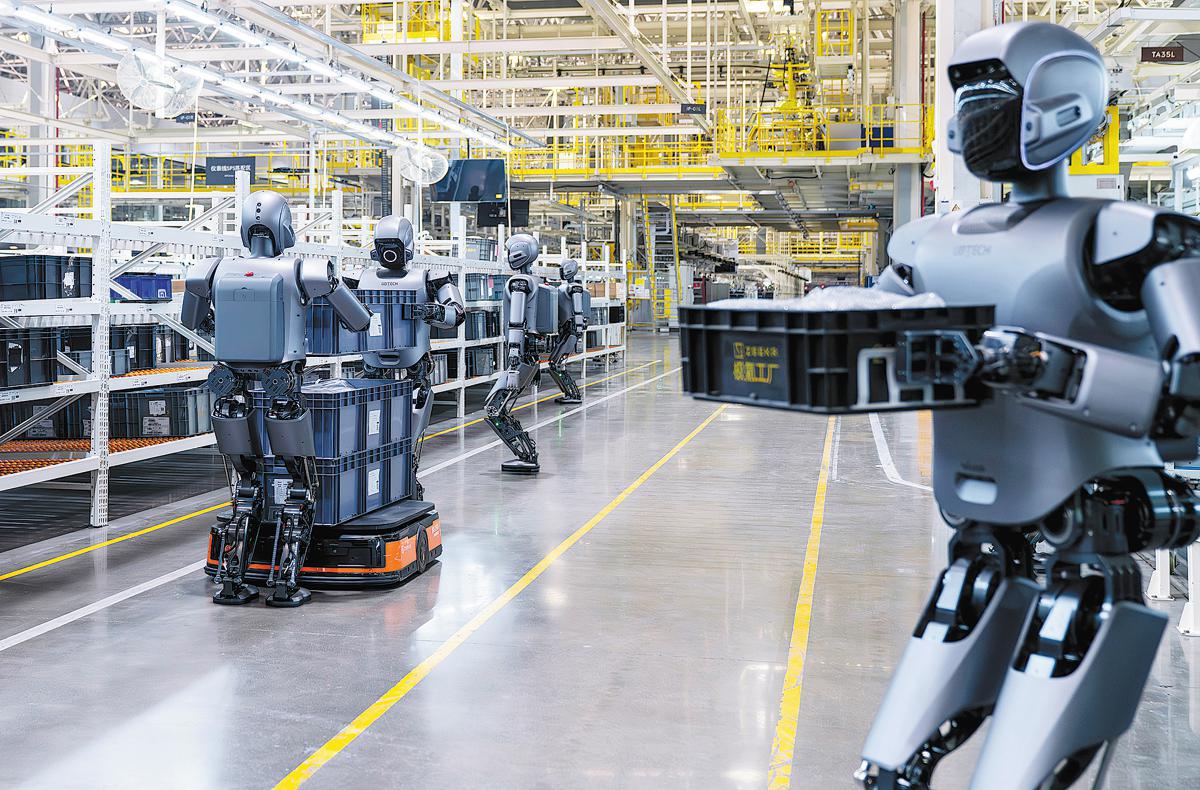
While the rapid adoption of robots and artificial intelligence improves efficiency and reduces the cost of human resources, the social security system could face challenges in sustaining individual benefits, pension payouts and healthcare funds — an issue that should be addressed in advance, experts said.
Zheng Gongcheng, president of the China Association of Social Security, said that if automation replaces 70 percent of manufacturing jobs — a plausible scenario given the current technological trends — workers displaced by robots may receive lower welfare benefits during their transition to new roles.
"Traditional social insurance relies on payroll deductions from employers and employees. How-ever, as robots replace human workers, the contribution base shrinks," said Zheng, who is also a professor at Renmin University of China in Beijing.
For example, a factory replacing 100 workers with robots would by default eliminate 100 monthly contributions, straining pension and healthcare funds. This raises a critical question: Should enterprises pay social security fees for robots?
"Although there is currently no consensus, social security issues must be addressed with seriousness and prudence," Zheng said, adding that if left unaddressed, these issues may undermine the fairness and stability of the entire social security system.
The social security system, as a mechanism of wealth redistribution, should evolve simultaneously with technological progress, or otherwise it will lose its core function of promoting social equality, he said.
Zheng suggested exploring new payment channels for robot-using companies to complement social security contributions, such as imposing a levy on robotic productivity gains.
Starting with the replacement of agricultural workers and expanding to the manufacturing and services sectors, robots can free humans from simple, repetitive and hazardous jobs, which is a commendable progressive trend. However, the replacement process must be cautiously approached to avoid abrupt unemployment shocks, Zheng said.
"Robots and humans are not always competitors; instead, they can work together. For instance, as China has a large elderly population, robot-assisted elderly care could address labor shortages without fully replacing human roles," he added.
Zhao Ziyi, dean of the Guizhou Institute for Urban Economics and Development at Guizhou University of Finance and Economics, said that low-skilled workers, particularly those engaged in repetitive tasks in labor-intensive industries, face the maximum risk of being replaced.
"An expansion of the unemployed population could further widen the wealth gap. Capital and technology owners will likely reap greater benefits, while ordinary workers who fail to adapt may face exacerbated social inequality," Zhao said.
Adaptive adjustments to social policies are imperative, according to Zhao.
"First, we should build a basic security net by exploring universal basic income, reducing job transition costs and alleviating widespread anxiety," she said.
Next, innovative employment models should be introduced, such as reducing working hours in line with technological advancements and developing shared employment strategies to ease labor market pressures, she said.
Positive outcomes
The impact of AI on the economy is not strictly negative, there are some positive outcomes as well, Zhao said, adding that new job positions such as AI training and robotics maintenance could be created.
The use of AI and robots also reduces the monotony of labor, allowing a shift of the human workforce to fields that require emotional intelligence, complex decision-making abilities or innovative thinking, she said.
While machines may replace specific jobs, they cannot replicate human ingenuity, Zhao said, adding that shifting education from rote learning to fostering creativity is one way to embrace the change.
According to the report "Global Talent Trends 2024", released by international human resource service provider Mercer, 56 percent of executives believe that AI will create jobs within their organizations. In addition, the proportion of employees worried about losing their jobs to AI decreased from 53 percent in 2022 to just 10 percent in 2024.
Li Bing, a partner at consultancy Roland Berger, said that more people now view AI as a tool to boost efficiency.
"History shows that technological evolutions eventually create new forms of employment," Li said. "The key is to shorten the painful period of transformation and turn the impact of AI into opportunities for high-quality employment through education empowerment and policy guarantees."
Li suggested introducing AI skills to vocational training programs, as Singapore and Germany have done. Some parts of the United States introduced a tech dividend tax that is imposed on businesses with high levels of AI and automation and uses the proceeds to support education and employment in low-income communities.
chenmeiling@chinadaily.com.cn