Zoellick: I respect China's achievements









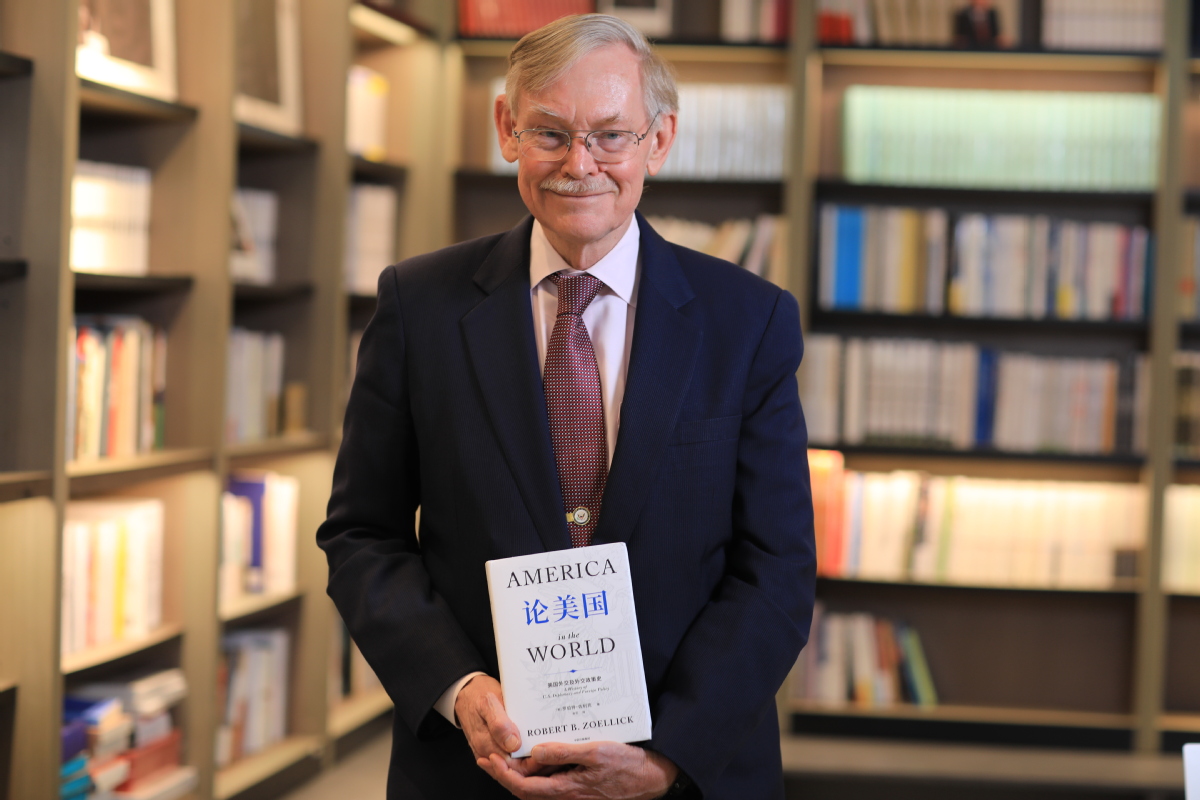
Editor's note: The Chinese edition of America in the World: A History of US Diplomacy and Foreign Policy by Robert B. Zoellick, former World Bank president and former US deputy secretary of state, has hit bookstores this month. In an interview with China Daily's Song Wei, Zoellick offered his insights into diplomacy, reflected on China's economic and technological transformations, and explored the pivotal issues in China-US relations. Excerpts follow:
Q: What inspired you to write America in the World: A History of US Diplomacy and Foreign Policy?
A: I wanted to share my experience with younger generations about how to think about history and problem-solving. As you probably know, (former US secretary of state) Henry Kissinger wrote a book titled Diplomacy in the 1990s, but Kissinger drew primarily from the European experience. So, I wanted to try to draw from some of the American experiences.
I think the way you bring history to life is to talk about stories and people. So, as you know, each of the chapters focuses on a person or a group of people and a problem they're trying to solve.
In addition to security issues, you've got financial issues, trade issues, and technology issues. And when you wrap them all together, I have a strong belief that diplomacy is an art, not a science.
Q: You first visited China way back in 1980, just two years after the country launched reform and opening-up. How do you see the economic and social transformation China has undergone over the past four-plus decades?
A: I'm so pleased I had a chance to visit China. I was here for only a day. My wife and I were in Macao where we got the one-day sort of visitations. We visited a communal farm. We visited a city that I just remember having cinder blocks and everybody being dressed in blue and gray. But it gave me a visual reference point.
So, when I visited China over the following years, I saw a huge transformation. This is a historic change. This is a huge change. And, obviously, it lifted hundreds of millions of people out of poverty. It created great opportunity.
I've always been fascinated by the transformation of China. At heart, what I have felt most strongly is that when I was with the World Bank, in addition to going to Beijing or Shanghai, I tried to visit other parts of the country. My main takeaway was that the Chinese (people) were very hard-working people who wanted to create a better life, and that's something you have to respect and admire. So, for me, my purpose is that while you have differences in history, culture, and politics, how can we find the common ground to steer away from trouble and build on the common advantages?
I've a lot of respect for what China has accomplished. Within one lifetime, you saw people move from impoverished conditions and sort of just drab clothing to what you see around you. It's a huge transformation. It's amazing.
Q: How can the US and China build a positive relationship?
A: You've got the two most important countries in the world. You don't want them to clash. You want to try to do things to avoid miscalculations. Sometimes people get into trouble by assuming things or accidents that can expand and turn worse over time. You obviously want to try to rebuild some of the trust and find the commonalities of issues, whether economy, climate, pandemics, or others.
I think in the current environment, President Donald Trump believes in transaction. He's a dealmaker, and you can see that in all his comments. The stories in my book are beyond dealmaking. The stories in my book talk about systemic issues. But I'm trying to give you a sense of Trump's approach as opposed to my approach. So he's concerned about fentanyl and narcotics. He's concerned about the illegal immigration. He's concerned about the bilateral trade deficit. He's trying to negotiate peace settlements, so the question is whether there are opportunities for some win-win cooperation there. I hope they move in the positive direction.
Q: What does China's strategy to boost technological innovation mean for the world?
A: In the artificial intelligence field, I expect the US and China to remain leaders.
The success of DeepSeek to me is interesting, not so much in China-US competition as in a new phase of AI. And what I mean by that is last year, all the discussion was on building these very expensive large language models. Very capital intensive, very energy intensive. So, it was an investment in the enabling of technology.
DeepSeek, I think, represents a phase shift not just for China but for others (as well) and the idea that technology is moving from "the enabling" to "the adapting". How do you provide uses for this? So DeepSeek is an open system, but it's also showing how you can develop, sort of, methods in a lower-cost way.
While the US and China might have somewhat separate systems, the ideas travel across borders, and they will still be transformative.
Q: Tariffs and trade barriers remain major challenges for globalization. What are effective ways to reduce trade frictions between China and the US?
A: I'm not a fan of tariffs. If you ask what's the effect of tariffs or barriers, the effect is they raise costs and lower productivity. Whether it's China or whether it's the US. So, it's not just China and the US. The US is doing this with Canada and Mexico. It will also hurt the auto industry in North America. I don't think those are the right policies, but sometimes tariffs are used as part of a negotiation.
Maybe part of Trump's purpose is to get other countries to do various things. With China, he's talked about using tariffs to create pressure on the fentanyl and the drug issue. All I can say is he sees the world through the lens of a dealmaker.
Q: Why can't the US increase tech exports to China to reduce deficit?
A: Export controls in my view can buy you a few years, but they won't stop somebody (from developing). You can't stop the development. So, if the US limits semiconductors (export), that may serve a security purpose. But don't fool yourself. China will develop it in a few years.
What I'm trying to explain is I understand the logic for some export controls, but on the other hand, there is a danger because what it will do is (that) it will produce separate systems, and that's the era that we're now dealing with.
Q: How do you view China's rise?
A: China has grown so quickly. Many Chinese people still say, "well, we are a poor developing country". But the rest of the world sees China as a powerful giant, and when you're a powerful giant, one has to give thought to how you will be perceived. My hope is that we can continue to find a basis where not only the US and China but also Japan and South Korea, Australia and the Philippines and Europe will create a more cooperative working basis.
The views don't necessarily represent those of China Daily.
If you have a specific expertise, or would like to share your thought about our stories, then send us your writings at opinion@chinadaily.com.cn, and comment@chinadaily.com.cn.

See more by scanning the code.