



Stocks plunge after US tariff hike
Investors across globe set to lower their risk appetite









While the Chinese stock market was not immune from Monday's global stock market meltdown after the United States announced wide-ranging tariffs, the A-share market will likely gain continued favor from investors, as China has plenty of policy room in the midterm to long run and its economy is resilient enough to offset the impact of the sweeping tariffs, said experts.
Although the benchmark Shanghai Composite Index and Shenzhen Component Index were down by 7.34 percent and 9.66 percent respectively on Monday, action was taken immediately. Central Huijin Investment, an arm of China's sovereign wealth fund, said during the late trading hours on Monday that it had increased its holdings in exchange-traded funds.
Fully acknowledging the A-share market's current investment value, Central Huijin said it would increase its exposure and firmly safeguard the stable operation of the capital market.
A sell-off swept the global market after US President Donald Trump signed an executive order on Wednesday to impose a 10 percent baseline tariff on all imports to the United States. The policy includes tariffs as high as 34 percent on imports from China and 20 percent from the European Union.
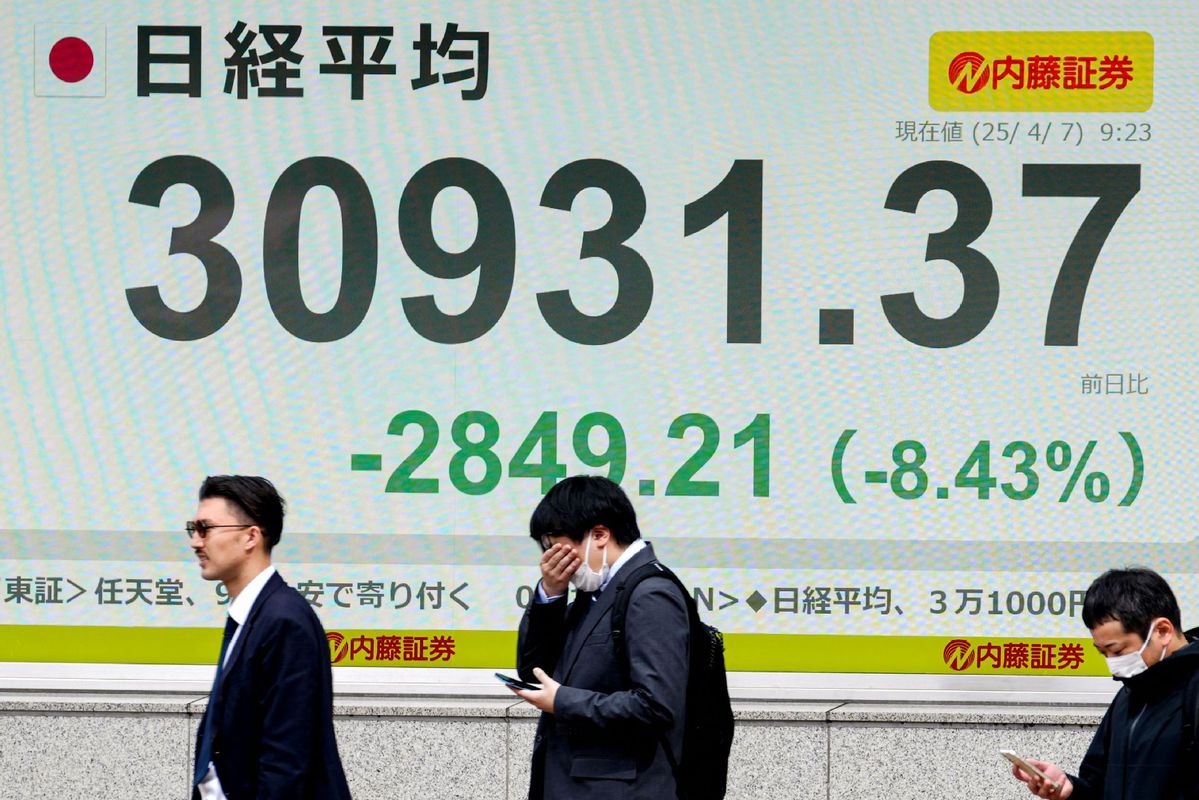
Japan's Nikkei 225 closed 7.83 percent lower on Monday, while Hong Kong's Hang Seng Index slumped 13.22 percent. The pan-European STOXX 600 was 6 percent lower shortly after the opening bell, and Germany's DAX index was more than 9.5 percent lower during early deals.
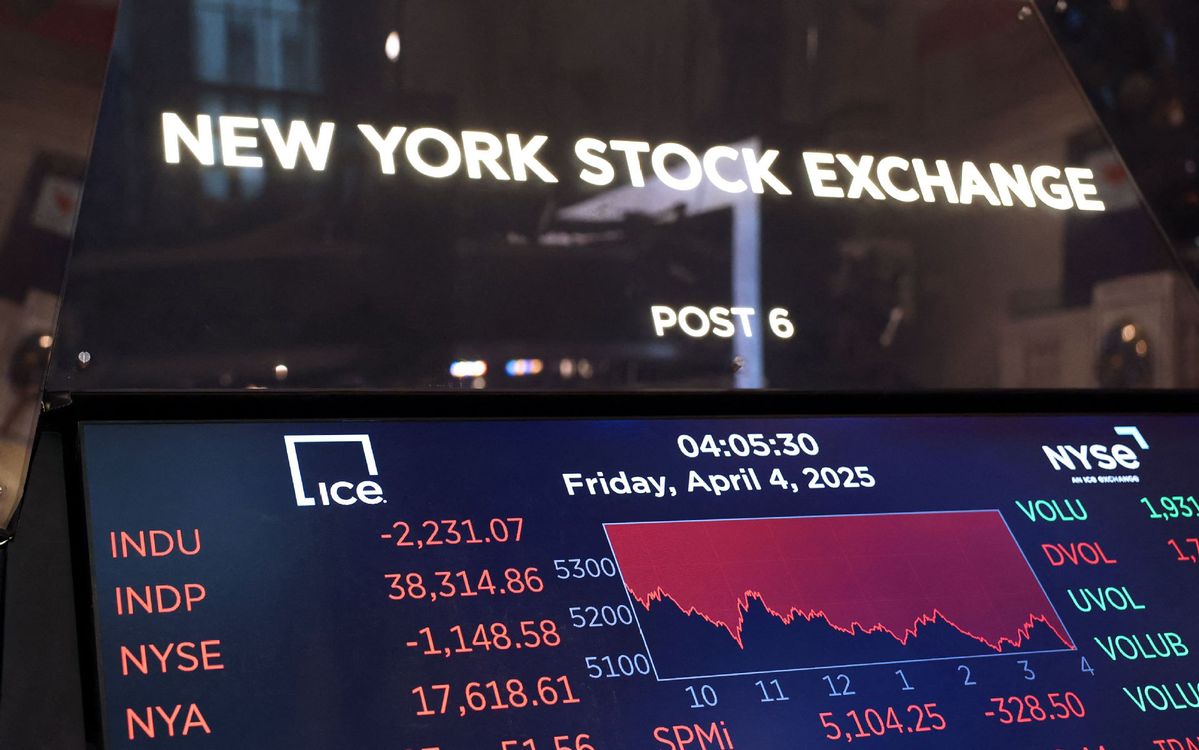
The US stock market also fell victim to the country's tariff regime. The Nasdaq plunged 5.8 percent on Friday to end the week by losing over 10 percent, signaling the entry of a bear market for the first time since 2022, according to Dow Jones Market Data. The S&P 500 nosedived 9.08 percent over the past week, while the Dow Jones slumped 7.86 percent, with both reporting their biggest weekly losses since March 2020.
Zhang Bin, deputy director of the Institute of World Economics and Politics at the Chinese Academy of Social Sciences, said that the latest US tariff policies are "unprecedented" for this generation. Bringing harm both to the US and other economies, the chain effects are hard to predict. Under such circumstances, it is also difficult to foresee the bottom of the US economy and its capital market.
But most domestic and international investors still have a relatively optimistic outlook with regard to China's economic growth and its capital market. China's development of new technologies and the upgrading of its traditional industries have buoyed economic activity and facilitated the recovery of the capital market, he said.
China has much room for more policies to expand domestic demand, facilitate industrial growth and stabilize exports. The current valuation of Chinese stocks is quite low when compared with historic levels. This indicates the greater appeal of the Chinese capital market, added Zhang.
In the near term, investors across the globe will lower their risk appetite and adopt a wait-and-see stance in anticipation of a recession due to the US tariffs, said Qiu Xiang, chief strategist of CITIC Securities. But A shares will show higher resilience than Hong Kong stocks or those listed on the US stock market, mainly due to the investor structure.
China's policies to offset the aggravated external impact may be implemented earlier or to a greater extent, he said.
Yi Huan, chief macroeconomist at Huatai Securities, agreed that China may come up with stronger countercyclical policies, including boosting consumption and increasing government investment, as well as further energizing the capital market and the property sector.
In a report released on Sunday, Goldman Sachs, a US investment bank, expected Chinese policymakers to accelerate fiscal easing measures to offset the drag on growth from the higher tariffs announced by the US.
Mark Haefele, chief investment officer of UBS Global Wealth Management, said on Monday that it holds a "neutral" rating on A shares, given the negative impact of the US tariff policies and the potential retaliatory measures.
Investors are advised to look for opportunities in certain State-owned enterprises and high-dividend stocks from the finance, telecommunications, public utility and energy sectors, as these can provide stable returns amid market fluctuations, he said.
In a survey released on Monday, HSBC said that 34 percent of respondents had a positive outlook on the Chinese stock market, higher than the emerging market average and 15 percentage points higher than the last survey conducted in December. The A-share market is thus rated as the top choice among all emerging markets.
Meanwhile, these investors, mostly from financial institutions, believed that China's economic stimulus packages will help it to achieve its growth targets both in the short and long term.
Murat Ulgen, HSBC's global head of emerging markets research, said that such optimism has reflected investors' confidence in a rebound in China's economic activity, expectations of further stimulus and upbeat sentiment toward the technology sector.




















