



'Reciprocal tariffs' harmful to all









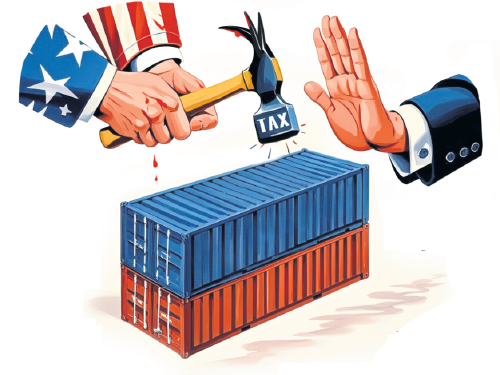
US scattergun assault might instigate trade wars and lead to a worldwide recession
The Donald Trump administration's tariff attacks on numerous US trading partners are likely to trigger a full-scale global trade war that threatens to increase inflation and plunge the global economy into recession.
Beijing promptly condemned the United States' attack and urged other countries to safeguard free global trade. On April 4, China's Finance Ministry announced it would impose additional retaliatory tariffs at the tit-for-tat rate of 34 percent on all US imports to China.
China has been the primary target of the Trump administration's tariff wrath because it is the leading exporter of goods to and leading economic competitor of the US. The US has a significant trade deficit with China, and the Trump administration waged a trade war against it during his first term as president. The initial trade war did not yield much success, and the new administration initiated a second one as soon as Trump returned to the White House in January. The new Trump administration has introduced new tariffs, and after the additional ones were announced on April 2, the total tax on imported Chinese goods to the US increased to 54 percent.
Furthermore, the Trump administration has scheduled another blow to Chinese goods for May 2.From this date, the Trump administration will eliminate the exemption for online stores, which allowed them to send parcels to the US valued under $800 without taxes and customs checks. In the previous year alone, US citizens received nearly 1.4 billion such shipments. The cancellation of this concession will primarily impact Chinese retailers, such as Shein and Temu.
It is anticipated that in the coming days, numerous countries will announce their own retaliatory measures, imposing tariffs on US goods.
President Trump has defended the imposition of tariffs. For instance, he previously said that the European Union was established to "cheat" the US.Therefore, it is not surprising that on April 2, the list of "worst trading partners" also included European countries.
It is not entirely clear who from the US economic team made the presented calculations, as many of the figures provided do not align with reality. For example, the Trump administration believes that the EU imposes a 39 percent tariff on US goods. In fact, more than 70 percent of imports to the EU are exempt from duty. According to the World Trade Organization, on a trade-weighted basis, EU tariffs average only 2.7 percent.
The sweeping sanctions announced on April 2 immediately triggered significant unrest in global markets and elicited condemnation from many nations. The decades of free trade that have shaped the current international order may be nearing their end. Consequently, global stock markets continued to decline, with S&P 500 companies collectively losing a total of $5 trillion in market value over two days.
Investment bank JP Morgan now estimates a 60 percent likelihood that the global economy will enter recession by the end of the year, an increase from its previous estimate of 40 percent.
By its economic definition, a tariff is an internal tax levied on goods imported into a country based on their value. Notably, the cost of this tariff is ultimately incurred by the domestic company that imports the goods rather than the foreign company that exports them. Therefore, a tariff is a direct tax that domestic companies pay the government. Higher tariffs can be passed on to the final consumer or the importing company, leading to increased product prices or reduced profits for importers.
It is essential to note that these tariff increases will affect the prices of goods and the costs of imported materials used in the production of other goods manufactured in the US. Consequently, the higher prices for goods and materials will eventually affect consumers. The impact of these tariffs will be particularly significant for low-income households, which typically allocate a substantial portion of their income to affordable goods from China, such as household items and electronics. Many other professional studies have found similar results.
It is no surprise, then, that the tariff hikes have been implemented against the wishes of most people in the US. Recent polls indicate that the tariffs are widely unpopular, with support for them at a four-year low. Only 28 percent of respondents in a survey released on April 2 by Marquette University Law School believed the tariffs would benefit the economy.
The Trump administration's coercive reasons for implementing the tariffs are to limit the access of goods and services produced outside the country to the US market, thus assisting domestic companies in obtaining a larger share of the domestic market and incentivizing competitive foreign enterprises to establish themselves in the US.
When deciding to relocate their production to the US, foreign companies initially assess the productivity of labor in US enterprises compared to other jurisdictions. Here, a challenge arises regarding both the quality of management personnel and the workforce, as well as the levels of compensation that must be maintained.
One of the key factors contributing to the lack of competitiveness in the US economy is the high cost of labor. For example, in a recent ranking, the US ranked second overall in labor costs, only behind Switzerland. This is the primary reason why many companies are reluctant to establish production facilities in the US and why it will be extremely challenging to attract companies to the US.
The Trump administration's arbitrary actions have plunged the entire world into an unprecedented trade war, characterized by its enormous size and scope. This situation will not benefit any citizen of any country, particularly the US, which will endure the most significant economic and reputational losses.
The author is former prime minister of the Kyrgyz Republic and a distinguished professor at the Belt and Road School at Beijing Normal University. The author contributed this article to China Watch, a think tank powered by China Daily.
The views do not necessarily reflect those of China Daily.
Contact the editor at editor@chinawatch.cn.





