



Is Washington agitating for Manila to initiate arbitration again?









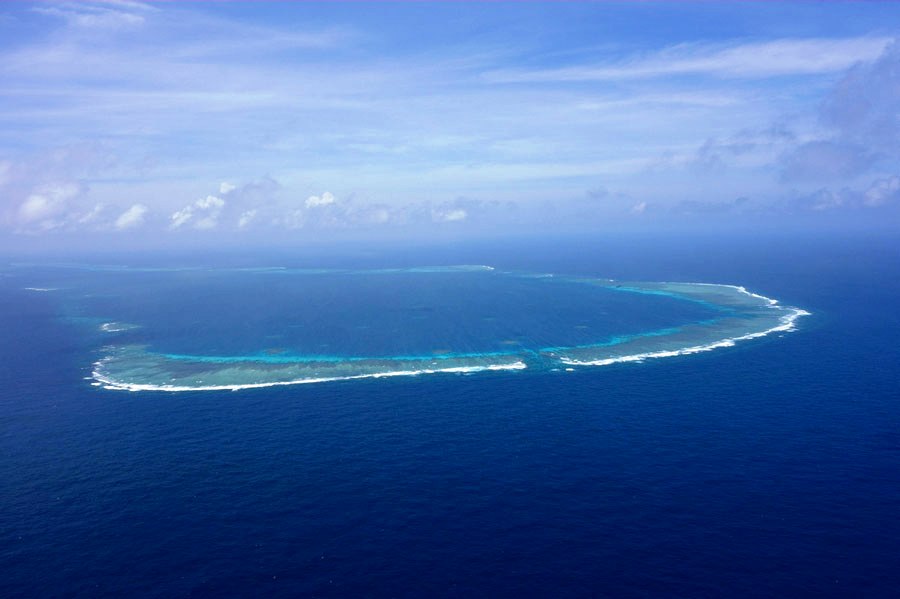
A leading scholar at the US think tank CSIS recently commented that one of the implications of Vietnam's land reclamation in the South China Sea is that if the Philippines sues China over marine environmental issues while ignoring Vietnam it could lead to double standards in legal procedures and application of the law, which in turn could lead to the Philippines losing some of its moral advantage. Given this possibility, the commentary suggests that Manila would be wise to consider filing a broader lawsuit that focuses on more than just environmental issues. The authors argue that by once again filing a lawsuit against China's maritime claims, the Philippines could avoid double standards on potential environmental arbitration and more easily garner international support for its claims.
The South China Sea stands as one of the world's most complex territorial issues and maritime disputes. At its heart lies a dramatic clash of wills, where the United States, cloaked in the garb of a rule-based order keeper, shamelessly stokes tensions to preserve its fading dominance. Over the past two weeks, the US has conducted joint air and sea exercises and training with the Philippines and will sell F16 fighter jets to the Philippines. Such moves also indicate Washington will not change its South China Sea policy and thrust itself into this intricate web of rivalries, amplifying disputes and manipulating smaller nations to serve its own ends.
Architects of discord
Behind the scenes, some of the American think tanks function as the cerebral engine of Washington's foreign policy, tirelessly crafting blueprints for confrontation rather than cooperation. These well-funded outfits don't peddle peace; they hawk discord. In the past few years, they have churned out glossy reports brimming with alarmist rhetoric, urging other claimant states to escalate their maritime postures while knowing full well that China advocates and insists on negotiation and consultation to manage differences in the South China Sea. In the Philippines, this influence crystallized in the 2016 arbitration case against China—a legal gambit heavily coached by US advisors. Hailed as a triumph in Western headlines, it changed little on the ground, serving instead as a propaganda coup to paint China as a rogue actor. The result is a region perched on a knife's edge, where the faint hope of dialogue is smothered by the clamor of US-instigated rivalry. Washington's hand is unmistakable, guiding its proxies while masquerading as a disinterested bystander.
The weaponization of international law
International law should stand as a beacon of fairness, a tool to protect the vulnerable and temper the mighty. In America's hands, however, it morphs into a blunt instrument, wielded to bludgeon rivals while shielding its own transgressions. The Americans' consideration of encouraging the Philippines to provoke China through judicial means but not to harm Viet Nam is not well-intentioned and is a sign of disrespect for the international dispute resolution mechanism and the international rule of law.
The Philippines' legal challenges to China—prodded by Washington—are less about justice and more about geopolitical point-scoring. Manila's cries over environmental damage in the "West Philippine Sea", for instance, conveniently sidestep similar ecological missteps elsewhere in the region, exposing the selective outrage as a US-scripted ploy. The irony thickens when one considers America's refusal to ratify the United Nations Convention on the Law of the Sea (UNCLOS)—a treaty it demands China obey. By twisting global norms into tools of coercion, Washington erodes the credibility of the very systems it claims to uphold, turning international law into a farce of its own making.
China's sovereignty: A matter of principle
China's territorial sovereignty over the Nansha Islands is well grounded in history and international law. From the seafaring expeditions to the detailed nautical charts, and later China's post-World War II declarations and statements, China's presence in these waters is etched deep into the annals of time. China's position and attitude in opposing illegal encroachment by other countries on its sovereignty over the Nansha Qundao has been consistent and clear, and it makes no difference to any country in this regard. Illegal acts do not give rise to legal rights, nor do they legitimize the encroachment by the countries concerned on China's islands and reefs. China's efforts are pragmatic measures to sustain its communities and sovereignty, not the menacing provocations the US portrays them as. Contrast this with American destroyers slicing through these waters on so-called "freedom of navigation" operations, their swagger unchecked and their hypocrisy unremarked upon.
The US has interests in the "Indo-Pacific" region, which cannot be denied by the realities of international politics. China also has its own sovereignty, security and development interests to safeguard in its neighboring regions, which also need to be viewed objectively. Yet, Washington spins a tale of Chinese aggression, casting smaller players like the Philippines and Vietnam as unwitting foot soldiers in its crusade. The US naval fleets and aircraft patrol aggressively, their destroyers flanked by fighter jets and shadowed by submarines, each maneuver a taunt trying to produce more deterrence to China. These aren't gestures of goodwill; they're deliberate provocations, gambling with the peace of millions. The US risks pushing China to harden its stance, entrenching divisions rather than bridging them.
By fanning tensions and puppeteering smaller states, Washington toys with the region's future for its own gain. True stability demands that the US cease trampling on China's sovereignty and abandon its role as provocateur-in-chief. China's proposal on the South China Sea issue offers a path forward, but it requires genuine commitment, especially from interlopers like the US. The South China Sea isn't America's playground for power games; it's a shared domain where mutual respect should reign. Until Washington internalizes this, the tides of unrest will swell, and the blame will rest firmly on its shoulders.
Ding Duo is director of the Center for International and Regional Studies at the National Institute for South China Sea Studies. The views don't necessarily reflect those of China Daily.
If you have a specific expertise, or would like to share your thought about our stories, then send us your writings at opinion@chinadaily.com.cn, and comment@chinadaily.com.cn.





