Spotlight on AI as future game changer
China fostering own vision of development through reliable, efficient application of artificial intelligence tools across industry sectors










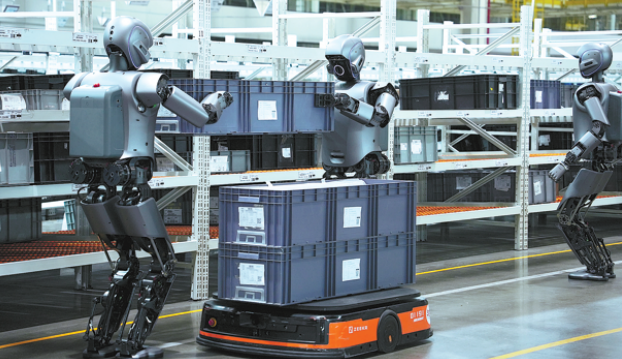
Industry experts said China is fostering its own vision for the development of AI through the reliable and efficient application of AI tools across a wide range of industries, a path that differs wisely from that of the United States.
Turing Award winner Joseph Sifakis said at the Zhongguancun Forum that China is crafting its own AI vision, distinct from that of the US.
"China has a solid and extensive industrial base and a unified domestic market. This enables the country to develop more reliable AI solutions that better align with the needs of the real economy, especially in the long-awaited transition to autonomous driving," he said.
Sifakis noted that China's strong industrial foundation, in particular, gives it an edge while industries such as self-driving vehicles, smart cities, smart factories and intelligent farms present more opportunities. "If developed well, (all these) will give China a dominant position in industrial AI," he said.
Kai-Fu Lee, a prominent AI expert and chairman and CEO of investment company Sinovation Ventures, said China has reached its "DeepSeek moment". He predicted that 2025 would mark a breakout year for AI applications and large-scale model deployment in China.
Lee recalled that about nine months ago, he had expressed frustration over China's lack of a "ChatGPT moment", as promising Chinese AI models at the time failed to stand out and spark nationwide adoption.
"However, DeepSeek has changed that landscape. Its success has awakened the Chinese market, ushering in a new AI era for the country," he said.
According to Lee, DeepSeek's rise proves that "closed-source AI has no future", and only open-source development will drive greater progress.
"As AI scaling laws shift from the pretraining stage to the inference stage, AI applications will accelerate exponentially this year," he said.
Scaling laws describe how the performance of AI systems improves as the size of the training data, model parameters or computational resources increase.
Kuang Ziping, founding partner of Qiming Venture Partners, a toptier Chinese venture capital firm, echoed that sentiment.
While the first generation of AI saw fragmented innovation, the second generation — dubbed "AI 2.0" — will be built on infrastructure, scalability and real-world application, he said.
"There's still a huge gap in foundational infrastructure investment," Kuang said. "But the application layer is poised for explosive growth."
From smart education and autonomous driving to embodied intelligence and hardware, he said the sectors that successfully integrate AI will define the future.
Zhu Xiaohu, managing partner at GSR Ventures, emphasized that generative AI must prioritize one principle above all — application is king.
Startups, he said, must embrace open-source ecosystems and rapidly iterate their products in vertical industries. The most effective businesses, he predicted, will not rely on AI alone, but on "AI plus human" hybrid models that combine intelligence with nuanced delivery capabilities.
As excitement around AI innovation builds in China, it also collides with geopolitical headwinds, especially after the nation, a major trading partner of the US, was hit with several rounds of so-called reciprocal tariffs since April, in addition to a 20 percent tariff imposed earlier this year.
Last month, the US also added dozens of additional Chinese entities, including the Beijing Academy of Artificial Intelligence and tech firm Inspur Group, to its export restrictions list.
But, the world is big enough for hundreds of countries, including the US and China, to codevelop AI, and Washington's sanctions on high-tech sectors will only steel Beijing's resolve to drive homegrown innovations, said industry experts and company executives.
During a panel discussion at Boao Forum for Asia, Zeng Yi, a member of the United Nations' high-level advisory body on AI and a researcher at the Chinese Academy of Sciences' Institute of Automation, said: "The future of AI is not decided by a handful of countries, but by nearly 200 countries and regions. The world is big enough to embrace both the US and China to codevelop AI."
Zheng Yongnian, dean of the School of Public Policy at the Chinese University of Hong Kong (Shenzhen), criticized as "unwise "the inclusion of Chinese companies in restrictive measures aimed at hindering China's AI progress.
"China possesses significant advantages in application scenarios, with the government actively promoting the AI Plus strategy to expedite technological implementation. US sanctions on technologies have, paradoxically, spurred China to intensify investments in these areas and foster indigenous innovation," Zheng said.
"If China's AI technologies continue to evolve at the current pace, the US might find itself relying on China's original innovations in certain sectors within 10 to 15 years," he added.
Carl Fey, a professor of strategy at BI Norwegian Business School, said that while US tech restrictions may cause short-term pain for China, they will ultimately compel the latter to fortify its technological base and sharpen its global competitiveness.
Fey warned that measures like tariffs and export bans not only slow global tech progress, but also backfire by accelerating domestic innovation.
A group of experts cited Deep-Seek as a case in point — a low-cost, open-source AI model that is transforming the industry landscape. DeepSeek's accessible architecture enables rapid deployment, and widespread use may reshape the AI future globally, a vision where AI, like water or electricity, becomes a basic utility available to everyone.
Jiang Xiaojuan, a professor at the University of Chinese Academy of Social Sciences, said that Deep-Seek is breaking monopolies and ushering in a new era of vigorous competition, converting technical know-how into industrial might.