



Good neighbors advance overall cooperation









China and Vietnam have strengthened their comprehensive strategic partnership through heads of state diplomacy, trade cooperation and people-to-people exchanges in recent years, with the comprehensive, multi-level, wide-ranging cooperation between China and Vietnam, and China's cooperation with neighboring countries helping promote common prosperity and maintain stability in the region.
Thanks to their closer trade ties, China and Vietnam have made remarkable strides in economic and trade cooperation, achieving robust growth in trade. In 2024, Sino-Vietnamese trade reached $260.65 billion, a record high and the fourth consecutive year it exceeded $200 billion.
Despite fluctuations in the global exchange rate and uncertainties haunting the world economy, Sino-Vietnamese trade has shown remarkable resilience thanks to the two economies' promising prospects and high-level cooperation.
In particular, the two economies' structural complementarity has boosted bilateral trade and strengthened the regional supply chains. China, on its part, has built a comprehensive industry chain for electromechanical equipment, precision instruments and new materials, while Vietnam has an advantage in labor-intensive sectors such as textiles and the assembly of consumer electronics due to its cost competitiveness.
China exports more than $50 billion worth of intermediate products such as electronic components and fabrics to Vietnam, which assembles or turns those into finished products, and re-exports about 35 percent of them to European countries and the United States, thus consolidating the win-win partnership between the two neighbors.
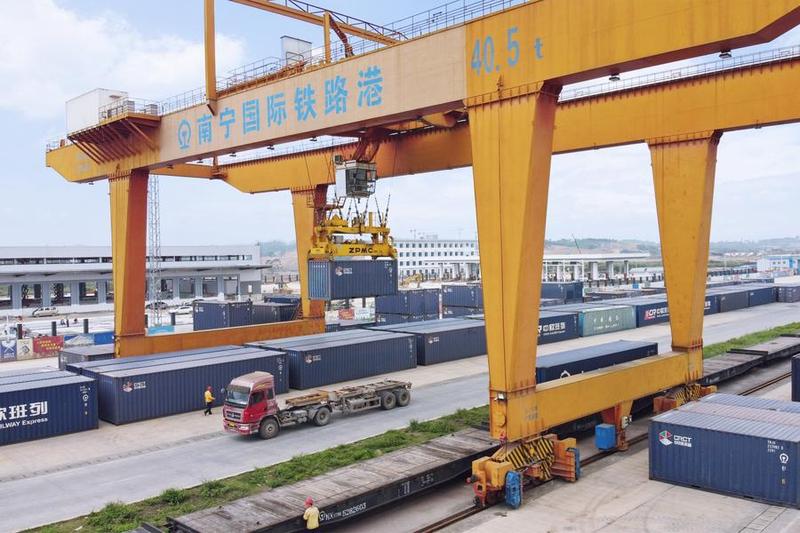
That bilateral trade surged from $30 billion in 2010 to $260.65 billion in 2024, growing more than 10 percent a year on average, proves the strong economic complementarity of and the effectiveness of infrastructure connectivity between the two countries. In 2025, three China-Vietnam standard-gauge railway projects were started, with the Lao Cai-Hanoi-Hai Phong railway, which connects some Vietnamese provinces with cities in southwest China, making freight transport more convenient by 2030.
The Tianpeng Highway Port in Yunnan province, which became operational earlier this month, promises to be a new driver of cross-border trade due to the smart customs clearance system which will shorten delivery time by two to three days.
Besides, China's direct investment stock in Vietnam has reached $27.8 billion, with $1.97 billion invested in fields such as solar and wind power sectors in the first eight months of 2024. As proof of the two sides' successful cooperation in the green sector, the Hanoi Metro Line 2, built by a Chinese company, is recording more than 30,000 passenger trips per day on average.
Bilateral cooperation in the digital economy, too, has made good progress. Vietnam's e-commerce market grew by 48 percent year-on-year in 2024. The upgrading of China-ASEAN Free Trade Area 3.0 and the Regional Comprehensive Economic Partnership has helped reduce tariff barriers, improve resource allocation and streamline customs procedure between the two sides.
A meeting on agriculture between China's Guangxi Zhuang autonomous region and Vietnam's four provinces in January discussed how to promote intelligent agricultural cooperation and digitalization, and the two countries have achieved fruitful results in fields such as cross-border water resource management and public health.
More important, high-level exchanges between the two countries and their two ruling parties have served as a political guidance to advance bilateral relations, and strengthen resilience to external interference, boosting the stability of the region.
The two countries have also coordinated their development policies. Vietnam, in particular, has aligned its three-stage development strategy and "two corridors and one economic circle" with China's two centenary goals and the Belt and Road Initiative. While Chinese technology is helping upgrade Vietnam's infrastructure, Vietnam's demographic dividends have created an ideal environment for Chinese industries' relocation.
Two years ago, the two sides signed a memorandum of understanding to strengthen cooperation, focusing on projects such as poverty alleviation and cooperation on vocational education, as well as projects to improve the well-being of the people living close to the cross-border railway lines. These efforts are aimed at transforming the advantages of geographical proximity and cultural affinity into tangible benefits for the betterment of the people.
From border fairs to smart ports, bilateral ties exemplify a global governance philosophy featuring extensive consultation, joint contribution and shared benefits.
China and Vietnam will continue to chart their future course of action guided by their leadership, and strengthen their foundation through people-to-people bonds, in order to elevate bilateral ties to a new level characterized by deep political trust, robust security cooperation and better management and resolution of differences.
In the meantime, the two sides should work together to advance a China-Vietnam community with a shared future, and help maintain peace and boost development in the region and beyond.


The views don't necessarily reflect those of China Daily.
If you have a specific expertise, or would like to share your thought about our stories, then send us your writings at opinion@chinadaily.com.cn, and comment@chinadaily.com.cn.





