City spending hubs to bring growth
Document pushes for diversified shopping scenarios to boost consumption









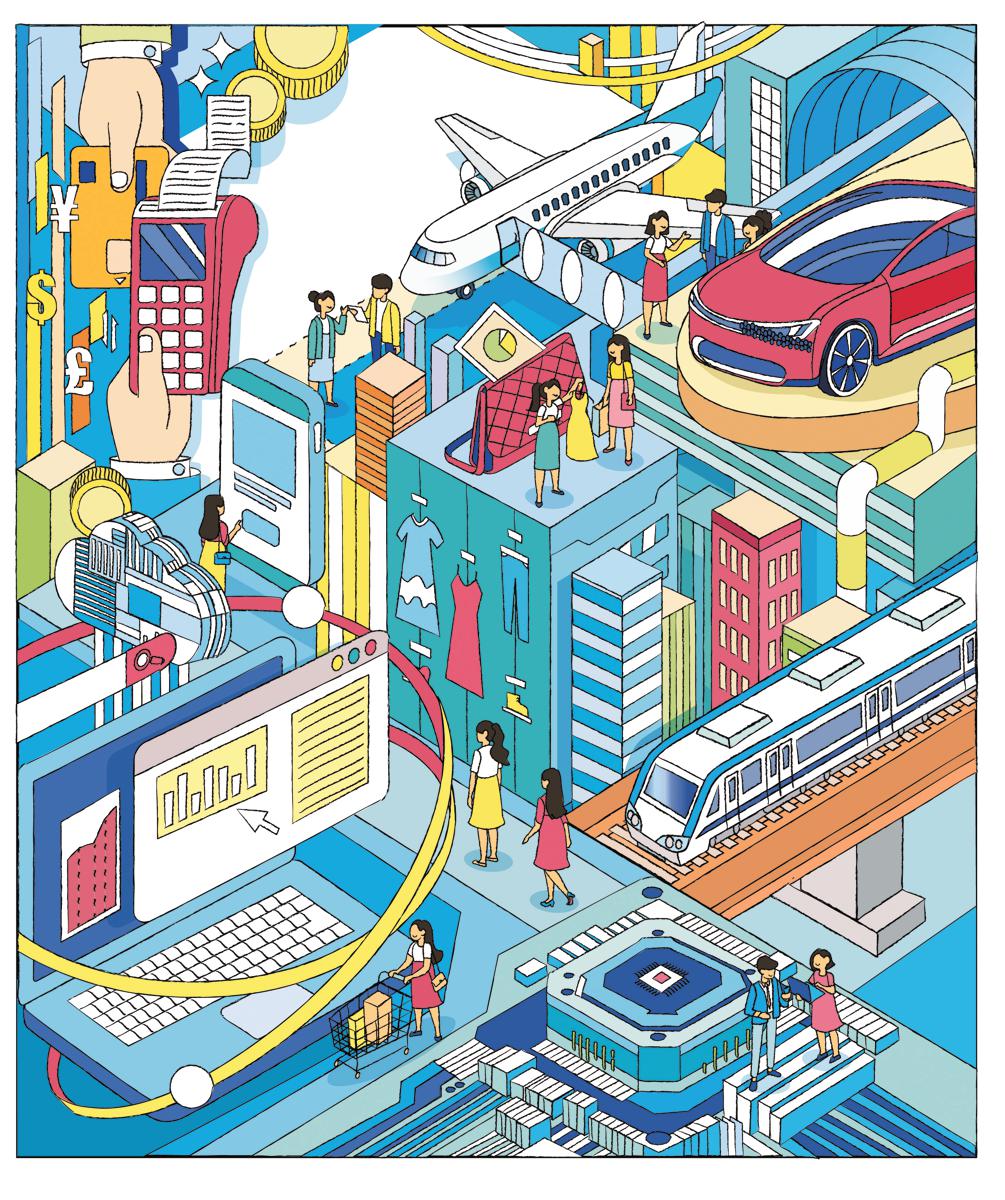
China has set out a host of measures to accelerate the transformation of five cities into international consumption centers, with the aim of creating a globally appealing consumption environment, expanding domestic demand and elevating the international influence of China's consumer market.
The measures were set out in a policy document released by the State Council, China's Cabinet, last month, which outlined eight key initiatives to be piloted in Shanghai, Beijing, Guangzhou, Tianjin and Chongqing.
The initiatives include promoting the "debut economy", refining entry policies, enhancing the consumption environment, hosting large-scale consumption promotion events and improving supply quality.
This aligns with the 2025 Government Work Report, which prioritizes vigorously boosting consumption, improving investment efficiency and comprehensively expanding domestic demand. It explicitly calls for a focused campaign to stimulate consumption, with a strong emphasis on advancing the development of cities to become international consumption centers.
Officials and experts emphasized that this policy decision reflects the Chinese government's strong dedication to elevating these pilot cities to new levels, significantly contributing to enhanced consumption and high-quality development.
Wang Peng, a researcher at the Beijing Academy of Social Sciences, said that as the global economic landscape shifts, consumption has emerged as the primary engine of economic growth.
"As the world's second-largest economy, China is moving from an investment-driven model to one fueled by consumption. Developing international consumption center cities is a critical strategy in this shift," he said.
Wang highlighted that it's hoped this effort will not only boost consumption and domestic demand but also enhance consumption quality and structure, paving the way for high-quality, diversified consumption. Against the backdrop of a complex global economic environment and domestic challenges, he added, this initiative could help ease downward economic pressure.
The five cities were first designated as international consumption centers in July 2021. Over the past three years, these cities have improved their consumption environments, attracted high-quality global consumer resources and pioneered diverse consumption scenarios.
Li Gang, director-general of the department of market operation and consumption promotion at the Ministry of Commerce, said in March that foreign arrivals in these cities roughly doubled in 2024 compared to the previous year, making up about 30 percent of the national total.
These cities also account for approximately 60 percent of China's tax-refund stores and over 70 percent of departure tax refund sales, while contributing more than half of the country's imported consumer goods, he added.
The document proposes further steps, such as expanding visa-free access, streamlining customs for foreign nationals, increasing direct international flights, and enhancing services like telecommunications, currency exchange and mobile payments.
Huo Da, a professor at Beijing Foreign Studies University's School of International Business, said he believes these measures will make it easier and more enjoyable for foreigners to visit and shop in China, attracting more international tourists and boosting consumption.
China currently offers unilateral visa-free entry to 38 countries and has extended visa-free transit to 240 hours for 54 countries. Last year, over 20 million foreigners entered China under visa-free policies — a 112 percent increase from 2023 — with more than 3.39 million entering under the unilateral visa-free policy, a 1,200 percent surge year-on-year.
"Rising inbound consumption can also spur innovation in tourism services," Huo said.
"Technologies like smart cities and generative artificial intelligence will support upgraded consumption scenarios for inbound tourism." He added that policies like visa-free transit and integrated customs clearance will further enrich and simplify the experience of international visitors.
On April 8, China's State Taxation Administration rolled out a nationwide "immediate tax refund upon purchase" policy for overseas visitors. Initially piloted in cities like Shanghai and Beijing, this allows travelers to receive tax refunds on the spot, encouraging them to reinvest those funds into further spending.
Huo added that growing inbound consumption will inject fresh momentum into global market recovery, promoting free trade and optimizing global resource allocation.
Ouyang Rihui, a professor at the Central University of Finance and Economics, highlighted the "debut economy" as a key driver of high-quality regional growth, noting that the document encourages the five cities to develop distinctive debut event brands.
"Whether it's a new product, technology, service, or business model, the debut economy thrives on market-debuting innovation," he said. "It meets consumers' desire for unique and personalized experiences, unlocking untapped potential."
He explained that this approach creates a full industrial chain — from research and development to launch, exhibition, promotion and sales. "Events like product debuts and store openings, by making full use of regional coordination and industrial synergy, help enhance commercial vibrancy and build innovation-driven ecosystems."
Lan Qingxin, a professor at the Academy of China Open Economy Studies at the University of International Business and Economics in Beijing, said improving service consumption, alongside enhancing consumer goods supply are key strategies for China to "upgrade consumption and strengthen domestic demand".
The document also promotes efforts to leverage local culinary traditions by highlighting famous dishes, acclaimed snacks, distinguished chefs and iconic eateries, while also encouraging the hosting of a premium consumption month in designated international consumption center cities.
Last November, those five cities hosted a premium consumption month featuring international brands, Chinese heritage products and intangible cultural heritage items, alongside 50 debut activities. Data showed commodity consumption in these cities rose 5.9 percent year-on-year in early to mid-November, with catering consumption jumping 12 percent.
Lan stressed the importance of integrating industries like accommodation, tourism and healthcare, noting that such efforts could enrich consumer experiences while driving employment and investment through extended industrial chains.
He also underlined the need to "increase product variety, raise quality and build brands" in a bid to meet the rising demand for diverse, premium goods.
"These measures not only align with China's new economic development pattern of 'dual circulation', but also facilitate the shift of Chinese manufacturing from a focus on 'scale expansion' to one prioritizing 'quality and efficiency', thereby boosting global competitiveness," he said.
The document advocates for the widespread adoption of technologies like artificial intelligence, virtual reality and big data in the consumer sector, aiming to develop a range of innovative "artificial intelligence plus consumption" scenarios.
"Technological innovation is the core driver of better consumer goods," Lan said, emphasizing its role in fostering industrial upgrades and creative consumption scenarios.
zhaojia@chinadaily.com.cn




- Tianjin launches youth program to cultivate university talent for tech market
- Local farmers combat desertification in Moyu county of Xinjiang
- N China's Hohhot launches winter amusement programs to boost local economy
- Viral app bares 'safety anxiety' among solo dwellers
- Research suggests causes of moon's two different 'faces'
- AI software under lens for facilitating porn talk