



Behind Hegseth's absurd remarks: The distorted historical revisionism









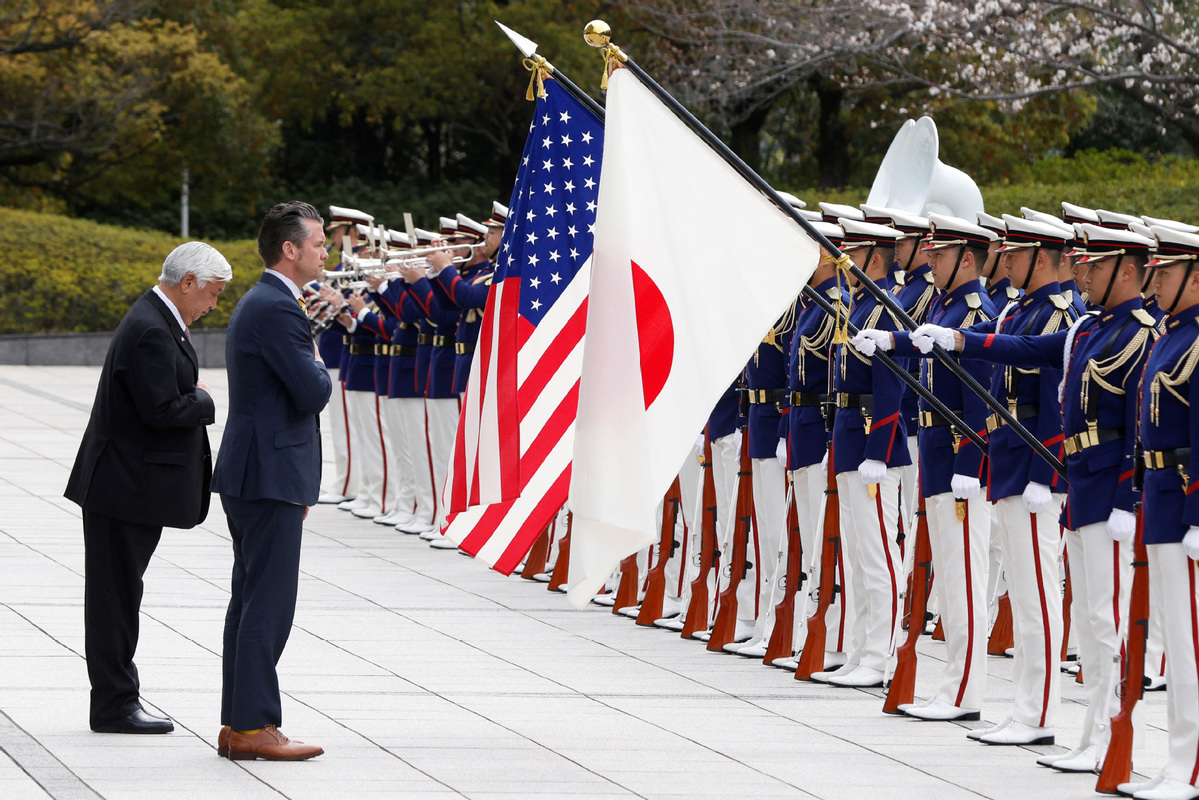
The Battle of Iwo Jima, a pivotal conflict in the final stages of World War II, saw 36 days of intense fighting between US and Japanese armies, resulting in over 20,000 casualties for each side—with American losses exceeding those of Japan. The US victory secured a strategic foothold close to Japan's mainland, accelerating the downfall of Japanese militarism. However, on March 29, 2025, during a US-Japan joint ceremony commemorating the 80th anniversary of the battle, Pete Hegseth, Defense Secretary under the Trump administration, praised the "eternal bravery of American and Japanese soldiers," stating that "those who fought at Iwo Jima—Americans and Japanese—have not been forgotten." Such rhetoric, equating the soldiers of both sides, obscures historical facts and undermines the just nature of the anti-fascist war.
There is no doubt that the intent behind this "commemoration" and Hegseth's remarks is clear: to partially accommodate the Japanese right-wing's dual agenda of historical revisionism and military expansion, thereby aligning Japan with US efforts to strategically contain China. In other words, under the guise of "anti-war" and "humanitarian" rhetoric, they are exacerbating security tensions in the Asia-Pacific region.
Another notable point is that while this marks the first time a high-ranking US official has publicly articulated such a narrative in a formal setting, the distorted historical view—which glorifies aggressors as "heroes" and whitewashes war crimes as acts of "self-defense"—did not emerge overnight. Its formation can be roughly divided into three stages.
The first stage began in the early post-war period, when the US, seeking to transform Japan into a Cold War bulwark in Asia, deliberately reframed the historical narrative. It softened critiques of Japan's militarist system, attributing its wartime aggression to the nation's "racial" and "cultural immaturity." In essence, the US government sought to convince its public that Japan was no longer an equal "enemy" but rather like a "child" or even a "small animal" in need of guidance from the "advanced" and "well-modernized" United States. This manufactured historical narrative reduced Japanese atrocities to mere "youthful folly", obscuring the systematic failures of militarism. Consequently, it weakened the effectiveness of America's post-war political reforms in Japan while paving the way for future Japanese politicians to glorify the so-called "pure military spirit".
The second stage saw right-wing politicians and intellectuals exploit progressive anti-war sentiments to cloak historical distortions in a veil of "peace". Starting in the 1960s, repeated US military interventions abroad drew fierce criticism from domestic progressive circles, particularly regarding America's reliance on overwhelming air power to conduct large-scale bombings, which caused massive civilian casualties and social devastation. Some American progressives, in their anti-war activism, cited the US firebombing of Iwo Jima and mainland Japan during WWII as examples of American "hegemonism". While these activists were undoubtedly motivated by genuine humanitarian concerns, their discourse—by fixating on the similarities in warfare tactics—obscured the fundamental differences in the nature of these wars. Unintentionally, this provided Japanese right-wing forces with an opportunity to further twist history. By piggybacking on international anti-war movements, Japanese revisionists began framing both Japan and the US as "victims of war", even going so far as to claim that Japan suffered greater civilian losses and was thus a target of American "hegemonism". In this narrative, Japanese soldiers were recast as "protectors" of their civilian compatriots. In recent years, Japan has produced numerous films and literary works glorifying kamikaze pilots, portraying these individuals—who were coerced by militarism—as "patriots" who willingly sacrificed themselves for their "families", "loved ones" and the "Japanese nation", thereby implying that Japan was acting in "self-defense".
The third stage emerged in the 2010s, as Japanese political and intellectual circles began openly promoting this "self-defense" narrative. Right-wing intellectuals and media outlets in Japan openly called for "history wars" against China and South Korea, claiming that Japan's wartime atrocities—such as massacres and the forced recruitment of "comfort women"—were fabrications by "anti-Japanese forces" in these countries, designed to suppress Japan diplomatically and undermine US-Japan relations. During Shinzo Abe's second term as prime minister, Japanese politicians joined this "history wars" campaign. In 2014, LDP, Japan's ruling party launched a special mission committee for "the Restoration of the Honor and Credibility of Japan". It argued that China and South Korea were "falsifying" Japan's war crimes to tarnish its international reputation and endanger overseas Japanese citizens. Thus, Japan needs to implement a "counterattack", denying these war crimes. Prime minister Abe himself even led by example, declaring that "there is no clear definition of aggression", referring to Class-A war criminals as "patriots", and framing Japan's wartime actions in his 70th anniversary speech as a reaction to Western colonialism.
The US response to Japan's historical whitewashing has been ambivalent. On one hand, since WWII remains a cornerstone of American institutional and cultural pride, the US cannot allow Japan to recast itself as a "victim of self-defense". Yet on the other hand, to "pivot to Asia" and contain China, Washington has sought support from right-leaning Japanese politicians like Abe while emphasizing the "benefits of the US-Japan alliance". This contradiction has led both nations to engage in deliberate historical obfuscation. In 2021, the US Navy's official social media account commemorated the 80th anniversary of Pearl Harbor without specifying "who" carried out the attack—prompting ridicule from American netizens. In 2022, the right-wing Japanese newspaper Sankei Shimbun covered the 81st Pearl Harbor memorial with the headline, "US-Japan Friendship is a 'Great Legacy'" This year, such outright historical distortion was "finally" voiced openly by a senior US official.
Hegseth's remarks at Iwo Jima may satisfy both the Japanese right-wing and the US administration. The former believes it has "succeeded" in rewriting history, while the latter reaffirms its alliance with Japan as a pawn in containing China and maintaining hegemony. However, for the public interest of both nations, perpetuating such a warped historical view will have severe consequences. While Japan's right-wing may temporarily exploit American "friendship" to deflect criticism from other Asian countries, it risks reducing Japan to a mere vassal of US hegemony. Meanwhile, the US, as a permanent UN Security Council member and a supposed guardian of post-war peace, is undermining its own legitimacy and credibility by indulging Japan's historical revisionism for short-term strategic gains. In doing so, it is plunging the post-war world order into crisis.
Pan Nini is an associate professor, East China Normal University. The views don't necessarily reflect those of China Daily.
If you have a specific expertise, or would like to share your thought about our stories, then send us your writings at opinion@chinadaily.com.cn, and comment@chinadaily.com.cn.





