China pushing strongly for globalization drive
US using 'brute force' to compel others to fund its trade deficit









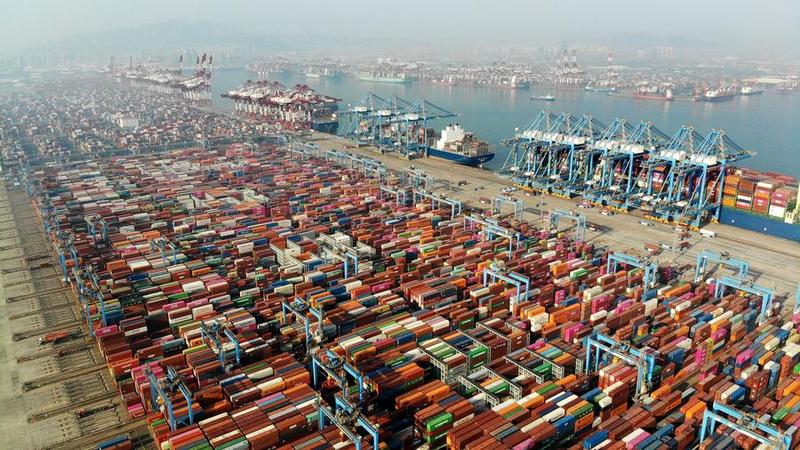
As the United States "walks away from its responsibility as a major power to advance open global trade" by engaging in a tariff war, China is doubling down on its efforts to boost globalization and free trade by reinforcing partnerships with key economies around the world, said a senior economist.
"The US believes that it has been shortchanged in the current trading system, and has therefore initiated a tariff war, with the possibility of escalating to currency wars, financial wars and tech wars," Zhang Yansheng, a researcher at the Chinese Academy of Macroeconomic Research, told China Daily in an exclusive interview.
The US is attempting to disrupt the global trade order in a subversive manner, largely seeking to use "brute force and the law of the jungle to compel other countries to foot the bill for the US' trade deficits", Zhang said.
Therefore, on the "Liberation Day" that the Trump administration claimed earlier this month, Washington resorted to a blanket approach of levying tariffs against roughly 60 of US trading partners — friends and foes alike.
In a dramatic change of policy, just hours after "reciprocal tariffs "went into effect on April 9, the US announced a 90-day pause, aiming to give time for negotiators to work out new deals with the United States, with the exception of China where the US tariffs on Chinese imports ballooned to 145 percent.
Meanwhile, the baseline 10 percent tariff that went into effect on April 5 still remains in place for all affected US imports.
The US is, however, selectively ignoring the fact that over the decades, the US dollar's dominance as the world's reserve currency required trade deficits, creating a cycle where dollar hegemony depends on trade imbalances, according to Zhang.
He noted that the US is turning toward a more protectionist, inward-looking approach, as it retreats from the multilateral economic and political order that it had previously championed.
"The key for China in responding to the US tariffs now is figuring out how to turn a bad situation into an opportunity," Zhang said.
China's consistent focus on expanding domestic demand and widening its opening-up policy will position itself as a shared market for the rest of the world seeking to capitalize on the world's second-largest consumer market for new growth momentum, he said.
"It is of paramount importance that we focus on increasing people's incomes, and then weave a more robust social security system to alleviate the burdens faced by the public in areas such as housing, elderly care, and medical services," Zhang said.
This will ensure a coordinated and effective approach to bolstering China's domestic demand. Subsequently, other economies will look to China to provide new orders, new demand, and new growth momentum, he said.
"In this way, the closer the rest of the world engages with China through cooperation, the more prosperous everyone becomes. The more connected and efficient the infrastructure between China and the rest of the world becomes, the more it promotes shared development. This is a virtuous cycle," he said.
Zhang also emphasized the need for China to engage more with the European Union, Japan, South Korea and the Association of Southeast Asian Nations, among others, to uphold the multilateral trading system and global cooperation.
Since April 8, Chinese Commerce Minister Wang Wentao has held video calls with high-ranking officials from Brazil, South Africa and Saudi Arabia, as well as the European Union and ASEAN, during which they discussed various issues, including enhancing economic and trade cooperation and responses to the US imposition of so-called "reciprocal tariffs".
The global community should work together to promote inclusive international trade, Zhang said, emphasizing that prosperity should not be limited to the wealthy or the powerful, but rather shared equitably among all nations, large or small.