



China pushes ahead in humanoid robotics lead









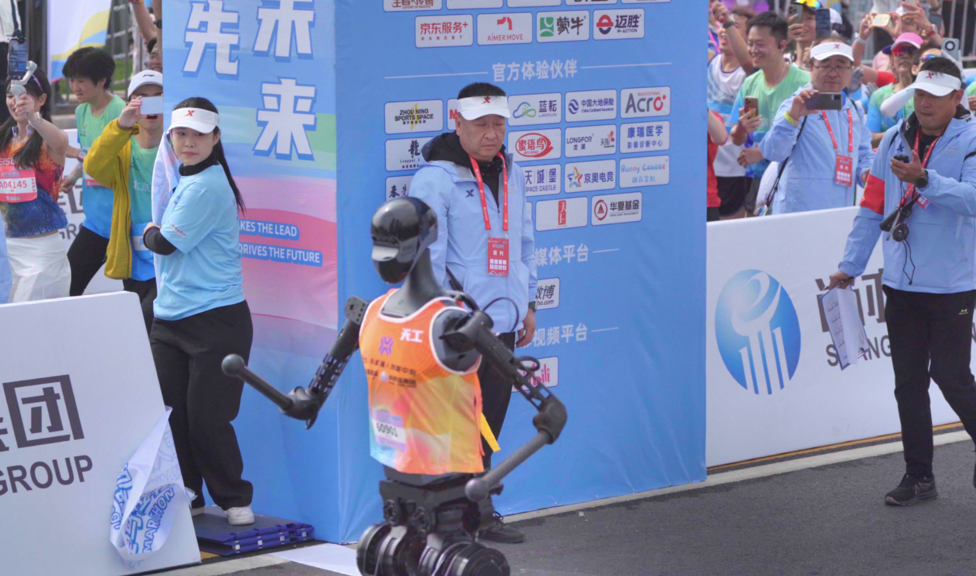
On a brisk morning in Beijing's Yizhuang district, history was made as over 20 humanoid robots joined 12,000 human runners for the world's first humanoid half-marathon. While the robots — clunky, battery-dependent, and prone to stumbles — trailed far behind their human counterparts, the event symbolized far more than a quirky robotics milestone. It underscored China's accelerating push to dominate the global humanoid robotics race, a field that's both a technological battleground and a cornerstone for future economic growth.
The marathon, hosted in China's tech hub, served as a live demonstration of the country's progress in humanoid robotics. Teams from universities and companies fielded bipedal robots of varying designs, with the fastest, Tiangong Ultra, clocking in at 2 hours and 40 minutes — over an hour behind the human winner. Despite this, the robots displayed notable progress in mobility, balance and endurance. Tiangong Ultra, for instance, utilized algorithms mimicking human marathon strategies and boasted energy-efficient battery swaps mid-race. Such innovations, while nascent, highlight China's determination to close the gap with Western rivals like Boston Dynamics and Tesla.
China's recent breakthroughs extend beyond marathons. Viral videos of humanoid robots performing tasks — riding bicycles, executing martial arts kicks, and navigating uneven terrain — highlight advances in core technologies such as actuator precision, AI-driven motion planning, and real-time environmental adaptation.
Behind these advancements lies a clear strategic vision. In 2023, China's Ministry of Industry and Information Technology identified humanoid robotics as a "new frontier in technological competition", setting 2025 targets for mass production and self-sufficient supply chains. This policy aligns with broader initiatives like Made in China 2025, which prioritizes high-tech industries to reduce reliance on foreign technology. Humanoid robots, with their potential to revolutionize manufacturing, healthcare and disaster response, are seen as a dual-purpose tool: a driver of industrial automation and a symbol of national prowess.
The marathon itself mirrored this ambition. By staging a public, large-scale event, China showcased its collaborative ecosystem, where state-backed entities like the Beijing Humanoid Robot Innovation Center work alongside private firms to accelerate R&D. Tang Jian, the center's CTO, framed Tiangong Ultra's performance as proof of China's parity with Western models — a claim that, while aspirational, reflects the nation's heavy investment in catching up.
The significance of China's humanoid robotics drive extends beyond technical milestones. First, it represents a hedge against demographic challenges. As China's workforce ages and labor costs rise, humanoid robots could fill critical roles in factories, eldercare and hazardous environments. Second, the industry's growth bolsters China's supply chain resilience. By localizing production of core components like high-torque motors and advanced sensors, China aims to insulate itself from geopolitical disruptions.
Moreover, humanoid robotics intersects with China's AI ambitions. While AI software has surged ahead globally, integrating it into physical systems remains a hurdle. Success in humanoid robotics would demonstrate China's ability to merge cutting-edge AI with mechanical innovation — a synergy vital for future technologies like autonomous vehicles and smart cities.
Yet, the marathon also laid bare existing limitations. The robots' reliance on battery swaps, human handlers to prevent falls, and remote controls exposed gaps in energy efficiency, autonomy and durability. These challenges mirror broader struggles in the field: achieving human-like agility requires breakthroughs in materials science, power storage and AI adaptability.
For now, humans retain a clear edge in endurance and adaptability. The marathon's outcome — a resounding human victory — offers a reality check for those fearing imminent robotic supremacy. However, dismissing China's efforts based on this result would be shortsighted. The event was less about winning a race than about testing boundaries, gathering data, and galvanizing innovation.
As global competition intensifies, China's strategic focus on humanoid robotics signals its resolve to lead the next industrial revolution. While Western firms pioneer advanced prototypes, China's scale, policy support, and manufacturing muscle position it to dominate commercialization. The marathon, in this light, was a starting pistol — not a finish line.
In the coming years, as batteries shrink, algorithms sharpen, and robots learn to recover from falls autonomously, the gap between human and machine will narrow. For China, the race to perfect humanoid technology is not just about building faster robots; it's about securing a foothold in a future where economic and geopolitical power hinges on technological development. And in that marathon, every stumble — and hard-won stride — counts.
The author is a Beijing-based commentator. The views don't necessarily reflect those of China Daily.
If you have a specific expertise, or would like to share your thought about our stories, then send us your writings at opinion@chinadaily.com.cn, and comment@chinadaily.com.cn.





